


Massive News: Oracle's $553 Billion Backlog Could Make It the Most Important AI Stock of 2026, But Is It Too Late to Buy?
Key Points
Oracle's latest results have improved investor confidence as it continues to sign more deals for its AI infrastructure.
Oracle has adopted a smart strategy of funding data center expansion efforts that could help boost its bottom line in the long run.
The stock seems poised to deliver big gains to investors.
- 10 stocks we like better than Oracle ›
Oracle (NYSE: ORCL) investors got some hopeful news last week after the company released its fiscal 2026 third-quarter results (for the three months ended Feb. 28). Shares of the tech giant rose more than 9% on March 11, the day after the release.
It's worth noting that Oracle stock has lost 49% of its value in the past six months, owing to multiple concerns, including a reliance on OpenAI for a significant share of its contractual backlog and taking on sizable debt to build artificial intelligence (AI) data centers. However, those concerns took a backseat after Oracle's beat-and-raise quarterly report.
Will AI create the world's first trillionaire? Our team just released a report on the one little-known company, called an "Indispensable Monopoly" providing the critical technology Nvidia and Intel both need. Continue »
Let's see what worked for Oracle last quarter. Then, let's take a closer look at its valuation to find out if it's too late to invest in this AI stock that has the potential to soar impressively for the rest of the year.
Image source: Getty Images.
Oracle is being smart with its AI hardware spending
Oracle's quarterly revenue jumped 22% year over year to $17.2 billion, exceeding the $16.9 billion Wall Street estimate. The company's non-GAAP earnings growth of 21% to $1.79 was a bigger surprise, as analysts would have settled for $1.70 per share.
The company's cloud infrastructure business also outperformed expectations, with revenue increasing by 84% year over year to $4.9 billion. That was higher than the $4.74 billion consensus expectation. Even better, Oracle's cloud infrastructure business is likely to continue growing at a terrific pace in the future. Its remaining performance obligations (RPO) jumped a whopping 325% year over year in the quarter to $553 billion.
RPO is a forward-looking revenue metric that refers to contracts the company has yet to fulfill. The massive increase in the RPO last quarter suggests that Oracle's future revenue pipeline is stronger than before, as more companies look to run AI workloads on its cloud infrastructure.
In fact, Oracle management noted on the latest earnings call that it is taking business away from rivals such as SAP and Workday and adding new customers at a nice clip. Even better, the company is now following a bring-your-own-hardware model to build new AI infrastructure. The good part is that this business model, which is supposed to help Oracle add more data center infrastructure without raising additional debt or equity, is proving to be successful.
The company signed $29 billion worth of bring-your-own-hardware-styled contracts, which it says "enables us to continue expanding without any negative cash flow." Additionally, Oracle has secured 10 gigawatts (GW) of data center power capacity, which it expects to bring online over the next three years. The important thing to note here is that Oracle's partners will fully fund 90% of this capacity.
Given that a single gigawatt of data center capacity could cost $35 billion to build, according to Bernstein, Oracle's strategy of having its partners fund the additional capacity is a smart move. As that capacity comes online in the next three years, Oracle should be able to convert its impressive backlog into revenue more quickly.
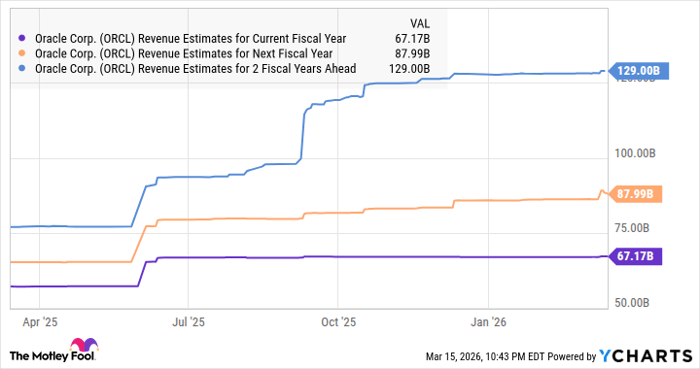
That's probably the reason why analysts anticipate that its top-line growth will accelerate.
Data by YCharts.
It isn't too late to buy Oracle yet, considering the potential upside on offer
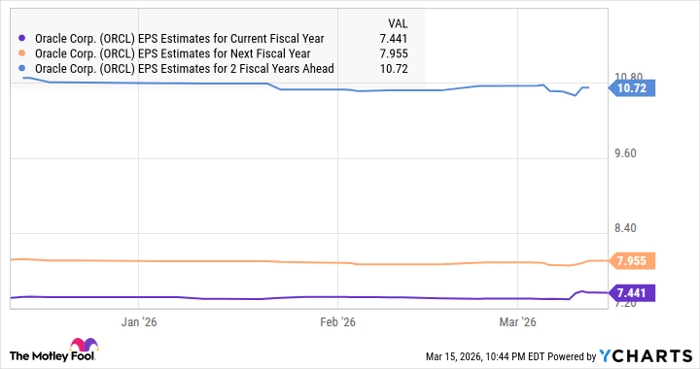
Oracle delivered impressive earnings growth last quarter, despite a 269% increase in capital expenditures to $8.5 billion. It expects to end the year with $50 billion in capex, a major increase over last year's spending of $21 billion. Even then, analysts expect a 24% increase in earnings this fiscal year to $7.45 per share.
However, consensus estimates project a significant slowdown in its bottom-line growth next year, despite an acceleration in revenue growth.
Data by YCharts.
However, Oracle could exceed analysts' expectations given its massive backlog, the bring-your-own-hardware strategy, and partner-funded infrastructure, which should help control capex growth. But even if Oracle's earnings grow in line with consensus expectations and it achieves $10.72 per share in fiscal 2028, its stock price could jump to $331 (based on the Nasdaq-100 index's earnings multiple of almost 31) over the next two years.
That's just over double where Oracle stock is trading right now. That suggests that it isn't too late for investors to buy this tech giant whose massive investments in AI data centers are likely to pay off handsomely in the long run.
Should you buy stock in Oracle right now?
Before you buy stock in Oracle, consider this:
The Motley Fool Stock Advisor analyst team just identified what they believe are the 10 best stocks for investors to buy now… and Oracle wasn’t one of them. The 10 stocks that made the cut could produce monster returns in the coming years.
Consider when Netflix made this list on December 17, 2004... if you invested $1,000 at the time of our recommendation, you’d have $510,710!* Or when Nvidia made this list on April 15, 2005... if you invested $1,000 at the time of our recommendation, you’d have $1,105,949!*
Now, it’s worth noting Stock Advisor’s total average return is 927% — a market-crushing outperformance compared to 186% for the S&P 500. Don't miss the latest top 10 list, available with Stock Advisor, and join an investing community built by individual investors for individual investors.
See the 10 stocks »
*Stock Advisor returns as of March 20, 2026.
Harsh Chauhan has no position in any of the stocks mentioned. The Motley Fool has positions in and recommends Oracle and Workday. The Motley Fool recommends SAP. The Motley Fool has a disclosure policy.
Recommended Articles


