


The Stock Market Is Sending a Major Warning. Here's What Investors Should Know Right Now.
Key Points
The S&P 500 Shiller CAPE Ratio and the Buffett indicator both suggest volatility could be looming.
While no metric can predict the future with 100% accuracy, it's still wise to prepare.
The right investments are key to protecting your portfolio.
- These 10 stocks could mint the next wave of millionaires ›
Americans are losing faith in the stock market, with more than 46% of investors worried that stock prices will be lower six months from now, according to the most recent weekly survey from the American Association of Individual Investors. That's up from around 36% the week prior.
History also suggests volatility could be on the horizon, with the stock market sending a warning sign for investors. Here's what to know right now.
Will AI create the world's first trillionaire? Our team just released a report on the one little-known company, called an "Indispensable Monopoly" providing the critical technology Nvidia and Intel both need. Continue »
Image source: Getty Images.
Multiple metrics suggest stocks are overvalued
Two popular stock market metrics many investors use to determine valuations are the S&P 500 Shiller CAPE Ratio and the Buffett indicator, and both have not-so-good news for investors.
The S&P 500 Shiller CAPE Ratio measures the S&P 500's inflation-adjusted earnings over the last 10 years. A higher ratio can signal that the market is overvalued, and historically, stock prices tend to fall after a peak.
The ratio's long-term average is around 17, and it reached a record high of 44 in December 1999, right before stocks entered a bear market. As of this writing, the ratio is approximately 39.
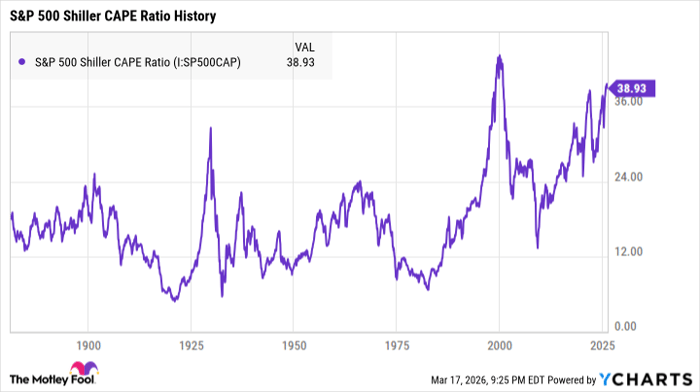
S&P 500 Shiller CAPE Ratio data by YCharts
The Buffett indicator also measures market valuations, but it does so by comparing the total value of U.S. stocks to U.S. GDP. It's nicknamed after Warren Buffett, who used this metric to predict the onset of the dot-com bubble burst.
A higher ratio suggests the market could be overvalued. In a 2001 interview with Fortune Magazine to explain his use of this indicator, Buffett himself noted that if it nears 200%, investors are "playing with fire." As of this writing, the Buffett indicator sits at around 218%.
What this means for investors
No stock market indicator can predict the future, so these metrics don't guarantee that a recession or bear market is looming. The market landscape is also much different now than it was 20 or 30 years ago, making these metrics trickier to interpret.
That said, it's wise to start preparing your portfolio just in case a bear market is looming.
The best way to protect against volatility is to invest only in stocks from healthy companies with solid fundamentals. That includes everything from a competitive advantage to robust finances to a competent executive team.
Strong companies are still vulnerable to short-term turbulence, but the healthier their fundamentals, the more likely they are to recover from downturns and earn positive total returns over time.
The key is to maintain a long-term outlook, as bear markets can sometimes last for years. By investing in quality stocks and holding them for at least five years or so, you're far more likely to come out the other side unscathed.
Where to invest $1,000 right now
When our analyst team has a stock tip, it can pay to listen. After all, Stock Advisor’s total average return is 936%* — a market-crushing outperformance compared to 189% for the S&P 500.
They just revealed what they believe are the 10 best stocks for investors to buy right now, available when you join Stock Advisor.
See the stocks »
*Stock Advisor returns as of March 19, 2026.
The Motley Fool has a disclosure policy.
Recommended Articles


