


Up 81% in 6 Months, This Glorious Growth Stock Should Soar Higher After March 18 (Hint: It's Not Micron Technology)
Key Points
Lam Research makes chip manufacturing equipment, and a nice chunk of that goes to memory manufacturers.
Micron's earnings report could give Lam stock a boost, as Micron could increase capex guidance.
Lam is well-positioned to capitalize on the overall growth of the wafer and fabrication equipment market.
- 10 stocks we like better than Lam Research ›
Micron Technology (NASDAQ: MU) is set to release results for its fiscal 2026's second quarter on March 18. Shares of the company have been in terrific form on the market over the past year, rising an incredible 323% as of this writing, driven by eye-popping revenue and earnings growth.
Analysts and investors will be eagerly awaiting Micron's earnings report to see whether this semiconductor stock can sustain its momentum. The good news for Micron investors is that the company can indeed jump higher after its upcoming report, primarily driven by the incredible demand for memory chips that's outpacing supply. The favorable pricing conditions in the memory market should continue to be a tailwind for the memory specialist, potentially paving the way for more upside in Micron stock following its results.
Will AI create the world's first trillionaire? Our team just released a report on the one little-known company, called an "Indispensable Monopoly" providing the critical technology Nvidia and Intel both need. Continue »
However, there is another company that's reaping the benefits of the booming memory demand: Lam Research (NASDAQ: LRCX), whose shares could get a nice boost following Micron's report. Let's see why that may be the case.

Image source: Getty Images.
Lam Research is a key player in the memory ecosystem
Lam Research stock has shot up an impressive 81% over the past six months, which isn't surprising as it supplies semiconductor manufacturing equipment to companies like Micron. Specifically, 34% of Lam's revenue is attributable to sales of memory equipment.
Mmanagement noted during the company's January earnings conference call that it achieved record revenue from sales of dynamic random-access memory (DRAM) manufacturing equipment. The company noted that memory manufacturers have been investing heavily in high-bandwidth memory (HBM), which is used in artificial intelligence (AI) data centers to move large data sets quickly, enabling AI workloads to run seamlessly.
Bank of America expects a 58% surge in the HBM market's revenue this year to almost $55 billion. What's more, Micron expects the HBM market to achieve $100 billion in revenue in 2028, suggesting manufacturers will continue to invest in this segment. It is worth noting that high HBM demand is causing a shortage of memory chips for other applications.
The high memory costs are expected to negatively impact the sales of smartphones and personal computers (PCs) this year. That's not surprising, as HBM reportedly requires 3 times the wafer capacity of traditional DRAM chips used in smartphones and PCs. Memory manufacturers are prioritizing data center customers due to the higher margins in this segment. Specifically, enterprise-grade memory products reportedly carry a 40% premium over consumer products.
So, there is a chance that memory makers will have to continue increasing their investments in manufacturing capacity to fill the supply gap for smartphones and PCs, as well as to meet robust demand from data centers. Micron already announced in December 2025 that it will increase its capital expenditure (capex) in fiscal 2026 to $20 billion from an earlier estimate of $18 billion to build more HBM capacity.
Other memory manufacturers, such as Samsung and SK Hynix, are also investing significantly to bring additional capacity online. All this is great news for Lam Research, which is already experiencing healthy growth due to the catalysts discussed above.
Investors can expect stronger growth from this semiconductor player
Lam's earnings in the quarter that ended December 2025 jumped by almost 40% year over year to $1.27 per share (from $0.91 per share in the same quarter last year). Its quarterly revenue increased by a solid 22% to $5.34 billion. Lam, therefore, seems to be in a position to exceed the 28% earnings jump to $5.31 per share that analysts are expecting from it in the ongoing fiscal 2026 (which will end in June 2026).
After all, there is a chance that the likes of Micron will further increase their investments in memory manufacturing capacity to help reduce the ongoing shortage, which is expected to last until 2028. This could boost investor confidence in Lam stock, especially if Micron announces a capex increase on March 18. Moreover, analysts have become bullish about Lam's earnings growth prospects.
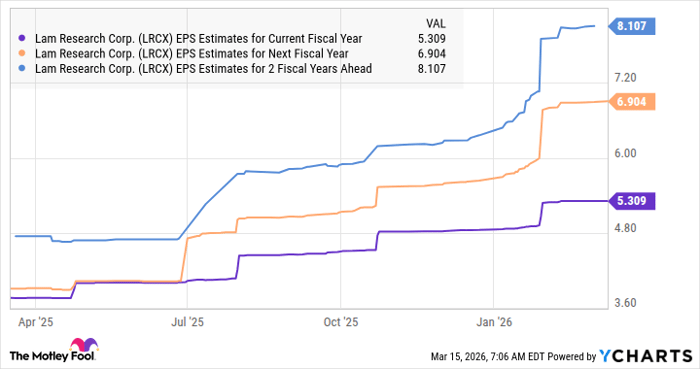
LRCX EPS Estimates for Current Fiscal Year data by YCharts
Don't be surprised to see this trend continue; according to McKinsey, semiconductor companies plan to invest a whopping $1 trillion in new fabrication plants through 2030. As Lam operates in the broader wafer and fabrication equipment market (59% of its revenue comes from selling equipment to foundry customers, such as Taiwan Semiconductor Manufacturing, Intel, Samsung, and others), it is well-positioned to capitalize on this lucrative trillion-dollar opportunity.
In all, Lam looks like a solid AI stock to buy ahead of Micron's quarterly report, as it has the potential to deliver bigger gains for investors in the long run.
Should you buy stock in Lam Research right now?
Before you buy stock in Lam Research, consider this:
The Motley Fool Stock Advisor analyst team just identified what they believe are the 10 best stocks for investors to buy now… and Lam Research wasn’t one of them. The 10 stocks that made the cut could produce monster returns in the coming years.
Consider when Netflix made this list on December 17, 2004... if you invested $1,000 at the time of our recommendation, you’d have $508,877!* Or when Nvidia made this list on April 15, 2005... if you invested $1,000 at the time of our recommendation, you’d have $1,115,328!*
Now, it’s worth noting Stock Advisor’s total average return is 936% — a market-crushing outperformance compared to 189% for the S&P 500. Don't miss the latest top 10 list, available with Stock Advisor, and join an investing community built by individual investors for individual investors.
See the 10 stocks »
*Stock Advisor returns as of March 18, 2026.
Bank of America is an advertising partner of Motley Fool Money. Harsh Chauhan has no position in any of the stocks mentioned. The Motley Fool has positions in and recommends Intel, Lam Research, Micron Technology, and Taiwan Semiconductor Manufacturing. The Motley Fool has a disclosure policy.
Recommended Articles


