


Why in the World Is Carvana Buying Brick-and-Mortar Dealerships?!
Key Points
Carvana's sales model is evolving as it scooped up its sixth Stellantis dealership recently.
Owning dealerships could add to Carvana's competitive advantages.
Dealerships can open the doors to new inventory and higher-margin service business.
- 10 stocks we like better than Carvana ›
Carvana (NYSE: CVNA) spent years convincing consumers and investors that the automotive industry was ripe for disruption through e-commerce. Many weren't believers in the vision and believed consumers would always prefer in-person visits and test drives.
But Carvana proved e-commerce could be powerful in the automotive world. Over recent years, a $10,000 investment would have turned into over $420,000. Rather than take a victory lap to taunt its rivals, Carvana is doing the opposite, and buying dealerships -- from Stellantis (NYSE: STLA), a struggling company, of all automakers. What in the world is Carvana thinking?
Will AI create the world's first trillionaire? Our team just released a report on the one little-known company, called an "Indispensable Monopoly" providing the critical technology Nvidia and Intel both need. Continue »

Image source: Getty Images.
What's going on?
It seems a bit strange for Carvana to go all-in on its online platform to drive its used-car retail business to new heights, only to then go backwards and scoop up a handful of Stellantis dealerships. But there are interesting points some investors may not have considered.
Carvana recently purchased its sixth Stellantis dealership, slightly altering its former all e-commerce approach. At first glance, investors might assume that scooping up dealerships is simply to diversify and expand sales from used cars into a hybrid of new and used cars, with new car sales representing better margins. This is partly true, and we'll dive more into this in a moment, but let's use AutoNation (NYSE: AN), a leading dealership group, as an example to better understand the auto retail business.
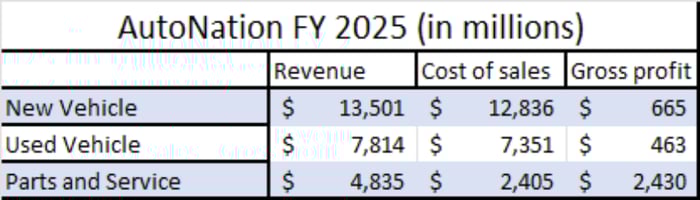
Data source: AutoNation 10k filings. Table source: Author.
This is a simple, yet phenomenal, example of what exactly Carvana is gaining. Yes, adding dealerships opens the door to incremental profits from the new car route, but as you can see that only adds a little value compared to the used car business. Parts and service is the game changer for the dealership business, and now Carvana is dipping its toes into that higher-margin business.
This also widens Carvana's funnel for gaining inventory at favorable pricing. It's generally true that trade-ins, or Carvana buying your car, is more valuable to the company than gaining inventory from auction sites. As Carvana is continuing to accelerate its used car business nationally, its competitive advantages are amplified by having more inventory -- or more favorably priced inventory.
How Carvana wins
The automotive retail industry is highly fragmented and while Carvana is the nation's second-largest used car retailer, its market share is currently around 1.6%. Carvana recognizes the value in owning dealerships for parts and services revenue and higher margins, among other benefits such as access to used-car trade ins. At the same time, car dealerships recognize the value in a national distribution, pricing system, and online convenience. This will force massive industry consolidation.
Carvana has already accomplished the difficult task -- it's easier for Carvana to buy dealerships and gain advantages than it is for a small fragmented dealership group to create artificial intelligence-driven pricing and appraisals, national distribution networks, and a competitive online presence. As the industry speeds toward massive consolidation, savvy investors would be wise to put capital into companies such as Carvana.
Should you buy stock in Carvana right now?
Before you buy stock in Carvana, consider this:
The Motley Fool Stock Advisor analyst team just identified what they believe are the 10 best stocks for investors to buy now… and Carvana wasn’t one of them. The 10 stocks that made the cut could produce monster returns in the coming years.
Consider when Netflix made this list on December 17, 2004... if you invested $1,000 at the time of our recommendation, you’d have $513,407!* Or when Nvidia made this list on April 15, 2005... if you invested $1,000 at the time of our recommendation, you’d have $1,123,237!*
Now, it’s worth noting Stock Advisor’s total average return is 938% — a market-crushing outperformance compared to 188% for the S&P 500. Don't miss the latest top 10 list, available with Stock Advisor, and join an investing community built by individual investors for individual investors.
See the 10 stocks »
*Stock Advisor returns as of March 17, 2026.
Daniel Miller has no position in any of the stocks mentioned. The Motley Fool recommends Stellantis. The Motley Fool has a disclosure policy.
Recommended Articles


