


Contrarian Take: This 6.9%-Yielding Dividend Stock Is a Buy at a 23-Year Low
Key Points
Campbell's slashed its full-year guidance as sales fell across several core brands.
The 157-year-old food company also paused buybacks and dividend raises.
Even so, Campbell's has the product portfolio needed to pull off a turnaround.
- 10 stocks we like better than Campbell's ›
Shares of Campbell's (NASDAQ: CPB) fell to a 23-year low on March 11 in response to abysmal quarterly earnings results and a guidance cut. With so much going wrong, it can seem counterintuitive to step in and buy the stock. But Campbell's is shaping up to be a compelling high-yield dividend stock for ultra-long-term value investors. Here's why.

Image source: Getty Images.
Will AI create the world's first trillionaire? Our team just released a report on the one little-known company, called an "Indispensable Monopoly" providing the critical technology Nvidia and Intel both need. Continue »
From bad to worse
When Campbell's announced its fiscal 2026 first-quarter results in December for the three months ended Nov. 2, 2025 -- the food and beverage company guided for full-year organic net sales growth of negative 1% to positive 1% and adjusted earnings per share (EPS) down 12% to 18%. But in Campbell's latest quarterly earnings for the period ended Feb. 1, 2026, the company updated its forecast -- projecting a 1%-2% decline in net sales and 23%-26% lower adjusted EPS to a new range of $2.15 to $2.25.
Strained consumer spending is heavily affecting Campbell's results. But consumer pressures could be even worse now, given that Campbell's latest quarterly results don't reflect the inflationary effects of surging oil prices since early February.
On the March 11 earnings call, management blamed the fresh bakery and salty snack product lines as the main drivers of the snack segment's weak performance, despite Goldfish's strength. But aside from promotions and pricing adjustments, there's little hope that the segment will turn around anytime soon.
The good news is that the meals and beverages segment is holding up fairly well, with decent margins driven by growth in Rao's tomato sauce and aspects of the soup segment that focus on cooking ingredients rather than stand-alone meal replacements.
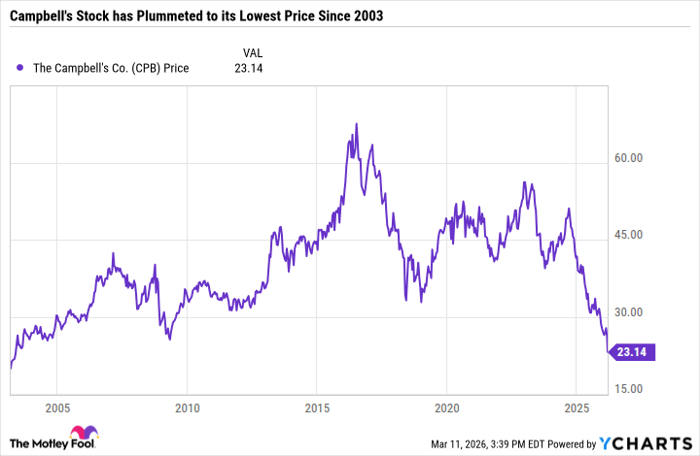
CPB data by YCharts
Campbell's is a good value and can afford its dividend
In addition to slashing its guidance, Campbell's reduced its full-year capital expenditures by $50 million and suspended its stock repurchase program to improve cash flow and address its debt load. It also said it wouldn't increase its dividend anytime soon, although it remains committed to the payout.
Campbell's hasn't cut its dividend since 2001. Full-year guidance of $2.15 to $2.25 in adjusted EPS is still plenty to cover Campbell's annualized dividend of $1.56 -- although the margin for error is shrinking. But given that Campbell's yield is a sky-high 6.9%, it would still be in high-yield territory even if it cut its dividend by a third or in half.
Based on the stock price at the time of this writing and the midpoint of its revised earnings guidance of $2.20 per share, Campbell's trades at just 10.5 times earnings, which is dirt cheap. Granted, Campbell's valuation could fall further if its fundamentals continue to deteriorate.
A deep-value stock for patient investors
Campbell's is a buy because it can still afford its dividend, the stock is cheap, and its portfolio of brands is better than the market is giving it credit for today.
Some investors may prefer to wait to buy Campbell's until it shows signs that the worst of its slowdown is over. But risk-tolerant investors may want to step in and buy the dividend stock now, given the compelling valuation and passive-income opportunity.
Should you buy stock in Campbell's right now?
Before you buy stock in Campbell's, consider this:
The Motley Fool Stock Advisor analyst team just identified what they believe are the 10 best stocks for investors to buy now… and Campbell's wasn’t one of them. The 10 stocks that made the cut could produce monster returns in the coming years.
Consider when Netflix made this list on December 17, 2004... if you invested $1,000 at the time of our recommendation, you’d have $513,407!* Or when Nvidia made this list on April 15, 2005... if you invested $1,000 at the time of our recommendation, you’d have $1,123,237!*
Now, it’s worth noting Stock Advisor’s total average return is 938% — a market-crushing outperformance compared to 188% for the S&P 500. Don't miss the latest top 10 list, available with Stock Advisor, and join an investing community built by individual investors for individual investors.
See the 10 stocks »
*Stock Advisor returns as of March 17, 2026.
Daniel Foelber has no position in any of the stocks mentioned. The Motley Fool recommends Campbell's. The Motley Fool has a disclosure policy.
Recommended Articles


