


Oracle Is Burning Cash in the Pursuit of "Hypergrowth." Is the AI Growth Stock a Buy Anyway?
Key Points
Oracle is accelerating data center construction timelines and managing costs.
It is justifying its spending by fulfilling highly profitable contracted capacity.
Oracle’s cash burn is taking a toll on its balance sheet.
- 10 stocks we like better than Oracle ›
There was a lot to like from Oracle's (NYSE: ORCL) latest quarterly results and guidance for the upcoming fiscal year.
Oracle stock jumped in response to the earnings release but remains down 20% year to date at the time of this writing, badly underperforming the tech sector's 3.3% decline and the S&P 500's 2% drop.
Will AI create the world's first trillionaire? Our team just released a report on the one little-known company, called an "Indispensable Monopoly" providing the critical technology Nvidia and Intel both need. Continue »
Here's why Oracle remains in "prove it" mode for investors as it burns cash at a breakneck pace, and some insight into whether the growth stock is worth buying despite its glaring risks.
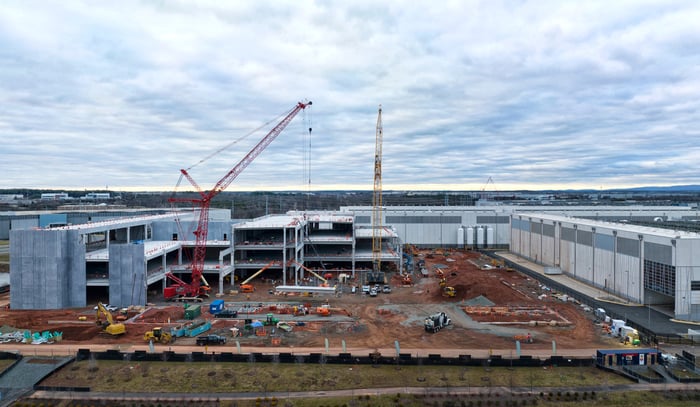
Image source: Getty Images.
The cost of hypergrowth
Oracle stock hit an all-time high last September after announcing a detailed roadmap for exponential artificial intelligence (AI) growth led by Oracle Cloud Infrastructure (OCI). But to pull it off, Oracle has to take on significant debt, because its database and data management software segment doesn't generate enough cash flow to cover costs.
As investors digested the consequences of this debt, Oracle has undergone a massive sell-off over the last six months. And the cash burn has only gotten worse -- with Oracle reporting a staggering $43.8 billion in negative free cash flow (FCF) through the first three quarters of fiscal 2026, compared to $26.2 billion in positive FCF in fiscal 2025.
Clay Magouyrk, Oracle co-CEO and head of OCI, addressed the cash burn on the third-quarter fiscal 2026 earnings call:
The reason we are not even more profitable right now, despite the fact that we are continuing to grow EPS [earnings per share], etc., is because we have so much under construction at one time, and we have some expenses for those things. Now we are really good at that. We are very, very good at minimizing the time under which that construction is happening. We are very, very good at reducing those costs during that time period. But they are not zero. And so as our business is going through this hypergrowth phase, that is the only drag on profitability. But, thankfully, we are very good and getting better at delivering that capacity. That capacity, when we deliver it, is all already contracted for at a very profitable rate. So when you combine those things together, we are extremely confident in both the capacity we delivered and the continuing increase in profitability of our AI business.
Oracle's overall costs are coming down as it gets better at operating its data centers through lower networking, hardware, and power costs. But its spending remains an issue.
Oracle confirmed its earlier fiscal 2026 guidance of $67 billion in revenue and $50 billion in capital expenditures (capex), and announced $90 billion in anticipated fiscal 2027 revenue. But on the earnings call, management declined to give a firm fiscal 2027 capex number, preferring to wait until June when it provides full-year fiscal 2026 results.
A bold bet on AI infrastructure
Oracle is one of the most exciting AI stocks to buy now, but only for investors who can stomach the risks of operating with ultra-high leverage. Oracle's weak balance sheet makes it highly vulnerable to a slowdown in AI spending, and puts pressure on its customers to make good on their promises to book capacity.
At the same time, OCI is purpose-built for AI. In addition to OCI-specific data centers, Oracle embeds native versions of its database services inside data centers managed by its multicloud partners -- Amazon, Microsoft, and Alphabet -- offering a compelling competitive advantage.
Add it all up, and Oracle presents a high-risk, high-potential-reward scenario for growth stock investors.
Should you buy stock in Oracle right now?
Before you buy stock in Oracle, consider this:
The Motley Fool Stock Advisor analyst team just identified what they believe are the 10 best stocks for investors to buy now… and Oracle wasn’t one of them. The 10 stocks that made the cut could produce monster returns in the coming years.
Consider when Netflix made this list on December 17, 2004... if you invested $1,000 at the time of our recommendation, you’d have $513,407!* Or when Nvidia made this list on April 15, 2005... if you invested $1,000 at the time of our recommendation, you’d have $1,123,237!*
Now, it’s worth noting Stock Advisor’s total average return is 938% — a market-crushing outperformance compared to 188% for the S&P 500. Don't miss the latest top 10 list, available with Stock Advisor, and join an investing community built by individual investors for individual investors.
See the 10 stocks »
*Stock Advisor returns as of March 17, 2026.
Daniel Foelber has positions in Oracle and has the following options: short March 2026 $240 calls on Oracle. The Motley Fool has positions in and recommends Alphabet, Amazon, Microsoft, and Oracle. The Motley Fool has a disclosure policy.
Recommended Articles


