


Micron Is the Best-Performing Artificial Intelligence (AI) Stock of the Past Year -- Up 318%. Can It Keep Going in 2026?
Key Points
The remarkable surge in memory prices is poised to continue in 2026, paving the way for strong results for Micron.
The company's strong earnings growth potential suggests that it can still become a multibagger from current levels.
- 10 stocks we like better than Micron Technology ›
There is no doubt that Micron Technology (NASDAQ: MU) has been one of the top-performing artificial intelligence (AI) names over the past year. The 318% appreciation in the memory specialist's shares during this period has been well above the gains delivered by other AI pioneers such as Nvidia, Palantir Technologies, and Broadcom.
Micron's stunning surge in the past year is well deserved. The memory specialist's revenue and earnings have been supercharged by a phenomenal increase in memory prices, driven primarily by demand from AI data centers that are consuming a significant chunk of the available supply. Investors, however, may be wondering if Micron's catalyst is strong enough to help it sustain its impressive momentum in 2026.
Will AI create the world's first trillionaire? Our team just released a report on the one little-known company, called an "Indispensable Monopoly" providing the critical technology Nvidia and Intel both need. Continue »
That's why I will take a closer look at the memory market's dynamics and help investors determine whether Micron stock can deliver more upside this year.

Image source: Micron Technology.
The incredible memory price growth is here to stay in 2026
A closer look at memory-related news shows that Micron will continue to benefit from a favorable pricing environment. UBS, for instance, expects a 62% spike in the price of dynamic random-access memory (DRAM) in the first quarter of 2026. NAND flash memory prices are expected to jump by 40% in the current quarter.
Micron sells both DRAM and NAND flash chips. DRAM chips, which are used for computing purposes in data centers, smartphones, and computers, move the needle in a bigger way for the company, accounting for almost 80% of its revenue. The rest of Micron's revenue comes from the storage-focused NAND flash chips.
The good news for Micron investors is that the DRAM chip shortage is expected to persist for the next 12 to 18 months. Even NAND chips are expected to be in tight supply until the middle of next year. In fact, the shortage of memory chips is so acute due to the robust AI-fueled demand that DRAM prices are expected to surge by a whopping 70% in the second quarter of 2026.
Memory manufacturers are taking advantage of the supply constraints. Samsung, for instance, has reportedly increased DRAM prices by a whopping 100%. This follows a sizable 70% increase by the South Korean chip giant in January. It won't be surprising to see Micron follow a similar path and capitalize on the intense demand for AI chips from data centers.
The biggest reason the DRAM market is undersupplied is that high-bandwidth memory (HBM) chips reportedly consume 3 times the semiconductor wafer capacity of standard memory chips. As HBM is being used in graphics cards, AI-focused application-specific integrated circuits (ASICs), and even server processors, it is easy to see why it is sold out for 2026.
Moreover, Micron points out that the HBM market's revenue is poised to almost triple between 2025 and 2028, reaching $100 billion within a couple of years. So, Micron's biggest catalyst is here to stay, not just in 2026, but for the next two years at least.
Is the stock set to soar further this year?
The semiconductor stock has already logged impressive gains of 36% in 2026. It trades at almost 38 times earnings right now, a premium to the tech-focused Nasdaq-100 index's earnings multiple of 32. However, this premium is justified if we consider that analysts are expecting a massive 322% increase in earnings this year to $35 per share, followed by another sizable increase next year.
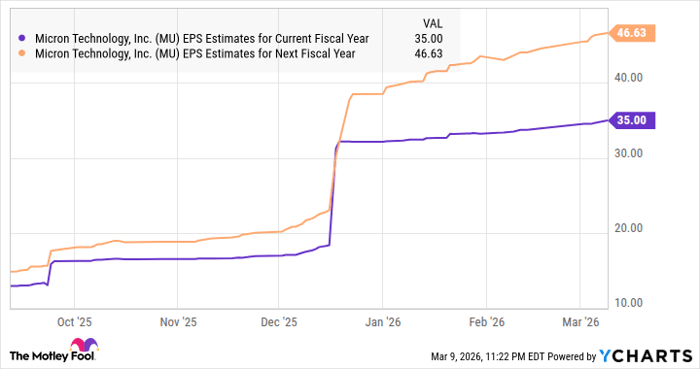
MU EPS Estimates for Current Fiscal Year data by YCharts
An important point to note in the above chart is that Micron's earnings estimates have been moving higher, a trend that could continue based on the points discussed above. Assuming Micron indeed achieves $46.63 per share in earnings in the next fiscal year (which will end in August 2027), its stock price could jump to $1,189 (if the stock trades in line with the Nasdaq-100 index's forward earnings multiple of 25.5 next year).
That's around triple Micron's current price, suggesting that this AI stock isn't done soaring just yet.
Should you buy stock in Micron Technology right now?
Before you buy stock in Micron Technology, consider this:
The Motley Fool Stock Advisor analyst team just identified what they believe are the 10 best stocks for investors to buy now… and Micron Technology wasn’t one of them. The 10 stocks that made the cut could produce monster returns in the coming years.
Consider when Netflix made this list on December 17, 2004... if you invested $1,000 at the time of our recommendation, you’d have $514,000!* Or when Nvidia made this list on April 15, 2005... if you invested $1,000 at the time of our recommendation, you’d have $1,105,029!*
Now, it’s worth noting Stock Advisor’s total average return is 930% — a market-crushing outperformance compared to 187% for the S&P 500. Don't miss the latest top 10 list, available with Stock Advisor, and join an investing community built by individual investors for individual investors.
See the 10 stocks »
*Stock Advisor returns as of March 14, 2026.
Harsh Chauhan has no position in any of the stocks mentioned. The Motley Fool has positions in and recommends Micron Technology, Nvidia, and Palantir Technologies. The Motley Fool recommends Broadcom. The Motley Fool has a disclosure policy.
Recommended Articles


