


2 Top Tech Stocks to Buy in March
Key Points
Amazon is the world's highest-revenue-making public company.
Amazon Web Services revenue growth has re-accelerated from previous quarters.
Microsoft is becoming one of the more vertically integrated AI companies.
- 10 stocks we like better than Amazon ›
On the heels of an artificial intelligence (AI)-fueled run over the past few years, major tech companies have started 2026 off on a not-so-good trajectory. Through March 10, all of the "Magnificent Seven" stocks (Mag 7) are down year to date, while the S&P 500 is down around 0.7%.
Will AI create the world's first trillionaire? Our team just released a report on the one little-known company, called an "Indispensable Monopoly" providing the critical technology Nvidia and Intel both need. Continue »
Two Mag 7 stocks that have especially started 2026 on the wrong foot are Amazon (NASDAQ: AMZN) and Microsoft (NASDAQ: MSFT), which are down over 7% and 15%, respectively, at the time of this writing. Yet, they're my top tech stocks to buy right now in March.

Image source: The Motley Fool.
The world's top cash cow
Amazon is known for its e-commerce business, but it has expanded well beyond that into many different tech industries. It has the world's largest cloud platform with Amazon Web Services (AWS), a fast-growing advertising business, and entertainment businesses (Prime Video, Twitch). It's also progressing in AI hardware with its custom AI chips.
Three of Amazon's most important businesses (e-commerce, AWS, and advertising) are each showing encouraging progress. Amazon's e-commerce business is becoming more efficient as the company deploys more robots to handle warehouse duties. AWS growth is reaccelerating as AI demand and cloud adoption continue to grow, and advertising is a high-margin business that adds to Amazon's bottom line.
Despite its current stock price struggles, one thing is clear about Amazon: It's a major cash cow. In 2025, it made $716.9 billion in revenue, surpassing Walmart as the world's highest-revenue-making public company (Walmart made $713.2 billion).
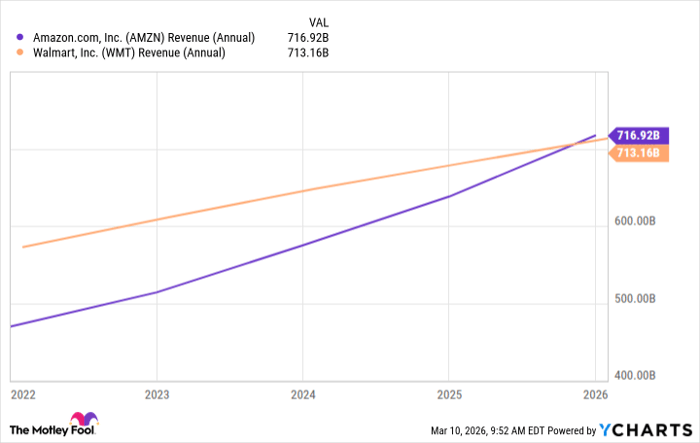
AMZN Revenue (Annual) data by YCharts.
That type of financial performance gives Amazon plenty of flexibility to continue improving its current operations and pursuing higher-risk, higher-reward endeavors.
A company with established businesses that generate billions in revenue while maintaining the cash flow to explore other lucrative opportunities is one set up for long-term success -- and that's what Amazon has.
When in doubt, look at Microsoft
Microsoft may well be the safest long-term bet among the Mag 7 companies because of its highly diversified business and its large number of enterprise clients. The focus now is rightly on AI (and Microsoft's projected AI-related spending), but it has a business that will continue to bring in billions regardless of AI's progression (or lack thereof).
When you invest in Microsoft, you know you're investing in a company built for longevity. Its products and services are used by numerous businesses worldwide, many of which rely on Microsoft for their daily operations. That's a recipe for sustained success because businesses tend to continue paying for their services through rough economic patches, while consumer spending tends to fluctuate with the economy.
From an AI standpoint, Microsoft is well-positioned because it owns key platforms that stand to benefit from AI without fully relying on it for its success (Office, Azure, Teams, Windows, etc.). That can't be said for many other AI-focused tech companies.
It's also becoming one of the more vertically integrated tech companies in the AI world. It's creating its own AI chip (Maia 200), has the world's second-largest cloud platform in Azure, and has the previously mentioned distribution platforms with its widely used software.
The bargains are becoming too good to pass up
Just because Amazon's and Microsoft's stock prices have fallen noticeably doesn't mean they won't keep falling. We can't predict how the stock prices will perform. However, at current levels, it's worth considering beginning or adding to your stake in the companies.
Amazon's price-to-earnings (P/E) ratio of 29.7 is much less than its 113.8 average over the past decade, and Microsoft's 25.3 is well below its 33.2 average. That alone doesn't make them automatic buys, but it's a very intriguing entry point for blue chip tech companies like these two.
Should you buy stock in Amazon right now?
Before you buy stock in Amazon, consider this:
The Motley Fool Stock Advisor analyst team just identified what they believe are the 10 best stocks for investors to buy now… and Amazon wasn’t one of them. The 10 stocks that made the cut could produce monster returns in the coming years.
Consider when Netflix made this list on December 17, 2004... if you invested $1,000 at the time of our recommendation, you’d have $508,607!* Or when Nvidia made this list on April 15, 2005... if you invested $1,000 at the time of our recommendation, you’d have $1,122,746!*
Now, it’s worth noting Stock Advisor’s total average return is 933% — a market-crushing outperformance compared to 188% for the S&P 500. Don't miss the latest top 10 list, available with Stock Advisor, and join an investing community built by individual investors for individual investors.
See the 10 stocks »
*Stock Advisor returns as of March 13, 2026.
Stefon Walters has positions in Microsoft and Walmart. The Motley Fool has positions in and recommends Amazon, Microsoft, and Walmart. The Motley Fool has a disclosure policy.
Recommended Articles


