


3 Things Energy Investors Need to Know About President Trump's Latest Tariff Moves
Key Points
The Supreme Court struck down the Trump administration's earlier tariffs.
The administration has since imposed tariffs in a new way.
- 10 stocks we like better than ExxonMobil ›
How much should energy investors worry about the Trump administration's fast-changing tariff regime? It seems like an important question to ask, but the truth is, it may be focusing on short-term gyrations that really won't have a huge long-term impact on the energy sector.
When the U.S. Supreme Court recently struck down some of President Donald Trump's tariffs as unconstitutional, Trump's response was to enact a global 15% tariff on all goods coming into the U.S. for a limited period (other tariffs not affected by the Court's ruling also remain in effect). That means companies that operate internationally in any way (including energy companies) need to continue dealing with tariffs.
Will AI create the world's first trillionaire? Our team just released a report on the one little-known company, called an "Indispensable Monopoly" providing the critical technology Nvidia and Intel both need. Continue »
Here are three things you need to know before you start worrying too much about the administration's tariff moves.
1. Oil and natural gas prices are the important issue
The real driver of performance in the energy sector is the price of oil and natural gas. These are highly volatile commodities, prone to rapid and material price changes. The geopolitical events unfolding in recent weeks highlight just how quickly oil prices rise and fall. Tariffs are a part of the story, but not the only factor. And tariffs are really not even the largest factor to consider.
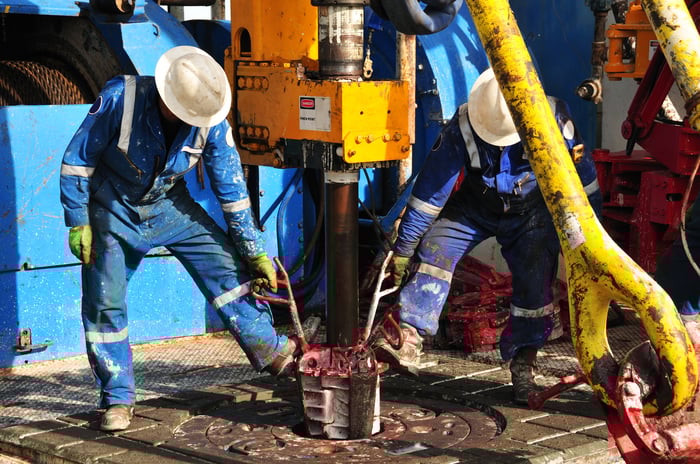
Image source: Getty Images.
2. Different companies face different levels of exposure
That said, not all companies are created equal. For example, Devon Energy (NYSE: DVN) is a large U.S.-based energy company. Tariffs on foreign energy supplies won't have as big an impact on it as, say, such taxes might have on ExxonMobil (NYSE: XOM), which produces oil on a global scale. That said, ExxonMobil's business spans the entire energy value chain, from producing energy to processing and transporting it. That diversification helps to mitigate the impact of both tariffs and commodity price volatility. Devon Energy, as a pure-play producer, will be greatly affected by commodity prices.
If you want to step away from commodity risk, you could always buy a midstream-focused business like Enterprise Products Partners (NYSE: EPD), which collects fees for moving oil and natural gas around the world. The price of the commodities it transports is less important than demand. Energy demand tends to remain high even when energy prices are low. That said, tariffs could change how oil and gas move around the world, so Enterprise isn't immune to them.
3. Energy is vital to the world
All of that said, no country can simply stop using oil and natural gas. Both are vital to the world economy, and without them the world would quickly grind to a halt. And while oil and natural gas are global commodities, there's really only so many viable options for accessing them. Tariffs may change things at the edges, but they aren't likely to drastically alter the industry's long-term operations. Indeed, historically, even all-out wars generally affect oil supplies and prices for only a limited period before energy markets revert to normal.
Should you buy stock in ExxonMobil right now?
Before you buy stock in ExxonMobil, consider this:
The Motley Fool Stock Advisor analyst team just identified what they believe are the 10 best stocks for investors to buy now… and ExxonMobil wasn’t one of them. The 10 stocks that made the cut could produce monster returns in the coming years.
Consider when Netflix made this list on December 17, 2004... if you invested $1,000 at the time of our recommendation, you’d have $532,066!* Or when Nvidia made this list on April 15, 2005... if you invested $1,000 at the time of our recommendation, you’d have $1,122,072!*
Now, it’s worth noting Stock Advisor’s total average return is 960% — a market-crushing outperformance compared to 193% for the S&P 500. Don't miss the latest top 10 list, available with Stock Advisor, and join an investing community built by individual investors for individual investors.
See the 10 stocks »
*Stock Advisor returns as of March 5, 2026.
Reuben Gregg Brewer has no position in any of the stocks mentioned. The Motley Fool recommends Enterprise Products Partners. The Motley Fool has a disclosure policy.
Recommended Articles


