


Better Buy During the Crypto Crash: Bitcoin or XRP?
Key Points
Bitcoin is widely considered a store of value within the broader cryptocurrency landscape.
Although it still is highly speculative, XRP could be interesting for those curious about the future of financial systems.
XRP offers compelling utility, but Bitcoin's durability may prove more profitable in the long run.
- 10 stocks we like better than XRP ›
As sell-offs within the cryptocurrency arena continue, some investors may be wondering whether the bottom has arrived. Against this backdrop, weighing the idea of buying the dip in Bitcoin (CRYPTO: BTC) or XRP (CRYPTO: XRP) is probably top of mind for many crypto enthusiasts.
Let's dig into some of the themes driving this new crypto winter and explore how smart investors are assessing the prospects of Bitcoin and XRP right now.
Will AI create the world's first trillionaire? Our team just released a report on the one little-known company, called an "Indispensable Monopoly" providing the critical technology Nvidia and Intel both need. Continue »
Image source: Getty Images.
Bitcoin is the gravitational anchor for the broader crypto landscape
Similar to gold, Bitcoin is viewed by some investors as an insurance policy against fragile fiat systems during market turmoil. With a hard supply cap of 21 million bitcoins, the same scarcity mindset that fuels interest in commodities or alternative investments such as rare art favors the idea of investing in Bitcoin during a market downturn.
Moreover, rising institutional investment in spot Bitcoin exchange-traded funds (ETFs) provides the asset with more price support compared to altcoins (any crypto other than Bitcoin). For this reason, Bitcoin is often perceived as the least speculative opportunity in an otherwise highly unpredictable cryptocurrency market.
XRP has an interesting utility proposition, but is it scalable?
While Bitcoin's value proposition is that of a store of value, XRP offers more tangible utility. XRP is a coin distributed through a financial infrastructure provider, Ripple.
The appeal of Ripple's payments network is that it allows institutions to send money faster and cheaper compared to legacy settlement houses such as the Society for Worldwide Interbank Financial Telecommunication (SWIFT) platform.
XRP enters the picture as an agnostic digital currency with optionality. One of the biggest pain points of cross-border transactions is foreign exchange fees and other processing costs.
For example, let's say a bank in Japan needs to wire money to a vendor in Italy. If the Japanese bank decided to denominate this transaction in XRP as opposed to fiat currency such as yen, however, it would be able to reduce the headaches and friction that often come with complex payments and exchange rates.
While XRP's utility is clear, the future trajectory of the coin is far from certain. Beyond the introduction of XRP, Ripple has worked hard to introduce a number of other adjacent solutions within its payments network -- including its own stablecoin, RLUSD. In other words, broader adoption of Ripple does not necessarily guarantee more use of XRP -- making the coin's future questionable.
How to invest in crypto during periods of high uncertainty
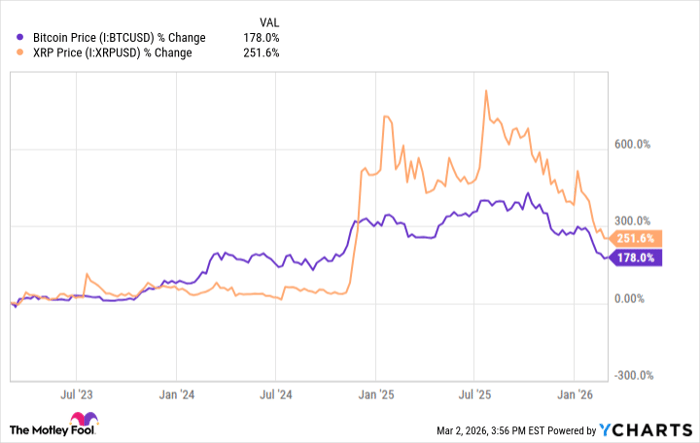
When choosing between Bitcoin and XRP, smart investors need to index volatility. During the past few years, Bitcoin's peaks and valleys have been far less pronounced compared to those of XRP.
Bitcoin Price data by YCharts
The extreme melt-ups and sell-offs seen in XRP could imply that investors generally buy the coin when the narrative looks compelling but are quick to dump their position when reality doesn't match the hype.
In my eyes, this disparity could signal that Bitcoin offers a smoother ride to the top (and bottom) compared to a more speculative opportunity such as XRP -- making it a more stable, but not totally painless, opportunity.
While XRP could be thought of as an innovative disruptor to the fintech landscape, its role as a category-defining bridge currency is not necessarily coming to fruition at the moment. With these ideas in mind, I think investors should only invest in XRP if the token is more widely adopted across major big-box retailers and Wall Street banks.
Conversely, while Bitcoin has not yet become a mainstream pillar supporting financial ecosystems, its perception as an inflation hedge and store of value during times of macroeconomic or geopolitical upheaval -- as now -- could reignite interest from institutional investors.
For these reasons, I think the prudent strategy is to own Bitcoin or similar proxies right now. If you are averse to owning Bitcoin outright, building positions in crypto stocks like Coinbase (NASDAQ: COIN), Circle (NYSE: CRCL), or Robinhood Markets (NASDAQ: HOOD) can be a backup plan to participate in the upside of future crypto-driven tailwinds without becoming overexposed to any single digital asset.
Should you buy stock in XRP right now?
Before you buy stock in XRP, consider this:
The Motley Fool Stock Advisor analyst team just identified what they believe are the 10 best stocks for investors to buy now… and XRP wasn’t one of them. The 10 stocks that made the cut could produce monster returns in the coming years.
Consider when Netflix made this list on December 17, 2004... if you invested $1,000 at the time of our recommendation, you’d have $523,599!* Or when Nvidia made this list on April 15, 2005... if you invested $1,000 at the time of our recommendation, you’d have $1,118,640!*
Now, it’s worth noting Stock Advisor’s total average return is 951% — a market-crushing outperformance compared to 194% for the S&P 500. Don't miss the latest top 10 list, available with Stock Advisor, and join an investing community built by individual investors for individual investors.
See the 10 stocks »
*Stock Advisor returns as of March 4, 2026.
Adam Spatacco has no position in any of the stocks mentioned. The Motley Fool has positions in and recommends Bitcoin and XRP. The Motley Fool recommends Coinbase Global. The Motley Fool has a disclosure policy.
Recommended Articles


