


Lucid's Former Chief Engineer Sold $4 Million of LCID Stock
Key Points
The company faces a very challenging 2026.
Lucid stock is down 40% since November.
- 10 stocks we like better than Lucid Group ›
Eric Bach, a former top employee at Lucid Group (NASDAQ: LCID), sold millions of dollars of Lucid stock in recent months. Previously, Bach served as senior vice president of product and chief engineer for the company.
Will AI create the world's first trillionaire? Our team just released a report on the one little-known company, called an "Indispensable Monopoly" providing the critical technology Nvidia and Intel both need. Continue »
An early February report noted two recent stock sales by Bach. One transaction totaled $2.8 million, with another totaling nearly $1.2 million.
The most obvious reason for the sales would seem to be that Bach left the company last November. No longer an employee, Bach likely isn't as keen on maintaining ownership. We don't know why Bach sold shares, but there are reasons any shareholder might want to sell.
Lucid stock faces a daunting 2026
Lucid stock has fallen by roughly 40% since early November, when the company announced Bach's departure. It's no surprise why. Back then, I was arguing that Lucid stock was overvalued.
I think the company's losses will likely force it to continue diluting shareholders. Since going public, Lucid has relied on share dilution to remain financially solvent. With no net profit expected in 2026, shareholders will likely continue to see their ownership stakes further diluted by additional stock sales.
Since its IPO, Lucid has increased its total shares outstanding by roughly 90%. Its stock price, meanwhile, has also slumped nearly 90% over that time period.
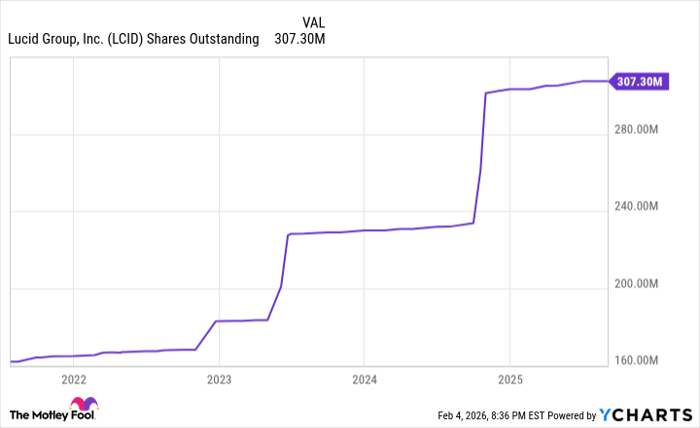
LCID Shares Outstanding data by YCharts
Share dilution is an acceptable compromise if a business is expected to reach profitability. But I would be surprised if Lucid achieves that goal. As competitors Tesla and Rivian have proven, getting an affordable car model to market is critical in gaining the mass scale necessary for positive net profits. I simply don't see a viable path for it to get affordable models to market in 2026 or 2027.
Lucid is years behind the competition when it comes to launching a mass-market model. It even had trouble launching and scaling the sales of a low-volume luxury model last year.

Image source: Getty Images.
Here's the main issue for investors: Lucid has a market cap of $3.3 billion. Rivian, meanwhile, is valued above $15 billion, with Tesla's market cap hovering well above $1 trillion. Lucid's paltry valuation makes it difficult to sell enough stock to plug net losses without massively diluting shareholders.
In 2026, analysts expect Lucid to book heavy losses despite 80% expected sales growth. The company is still likely years away from profitability. So while the company's revenue may continue to climb, Lucid simply doesn't have the capital or stock price necessary to scale without heavy dilution -- enough dilution to more than offset any gains for ordinary shareholders.
We don't know why Bach is selling. He may just want to cut ties with his former employer. But from a sheer investment standpoint, I understand why Lucid shares may not present much value to him.
I'm just not confident that the company can succeed with scaling without overly diluting shareholders. The company does seemingly have a strong long-term financial backer in the form of Saudi Arabia's Public Investment Fund. That vehicle owns more than half of Lucid's outstanding shares. But what is best for Saudi Arabia long term may not be in the interests of minority investors.
Without a clear path to launching affordable models without raising significantly more cash at a rock-bottom valuation, I'm leaving this once-promising EV stock for others to figure out.
Should you buy stock in Lucid Group right now?
Before you buy stock in Lucid Group, consider this:
The Motley Fool Stock Advisor analyst team just identified what they believe are the 10 best stocks for investors to buy now… and Lucid Group wasn’t one of them. The 10 stocks that made the cut could produce monster returns in the coming years.
Consider when Netflix made this list on December 17, 2004... if you invested $1,000 at the time of our recommendation, you’d have $519,015!* Or when Nvidia made this list on April 15, 2005... if you invested $1,000 at the time of our recommendation, you’d have $1,086,211!*
Now, it’s worth noting Stock Advisor’s total average return is 941% — a market-crushing outperformance compared to 194% for the S&P 500. Don't miss the latest top 10 list, available with Stock Advisor, and join an investing community built by individual investors for individual investors.
See the 10 stocks »
*Stock Advisor returns as of March 1, 2026.
Ryan Vanzo has no position in any of the stocks mentioned. The Motley Fool has positions in and recommends Tesla. The Motley Fool has a disclosure policy.
Recommended Articles


