


The Cheapest "Magnificent Seven" Stock Is a Screaming Buy Right Now
Key Points
Several "Magnificent Seven" stocks are much cheaper now than they were a few months ago.
Meta Platforms is the cheapest of the group.
The market is worried about Meta's artificial intelligence (AI) spending.
- 10 stocks we like better than Meta Platforms ›
The "Magnificent Seven" is a group of stocks that represents some of the largest and most dominant tech companies in the market. It's made up of:
- Nvidia
- Apple
- Alphabet
- Microsoft
- Amazon
- Meta Platforms (NASDAQ: META)
- Tesla
Of those seven stocks, all are among the 10 largest companies in the world, so being on this list is a big deal. So when one is cheap, then investors should start paying attention, as most of the stocks in this group rarely go on sale.
Where to invest $1,000 right now? Our analyst team just revealed what they believe are the 10 best stocks to buy right now, when you join Stock Advisor. See the stocks »

Image source: Getty Images.
Meta Platforms is the cheapest by one valuation measure
There are multiple ways to value a stock, but I think the most appropriate for the Magnificent Seven is the forward price-to-earnings ratio. For the most part, every company in this group is growing at a faster-than-market pace, at 10% annually, and is highly exposed to trends such as artificial intelligence (AI). As a result, investors are better off valuing a stock based on where it's going rather than where it's been.
From this viewpoint, Meta Platforms has the lowest forward earnings ratio. (Note: Tesla was removed from this chart because it has a price-to-forward earnings ratio of 200).
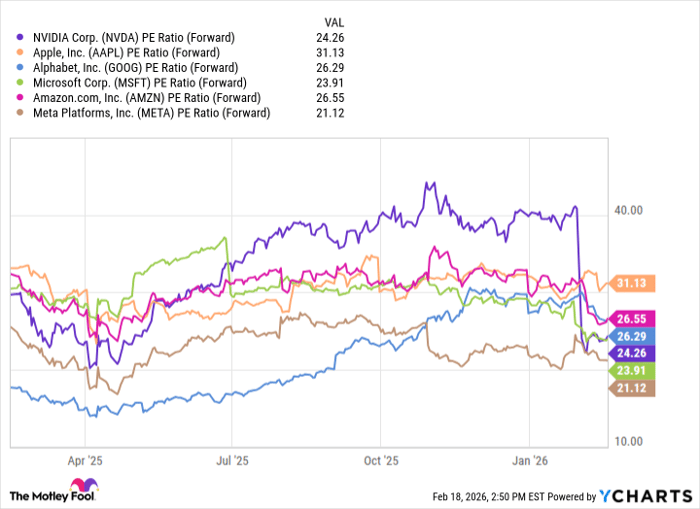
NVDA PE Ratio (Forward) data by YCharts
There are a lot of takeaways from this chart, but I think the most notable is Meta's 21.1 forward earnings price tag. For comparison, the S&P 500 (SNPINDEX: ^GSPC) has a forward earnings ratio of 21.9, indicating that Meta is cheaper than the overall market.
That's not an insignificant event to trade at a discount to the market, so is Meta worth buying right now?
Meta Platforms is spending big on AI
Meta Platforms is the parent company of several social media sites, including Facebook and Instagram. Still, it also has another division that works on AI capabilities and other hardware equipment, such as augmented- and virtual-reality glasses. While Meta touts its AI capabilities and other technological breakthroughs, the reality is that Meta is just an advertising company until it can prove anything different. That's not a bad thing, but it's also a reality check for most investors.
In Q4 2025, Meta generated $59.9 billion in revenue, up an impressive 24% year over year. Of that $59.9 billion total, $58.1 billion came from advertising on its social media platforms. This segment is also incredibly profitable and produced an operating income of $30.8 billion, while its Reality Labs division lost $6 billion.
Meta Platforms is spending big on AI, but it really doesn't have a lot to show for it, at least in terms of profit. For 2026, it's doubling down on AI, with plans to spend between $115 billion and $135 billion on capital expenditures, which are mostly being directed toward AI efforts. Despite all of this spending, Meta told investors to expect a higher operating income in 2026 than it delivered in 2025, so there should still be some growth.
The reason for Meta's decline is simple: The market is worried about Meta's AI spending. We've already seen CEO Mark Zuckerberg spend billions of dollars on the metaverse that never came to fruition, and the market is concerned that AI may offer the same payoff: nothing.
Until we see Meta's AI aspirations turn into a profit-producing enterprise, I don't see the stock getting back to the mid-20 forward earnings premium it used to trade at. But if you're a believer in AI and Meta's approach to it, it could be a monumental buying opportunity; you'll have to be patient until Meta can showcase real results instead of blank-check spending.
Should you buy stock in Meta Platforms right now?
Before you buy stock in Meta Platforms, consider this:
The Motley Fool Stock Advisor analyst team just identified what they believe are the 10 best stocks for investors to buy now… and Meta Platforms wasn’t one of them. The 10 stocks that made the cut could produce monster returns in the coming years.
Consider when Netflix made this list on December 17, 2004... if you invested $1,000 at the time of our recommendation, you’d have $424,262!* Or when Nvidia made this list on April 15, 2005... if you invested $1,000 at the time of our recommendation, you’d have $1,163,635!*
Now, it’s worth noting Stock Advisor’s total average return is 904% — a market-crushing outperformance compared to 194% for the S&P 500. Don't miss the latest top 10 list, available with Stock Advisor, and join an investing community built by individual investors for individual investors.
See the 10 stocks »
*Stock Advisor returns as of February 21, 2026.
Keithen Drury has positions in Alphabet, Amazon, Meta Platforms, Microsoft, Nvidia, and Tesla. The Motley Fool has positions in and recommends Alphabet, Amazon, Apple, Meta Platforms, Microsoft, Nvidia, and Tesla. The Motley Fool has a disclosure policy.
Recommended Articles


