


This Signal Has Coincided With Every Recession of the Past 65 Years; It Just Flashed Again
Key Points
The jobs market has been slowly deteriorating for more than a year.
Once the unemployment rate rises by a certain pace over a 12-month period, it usually indicates the beginning of a recession.
The Sahm rule was recently triggered again.
- These 10 stocks could mint the next wave of millionaires ›
The labor market is one of the strongest indicators of overall economic health. When companies are hiring and workers feel secure in their jobs, they both tend to spend more and drive up demand for goods and services. When businesses dial back on hiring plans or lay people off, consumers tend to spend cautiously.
Today, the U.S. labor market is at a bit of a middle ground. The unemployment rate has slowly crept higher and job growth has been minimal, but there hasn't been a sustained contraction in the number of jobs. And the unemployment rate is still below 5%, generally a sign of near-full employment.
Where to invest $1,000 right now? Our analyst team just revealed what they believe are the 10 best stocks to buy right now, when you join Stock Advisor. See the stocks »
Still, investors and analysts are always on the lookout for warning signs.
Image source: Getty Images.
The Sahm indicator has historically signaled job market stress
The Sahm indicator (or Sahm rule) was developed by former Federal Reserve economist Claudia Sahm specifically to trigger a warning quickly but avoid false alarms.
The rule is simple -- a recession signal occurs when the three-month moving average of the U.S. unemployment rate rises by at least 0.5% above its lowest level in the prior 12 months.
In other words, if the unemployment rate is rising relatively quickly, it almost always signals that a recession is coming.
Let's take a look at the past 65 years worth of data to see how this signal has performed.
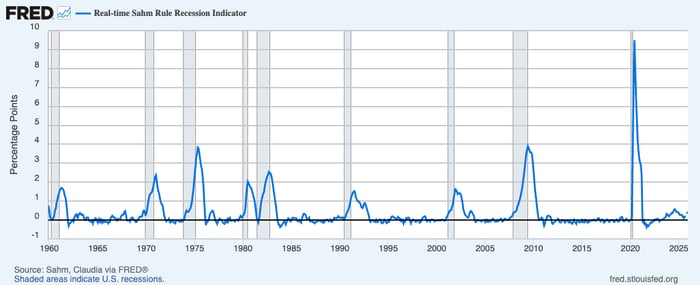
Image source: FRED.
Historically, the Sahm rule has in most cases, been triggered right at the beginning of a recession. Once that 0.5%-increase-over-12-months rule is triggered, the unemployment rate usually shoots much higher from there.
The Sahm rule just triggered again; investors should expect a recession
In July 2024, the Sahm rule was officially triggered when the unemployment rate rose by 0.54% over the previous 12-month window. In theory, that should have triggered a recession, but it hasn't. Yet.
If the Sahm rule is triggered without a recession, it would be the first time it's happened over the past six decades. But what we've seen over the past 12 to 18 months has been a slow and gradual deterioration in the jobs market, not a sudden one. If you take a look at 2025's non-farm payroll figures, the U.S. economy added just 181,000 jobs. In the big picture, that's nearly flat growth. And the unemployment rate has slightly ticked up over time.
I don't think there's any question the labor market is slowing. It's just happening at a much slower pace than it has in the past.
Are we headed toward a recession?
Perhaps slowly, but likely not yet.
GDP growth is strong enough and inflation is easing enough that it appears a recession isn't imminent. But we shouldn't ignore what the jobs market data is telling us, nor where the current economic trends are heading.
The fact that the Sahm rule already triggered once recently should serve as a warning. We're probably not through the storm yet.
Where to invest $1,000 right now
When our analyst team has a stock tip, it can pay to listen. After all, Stock Advisor’s total average return is 904%* — a market-crushing outperformance compared to 194% for the S&P 500.
They just revealed what they believe are the 10 best stocks for investors to buy right now, available when you join Stock Advisor.
See the stocks »
*Stock Advisor returns as of February 21, 2026.
The Motley Fool has a disclosure policy.
Recommended Articles


