


Lucid Group Is Trading Near Its Lows. Is It Finally Time to Buy?
Key Points
Lucid produced more than twice as many vehicles in 2025 as it did the year before.
An upcoming investor event will deliver key updates, including details on its mid-size SUV.
However, Lucid's deep-rooted financial issues could continue to keep the stock down.
- 10 stocks we like better than Lucid Group ›
It's been a struggle to hold Lucid Group (NASDAQ: LCID) over the past five years. The electric vehicle stock has lost almost all of its value -- 98% to be precise -- since it started trading in 2021.
But the company has strong financial backing from Saudi Arabia's sovereign wealth fund, and will begin manufacturing vehicles there this year. Lucid is also hosting an investor day in just a few weeks, where management will present updates on the company's technology and its upcoming mid-size vehicle model.
Where to invest $1,000 right now? Our analyst team just revealed what they believe are the 10 best stocks to buy right now, when you join Stock Advisor. See the stocks »
Is now finally the time to invest in Lucid stock?
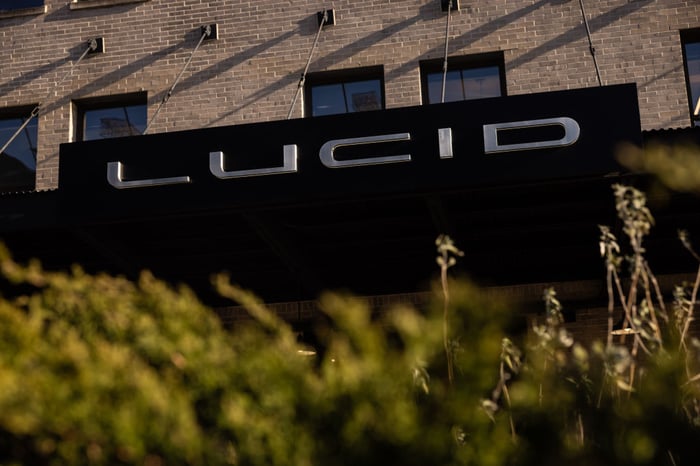
Image source: Getty Images.
Returning to growth, but cash flow problems remain
Lucid's fourth-quarter earnings wrapped up a solid 2025 on the sales front. Full-year vehicle production jumped 104% from last year to 18,378, and Lucid delivered (sold) 15,841, a 55% improvement over 2024. That's impressive growth at a time when federal EV tax credits expired, and the company still primarily caters to high earners with its premium Lucid Air and Lucid Gravity vehicles.
Investors will be looking to its mid-size SUV to carry that sales momentum forward. It's smaller than the Lucid Gravity and will have a lower price tag, starting at roughly $50,000. It's the same playbook Tesla used with the Model 3 to appeal to mainstream buyers and really solidify itself as a competitor in the automotive space.
The catch with Lucid remains its steep cash losses. Manufacturing vehicles is expensive, and factories cannot operate profitably without enough volume. Lucid just isn't there yet. The company has burned $3.4 billion over the past four quarters alone, on just over $1 billion in total revenue.
But can these positives breathe new life into the stock?
As much as the Model 3 was a game changer for Tesla, the company nearly imploded trying to launch it and scale production. It's worth emphasizing just how harsh the automotive industry is, given its ruthlessly competitive nature. Even Tesla has pivoted away from traditional electric vehicles to focus on autonomous Robotaxis and robotics.
Burning $3.4 billion on $1 billion in sales means that Lucid will likely continue to bleed cash as it works through its growth efforts. The company has continuously issued stock to raise funds, diluting existing shareholders and dragging down the stock price. The share count has risen by 90% since the stock began trading.
An expensive valuation has only made things worse. Even now, Lucid shares trade at over 15 times its revenue, while the top traditional automotive stocks trade at a fraction of that, often less than 1 times their sales. No, it's not time to buy Lucid stock. On the other hand, Lucid's valuation might cause the stock to fall further than it already has.
Should you buy stock in Lucid Group right now?
Before you buy stock in Lucid Group, consider this:
The Motley Fool Stock Advisor analyst team just identified what they believe are the 10 best stocks for investors to buy now… and Lucid Group wasn’t one of them. The 10 stocks that made the cut could produce monster returns in the coming years.
Consider when Netflix made this list on December 17, 2004... if you invested $1,000 at the time of our recommendation, you’d have $415,256!* Or when Nvidia made this list on April 15, 2005... if you invested $1,000 at the time of our recommendation, you’d have $1,151,865!*
Now, it’s worth noting Stock Advisor’s total average return is 892% — a market-crushing outperformance compared to 194% for the S&P 500. Don't miss the latest top 10 list, available with Stock Advisor, and join an investing community built by individual investors for individual investors.
See the 10 stocks »
*Stock Advisor returns as of February 20, 2026.
Justin Pope has no position in any of the stocks mentioned. The Motley Fool has positions in and recommends Tesla. The Motley Fool has a disclosure policy.
Recommended Articles


