


Sherwin-Williams' CEO Says Its "Magic Number" Is Coming. Are Shares a Buy?
Key Points
Sherwin-Williams' 13,470% run over 35 years shows that big profits can be made in the paint industry.
However, shares have been flat for a year amid what CEO Heidi Petz called "a very challenging environment."
Falling interest rates could bring on the "magic number" that jump-starts demand.
- 10 stocks we like better than Sherwin-Williams ›
In 1991, the paint-making company Sherwin-Williams (NYSE: SHW) was celebrating more than its 125th birthday. That year, profits climbed to $63 million on sales of $1.37 billion, securing Sherwin-Williams' place as one of the very few companies to dominate its industry for a century. Since then, profits have risen to $3.34 billion across all segments, a 5,200% rise. Capital appreciation naturally followed; since 1991, shares have returned 13,470%.
Over the last few decades, Sherwin-Williams has been one of the very best stocks on Wall Street to own. Yet its recent returns have been disappointing, with shares almost exactly flat over the last 12 months even as the S&P 500 returned 14%. The lag comes amid what CEO Heidi Petz acknowledged as a "very challenging environment" that she expected would persist at least throughout the first half of 2026.
Will AI create the world's first trillionaire? Our team just released a report on the one little-known company, called an "Indispensable Monopoly" providing the critical technology Nvidia and Intel both need. Continue »
This was six months ago, however. In the same earnings call, Petz also pointed to a "magic number" approaching that could bring back the company's momentum. Sure enough, shares have rallied 12% in 2026 so far, possibly in anticipation of this. While many companies cheer falling interest rates, there's one related number that Sherwin-Williams and every construction-involved company is more interested in: the 30-year fixed mortgage rate.
A 30-year fixed mortgage rate below 6% is a game-changer for Sherwin-Williams
Since the Federal Reserve began ramping up interest rates in mid-2022 to combat inflation, the 30-year fixed mortgage rate, or the most common mortgage loan option for U.S. homeowners, has risen from a pandemic-era low of 2.67% in December 2020 to as high as 7.79% in October 2023.

Image source: Getty Images.
This was the highest level seen since late 2000, and caused housing construction to fall despite a supply shortage, as potential new homeowners balked at the much higher monthly payments. This slowdown is a big deal for Sherwin-Williams since its North American architectural paint segment, known as Sherwin's Paint Stores Group, is its biggest and most profitable segment, accounting for nearly two-thirds of profits in 2023.
But as you can see below, the 30-year fixed mortgage rate has tumbled in recent months, and is tantalizingly close to the 6% level that Petz called the magic number for unleashing pent-up construction demand.
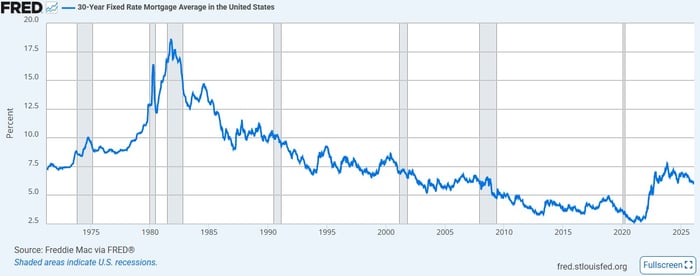
Image source: Freddie Mac via FRED®.
The fall comes amid three interest rate cuts from the Federal Reserve in 2025, with more expected by April or June. In May, President Donald Trump's nominee to chair the central bank, Kevin Warsh, is expected to be sworn in, and the likely new Fed Chair has signaled he will advocate for more cut rates. Traders are forecasting a 74% likelihood that the Fed cuts rates in June, possibly by a dramatic 75 basis points, which brings rates to the 2.75% to 3% range.
Of course, Wall Street knows this better than anyone, so Sherwin-Williams has already rallied 12% year to date amid these expectations. Given that, are shares a buy?
An 80% gain from a catalyst everyone saw coming
Falling rates will surprise no one, but then again, the Federal Reserve doesn't like to surprise markets. The last time it issued a rate cut unexpectedly was in March 2020, a special circumstance given the arrival of a once-in-a-century pandemic.
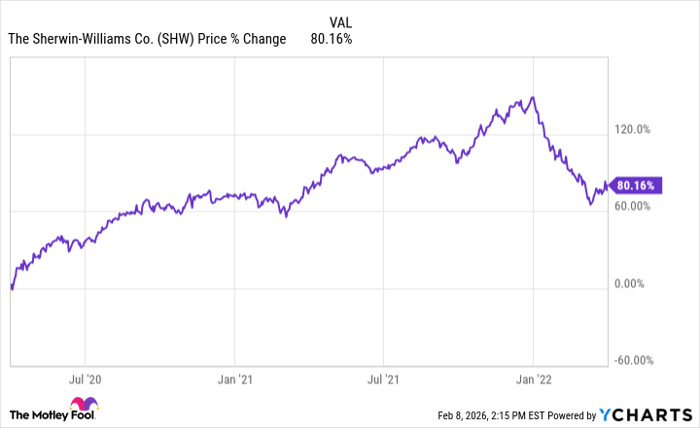
But while it clearly telegraphs its rate cuts in advance, Sherwin-Williams doesn't need this catalyst to be a surprise. Consider its 80% surge from April 1, 2020, to April 1, 2021, when it benefited from low rates that the Federal Reserve had begun implementing weeks before.
Data by YCharts.
Granted, rates won't fall that low anytime soon, but this shows that shares can rise from rate cuts that everyone knows are coming.
What if, for some reason, the Fed surprises in June and doesn't lower rates? Shares would likely fall, as traders price in the "challenging environment" stretching on at least a few months longer. That said, Sherwin-Williams has delivered some surprises of its own lately, with sales growth beating analysts' expectations in each of the last four quarters. The company recently raised its dividend for the 47th year running, issuing a hearty 10.5% increase that puts the company on the cusp of Dividend King status, a milestone very few companies achieve. This all signals a resilient company whose days of underperformance are numbered. For investors seeking growth and income, Sherwin-Williams is a buy.
Should you buy stock in Sherwin-Williams right now?
Before you buy stock in Sherwin-Williams, consider this:
The Motley Fool Stock Advisor analyst team just identified what they believe are the 10 best stocks for investors to buy now… and Sherwin-Williams wasn’t one of them. The 10 stocks that made the cut could produce monster returns in the coming years.
Consider when Netflix made this list on December 17, 2004... if you invested $1,000 at the time of our recommendation, you’d have $439,362!* Or when Nvidia made this list on April 15, 2005... if you invested $1,000 at the time of our recommendation, you’d have $1,164,984!*
Now, it’s worth noting Stock Advisor’s total average return is 918% — a market-crushing outperformance compared to 196% for the S&P 500. Don't miss the latest top 10 list, available with Stock Advisor, and join an investing community built by individual investors for individual investors.
See the 10 stocks »
*Stock Advisor returns as of February 11, 2026.
William Dahl has no position in any of the stocks mentioned. The Motley Fool recommends Sherwin-Williams. The Motley Fool has a disclosure policy.
Recommended Articles


