


I Predicted Tesla Would Be Unprofitable. I Was Dead Wrong. Here's How Elon Musk Surprised Me.
Key Points
I predicted Tesla would post an unprofitable Q4, but although profits declined 61%, the company still made money.
Automotive revenue came in better than I expected, and margins actually improved instead of shrinking.
Capital expenses haven't yet ramped up, but they're expected to explode this year.
- These 10 stocks could mint the next wave of millionaires ›
Back in December, I crunched some numbers and predicted that Elon Musk would be forced to admit that his flagship company, Tesla (NASDAQ: TSLA), was already unprofitable in fourth-quarter 2025. The evidence seemed compelling, and the math looked bleak.
As everyone now knows, of course, I was dead wrong.
Where to invest $1,000 right now? Our analyst team just revealed what they believe are the 10 best stocks to buy right now, when you join Stock Advisor. See the stocks »
True, Tesla did post its first-ever year-over-year revenue decline, and generally accepted accounting principles (GAAP) net income was down 61%, but even an $840 million profit is still a profit. That's because of a couple of key surprises Musk had up his sleeve. Here's how Tesla beat my prediction...for now.
Image source: Tesla.
Tesla's sales held (mostly) steady
Unlike many automakers, Tesla doesn't release monthly vehicle sales numbers, so I didn't have any Tesla Q4 sales numbers to go on when I made my prediction in December. But other automakers, like Ford and Honda, had released monthly figures from October and November -- after the U.S. electric vehicle tax credits expired -- and they were dreadful, with sales down as much as 88.6%.
Based on these numbers, I predicted Tesla would see a comparatively modest 50% year-over-year (YOY) drop in sales to $9.9 billion. I estimated its other business units would bring in $8 billion, for a total of $17.9 billion in quarterly revenue.
But Tesla's vehicle deliveries dropped by only 15.6% YOY in Q4 to 418,227. That's not only industry-leading, it's amazing! Even more astonishing, Tesla's Q4 automotive revenue fell by only 11% YOY to $17.7 billion. In percentage terms, that's the lowest drop of any U.S. electric vehicle (EV) maker by far. With revenue from the other business units, Tesla's total Q4 revenue was $24.9 billion, down a mere 3% from Q4 2024.
Image source: Tesla.
I'm still not sure how Musk pulled this off. On the earnings call, the company cited "an increase in demand leading to record deliveries in smaller countries like Malaysia, Norway, Poland, Saudi Arabia, and Taiwan" and the Asia-Pacific region as a whole, along with "continued strength" in the Europe/Middle East/Africa region. Given the intense competition Tesla faces from Chinese rivals and the small size of some of these car markets, I wouldn't have thought that Asia-Pacific sales would boost overall revenue by so much, but perhaps I was wrong about that, too.
Marginal improvement
To help make up for the loss of the $7,500 US tax credit, Tesla debuted newer standard versions of its Model 3 and Model Y in Q4, which cost $5,000 less than their original versions. I thought -- as did many others -- that these would be lower-margin products that would compress Tesla's margins. But instead, Tesla's gross profit margin actually rose by 2 percentage points over Q3 to 20%.
On the earnings call, management said that automotive (gross) margins improved sequentially from 15.4% in Q3 to 17.9% in Q4. That more than offset margin declines in energy generation and storage (from 42% to 40%) and the services and other segment (from 10.5% to 8.8%) to yield $5 billion in gross profit, higher than the $3 billion I was expecting.
So, it looks like Tesla is actually making more profits from its cheaper standard models, which is great news for the business! However, the company warned of margin compression in all three of its business segments later this year, so this may be a high-water mark.
Modest expenses...for now
The last thing I got wrong in my calculation was thinking that Musk would start ramping up research and development (R&D) spending on the Robotaxi and Optimus product lines immediately. (After all, he has a $1 trillion deadline to meet!) In reality, though, Tesla's Q4 capital expenditures (capex) increased by only $145 million over Q3 and actually declined 14% YOY.
That apparently won't last. On the earnings call, Musk flat-out stated that 2026 "is going to be a very big CapEx year." CFO Vaibhav Taneja pegged the total 2026 capex spend as "more than $20 billion." That's much, much higher than both 2025's total capex spending of $8.5 billion and Tesla's current record 2024 capex spend of $11.3 billion. The money will be used on starting production at six factories, scaling up the Optimus humanoid robot project, building AI compute infrastructure, and expanding capacity at existing factories, among other things.
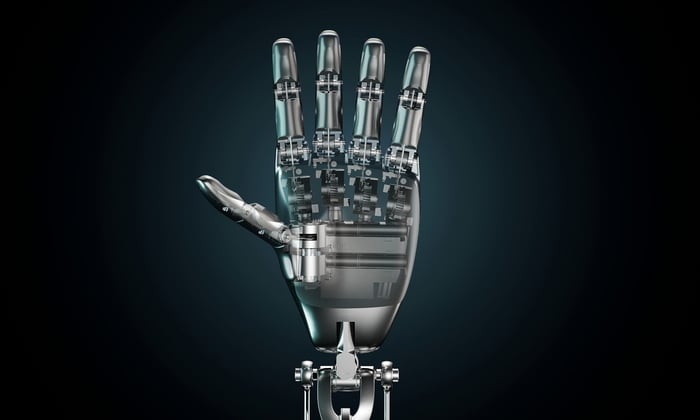
Image source: Tesla.
So, it turns out that maybe I wasn't exactly wrong about Tesla's impending unprofitability, just early to the party. Because if Musk and Taneja's 2026 projections are correct, and margins shrink across the board while capex more than doubles, and automotive sales continue their modest declines, Tesla really will be unprofitable within the year. And that's my updated prediction for 2026.
Don’t miss this second chance at a potentially lucrative opportunity
Ever feel like you missed the boat in buying the most successful stocks? Then you’ll want to hear this.
On rare occasions, our expert team of analysts issues a “Double Down” stock recommendation for companies that they think are about to pop. If you’re worried you’ve already missed your chance to invest, now is the best time to buy before it’s too late. And the numbers speak for themselves:
- Nvidia: if you invested $1,000 when we doubled down in 2009, you’d have $492,911!*
- Apple: if you invested $1,000 when we doubled down in 2008, you’d have $52,292!*
- Netflix: if you invested $1,000 when we doubled down in 2004, you’d have $439,362!*
Right now, we’re issuing “Double Down” alerts for three incredible companies, available when you join Stock Advisor, and there may not be another chance like this anytime soon.
See the 3 stocks »
*Stock Advisor returns as of February 11, 2026.
John Bromels has positions in Ford Motor Company and Tesla. The Motley Fool has positions in and recommends Tesla. The Motley Fool has a disclosure policy.
Recommended Articles


