

Will REITs be a Smart Investment in 2026?
Key Points
Higher interest rates over the past few years have weighed on REIT share prices.
Rates could continue falling in 2026.
Higher-yielding REITs would benefit from lower rates.
- 10 stocks we like better than Realty Income ›
Real estate investment trusts (REITs) are having a down year in 2025. The S&P U.S. REIT Index has declined by nearly 5% year-to-date. That continues the lackluster performance of the REIT sector in recent years.
While the sector has performed poorly in the short term, data from The Motley Fool shows that REITs have outperformed stocks over the long term. Here's a look at whether REITs will be a smart investment in the new year.
Where to invest $1,000 right now? Our analyst team just revealed what they believe are the 10 best stocks to buy right now. Continue »

Image source: Getty Images.
A look at what has been weighing on REIT returns
Interest rates have a considerable impact on the commercial real estate industry. Higher interest rates weigh on property values and increase borrowing costs. Additionally, they make the higher dividend yields typically offered by REITs less attractive to income-seeking investors compared to lower-risk, fixed-income securities such as bonds and CDs. As a result, REIT stock prices fall, causing their yields to rise to compensate investors for the relatively higher risk profiles of these investments.
We can see this correlation on the following chart comparing changes in the Federal Funds Rate to the returns of the S&P U.S. REIT Index over the past five years:
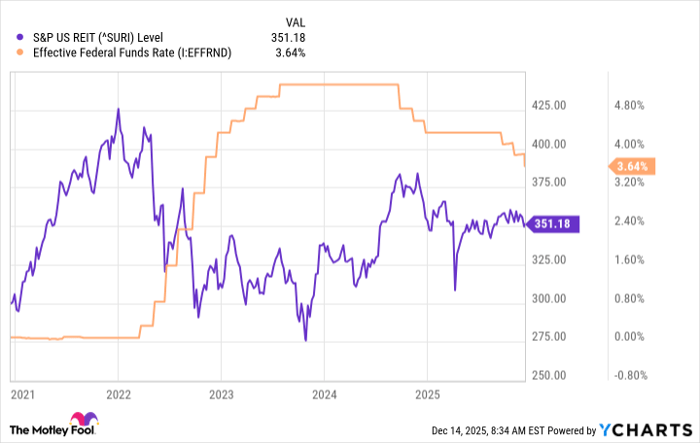
^SURI data by YCharts
As that chart shows, REIT share prices rose sharply in 2021 when rates were near zero. Values declined in 2022 and remained low through much of 2024 as rates surged. REIT returns have started to improve as rates began to fall last year.
The outlook for interest rates in 2026
The Federal Reserve recently lowered its target rate by 0.25% to a range of 3.5%-3.75%, its third cut of the year. The Fed's current projection is that it will make another quarter-point cut next year.
However, investors expect that it will reduce rates at least twice. Meanwhile, President Trump wants the Fed to lower rates even more. His stated target is to have them below 1% next year. With current Fed Chairman Jerome Powell's term expiring in May 2026, the President will likely appoint a new Fed Chair who is more open to additional rate cuts. If that happens, it could serve as a catalyst to boost REIT values in 2026.
These REITs could get the biggest boost from lower rates
With interest rates potentially poised to continue falling in 2026, REITs with higher-yielding dividends are likely to reap the greatest benefit. Their valuations could rise more than REITs with lower relative yields, enabling investors to earn higher total returns.
Many REITs focused on investing in real estate backed by long-term, triple net leases (NNN) have above-average dividend yields these days. For example, while the average dividend yield across the REIT sector is around 4% (nearly four times the S&P 500's dividend yield), many net lease REITs have yields above 5.5%.
VICI Properties (NYSE: VICI), a REIT focused on investing in casinos and other experiential real estate secured by NNN leases, currently yields 6.3%. The company has grown its payout at a peer-leading 6.6% compound annual rate over the past seven years, nearly triple the average of other NNN REITs (2.3% average). VICI Properties has been able to find attractive real estate investment opportunities despite the impact of higher rates. It recently secured a $1.2 billion sale-leaseback transaction to buy seven gaming assets across Nevada in a deal that will immediately boost its earnings upon closing. The company was able to structure the transaction to avoid relying on the capital markets for funding by issuing shares directly to the seller. While it has been able to continue growing despite the impact of interest rates, lower rates in 2026 would make it much easier for the REIT to expand its portfolio and increase its dividend payment.
Realty Income (NYSE: O), a diversified net lease REIT that pays a monthly dividend, currently yields 5.6%. Its diversification has provided it with the flexibility to invest where it sees the best opportunities in the current market. For example, it invested $1.4 billion in real estate during the third quarter, including $1 billion in Europe, as these deals offered a higher initial average cash yield of 8% compared to the 7% yield on U.S. investments. Realty Income's diversification has enabled it to continue increasing its dividend, which it has now done 133 times since its public market listing in 1994. While the financially strong REIT can continue growing in 2026 even if rates don't fall, lower rates would enable it to buy even more properties and grow at a higher rate in the coming year.
REITs could be smart investments in 2026
REITs have proven to be excellent long-term investments. While they've underperformed more recently due to higher rates, that headwind could fade in 2026 if Trump gets his way. Meaningfully lower rates would likely lift the entire REIT sector, especially those with higher yields, such as VICI Properties and Realty Income. That makes them look like smart investments in 2026.
Should you invest $1,000 in Realty Income right now?
Before you buy stock in Realty Income, consider this:
The Motley Fool Stock Advisor analyst team just identified what they believe are the 10 best stocks for investors to buy now… and Realty Income wasn’t one of them. The 10 stocks that made the cut could produce monster returns in the coming years.
Consider when Netflix made this list on December 17, 2004... if you invested $1,000 at the time of our recommendation, you’d have $513,353!* Or when Nvidia made this list on April 15, 2005... if you invested $1,000 at the time of our recommendation, you’d have $1,072,908!*
Now, it’s worth noting Stock Advisor’s total average return is 965% — a market-crushing outperformance compared to 193% for the S&P 500. Don’t miss out on the latest top 10 list, available when you join Stock Advisor.
See the 10 stocks »
*Stock Advisor returns as of December 15, 2025
Matt DiLallo has positions in Realty Income and Vici Properties. The Motley Fool has positions in and recommends Realty Income. The Motley Fool recommends Vici Properties. The Motley Fool has a disclosure policy.
Recommended Articles


