


Has DKNG Stock Been Good for Investors?
Key Points
2025 guidance revisions didn't impress.
Some of the slide is attributable to sheer bad luck.
The betting company is taking steps to address some investor concerns.
- 10 stocks we like better than DraftKings ›
One of the great things about investing is that results are cut-and-dry. When it comes to stocks, market participants are either winning or losing. That makes it easy to answer questions such as "Has such and such stock been good for investors?"
In the case of DraftKings (NASDAQ: DKNG), the answer to that question is a resounding no. Confirming that sin stocks aren't guaranteed to deliver saintly returns, DraftKings shed 36.95% over the past five years. Put simply, it has been a value destroyer, not a creator of upside for shareholders.
Where to invest $1,000 right now? Our analyst team just revealed what they believe are the 10 best stocks to buy right now. Continue »

This betting stock has been a dud, but the company can turn things around. Image source: Getty Images.
Making matters worse, that slump has occurred against an expansionary backdrop for the U.S. sports wagering industry. Today, some form of sports betting is legal in 39 states, Puerto Rico, and Washington, D.C. That's driving revenue growth. Last year, the domestic sports betting industry notched sales of $13.71 billion, up from $11.04 billion in 2023. Handle -- the total amount bet on sports -- is expected to reach $172.55 billion this year, up from $113.85 billion in 2023.
Per the efficient market hypothesis, it'd be reasonable to assume that DraftKings stock priced in those and other bullish factors, leading to some upside over the past several years. At the very least, it'd be fair to guess that this stock wasn't going to tumble 37% amid obvious industry growth. So where did DraftKings go wrong, and can it find ways to cobble together long-term gains? Let's answer those questions.
A confluence of factors made this stock a sour bet
Understanding DraftKings' multiyear tale of woe isn't difficult. It has some flawed fundamentals, including slowing revenue growth and a consistent string of posting operating losses. Those problems were on display in the third quarter when the company reported revenue well below Wall Street forecasts and a per-share loss that was wider than expected, leading to a downward revision of annual guidance.
Part of the problem boils down to another bout with bettor-friendly outcomes on the NFL, a scenario that plagued DraftKings and its peers during the 2024 football season. Translation: Bettors don't lose 100% of the time, and they're into two straight football seasons of pinching DraftKings' bottom line. Worse yet for investors holding betting stocks is that situations like that aren't confined to football. For example, favorites won at an 82% rate during the NCAA Tournament, also known as March Madness, earlier this year. That's bad for companies like DraftKings because recreational bettors -- DraftKings' core clientele -- typically wager on favorites more than underdogs.
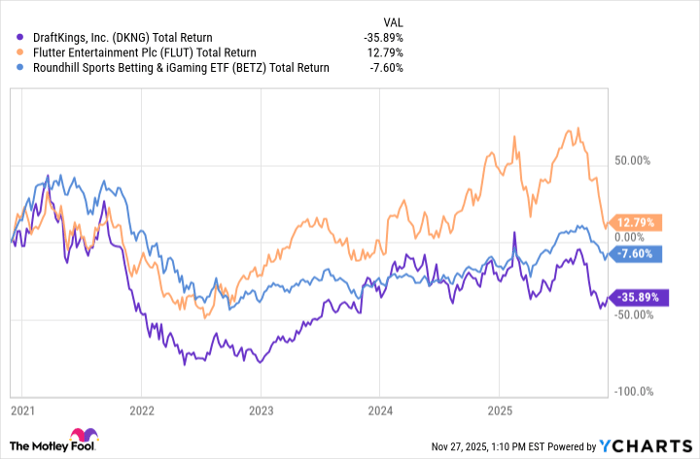
DKNG Total Return Level data by YCharts
Second, DraftKings and its peers have been stung by a hostile tax environment. States know that residents are betting on sports in growing numbers, and lawmakers want more of that cash for state coffers. Since the start of 2024, seven sports betting tax increases have been unveiled in six states, with Illinois accounting for two.
In 2024, the Land of Lincoln moved to a graduated sports betting tax scheme under which the largest operators by market share -- namely DraftKings and Flutter Entertainment's FanDuel -- pay higher rates than rivals. This year, the state launched a per-bet tax of $0.25 on the first 20 million bets booked by gaming companies, doubling to $0.50 for each wager after. Bottom line: Sports betting companies are grappling with taxation issues, and that means more money going out the door.
Predicting a rebound
The emergence of prediction markets has been a drag on DraftKings this year, too, but what has been a curse could become a gift for the gaming company. For starters, the prevailing sentiment among sell-side analysts is that DraftKings has been punished too harshly by various prediction markets headlines. They note that DraftKings and its rivals maintain superior sports wagering menus relative to event contracts like we see in prediction markets -- exchanges where bettors and traders buy and sell event contracts that are resolved in yes/no fashion.
DraftKings Predictions, the company's competitor to Kalshi and Polymarket, is expected to launch in the coming months. That confirms the operator sees opportunity in prediction markets. Some analysts see the same. Macquarie forecasts a $5 billion total addressable market in U.S. prediction markets for DraftKings and FanDuel with $4.4 billion of that attributable to sports event contracts. The research firm says that could drive $176 million in earnings before interest, taxes, depreciation, and amortization (EBITDA) for DraftKings three years out.
Prediction markets also buffer against potential sports betting cannibalization while getting companies like DraftKings into states where sports betting isn't yet legal, including the big kahunas of California and Texas.
No, event contracts aren't a magical elixir for all of DraftKings' problems, but if the company executes on this front, proving to investors it's taking share from Kalshi and doing so profitably, those could be tailwinds for a multiyear run of upside, not a sequel to the past five years of disappointment.
Should you invest $1,000 in DraftKings right now?
Before you buy stock in DraftKings, consider this:
The Motley Fool Stock Advisor analyst team just identified what they believe are the 10 best stocks for investors to buy now… and DraftKings wasn’t one of them. The 10 stocks that made the cut could produce monster returns in the coming years.
Consider when Netflix made this list on December 17, 2004... if you invested $1,000 at the time of our recommendation, you’d have $560,649!* Or when Nvidia made this list on April 15, 2005... if you invested $1,000 at the time of our recommendation, you’d have $1,100,862!*
Now, it’s worth noting Stock Advisor’s total average return is 998% — a market-crushing outperformance compared to 194% for the S&P 500. Don’t miss out on the latest top 10 list, available when you join Stock Advisor.
See the 10 stocks »
*Stock Advisor returns as of December 1, 2025
Todd Shriber has no position in any of the stocks mentioned. The Motley Fool has no position in any of the stocks mentioned. The Motley Fool has a disclosure policy.
Recommended Articles


