

Crypto AI investors dump $2.5B as China retaliates to Trump trade war with NVIDIA, Google probe

Source Fxstreet
  • The Crypto AI sector plunged 8.5%, shedding over $2.5 billion on Tuesday in reaction to the aftershocks of the U.S.-China trade war.
  • China has revived antitrust investigations into U.S. tech giants Google and NVIDIA following a 10% ]\tariff imposed by the Trump administration.
  • NEAR, Ai16z, and Bittensor were among the biggest losers on the day.

AI Crypto Sector Crashes as China Revives U.S. Tech Antitrust Probe

The artificial intelligence (AI) cryptocurrency sector nosedived on Tuesday, posting an 8.5% decline that wiped out more than $2.5 billion in market capitalization.

The sell-off came in response to escalating tensions between the United States and China, triggered by the Trump administration's aggressive tariff policies.

Technical indicators suggest that major AI crypto assets like NEAR, Ai16z, and Bittensor could experience heightened volatility in the coming days.

China’s renewed antitrust scrutiny on major U.S. technology firms, including Google and NVIDIA, has sparked investor anxiety. 

According to local reports, Chinese regulators have reopened investigations into Google and NVIDIA and are reportedly considering a broader probe into Intel.

This move appears to be a calculated response to the Trump administration’s tariff escalation.

“The tech investigations may be part of the retaliatory measures made by China in response to Trump’s new tariffs against the country” 
-  Liu Xu, Researcher, National Strategy Institute of Tsinghua University, China. 

Trump’s Trade War Spells Trouble for AI Crypto Markets

The Trump administration has doubled down on its hardline trade policies, imposing a 10% tariffs on Chinese imports while briefly threatening similar measures against Canada and Mexico.

Initially, the administration’s stance on cryptocurrency appeared promising, with Trump-linked entities such as WLFI making strategic crypto investments and his official campaign embracing the $TRUMP token.

However, recent trade policy shifts have sent shockwaves through global financial markets, with AI-focused blockchain projects taking a direct hit.

The latest U.S. tariffs include a 10% import tax on Chinese semiconductor components, a move that has disrupted the supply chains of major AI firms reliant on NVIDIA’s GPU hardware.

Beijing’s counterstrike—a retaliatory 15% tariff on select U.S. imports—escalated concerns over prolonged trade hostilities. The situation deteriorated further after reports surfaced of China leveraging legal action against U.S. tech giants to gain an upper hand in negotiations.

Crypto AI sector sheds $2.5 bllion as China probes NVIDIA

China’s decision to relaunch its antitrust investigation into NVIDIA sent ripples through AI-related cryptocurrencies, with the sector losing approximately $2.5 billion in daily trading volume.

According to Coingecko, AI crypto projects integrating blockchain with machine learning tools suffered significant losses, with NEAR, Bittensor, and Ai16z among the worst performers.

The sector’s total market cap tumbled to $29.2 billion, marking one of the sharpest daily contractions in recent months.
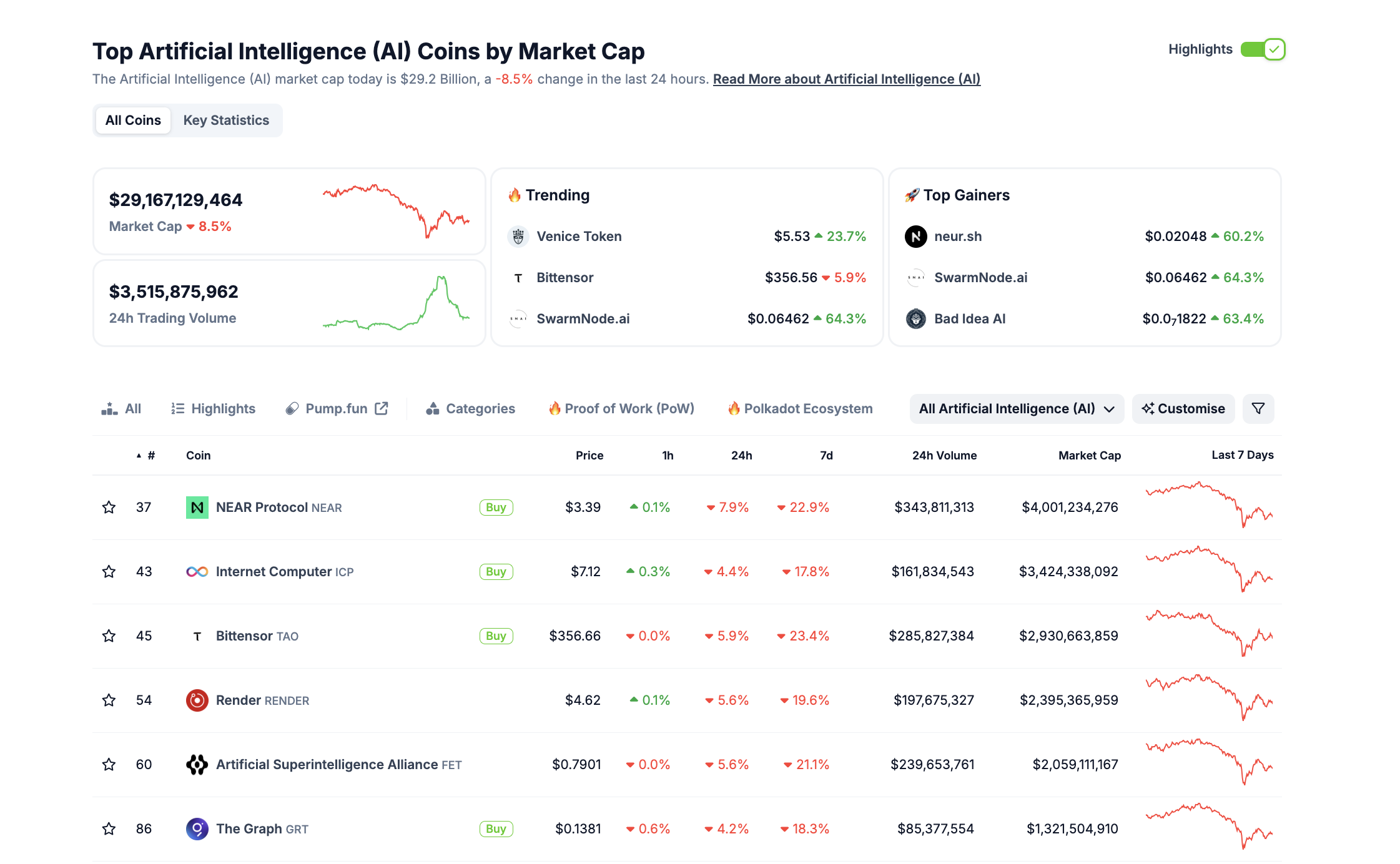
Crypto AI Sector Performance | Source: CoingeckoCrypto AI Sector Performance | Source: Coingecko

NEAR, the largest project in the AI crypto space by market capitalization, dropped 7.9% on the day, aligning with the broader sector downturn.

Meanwhile, Bittensor’s TAO token, which had seen a strong rally last week on growing optimism around decentralized AI solutions, declined by 5.9%.

Analysts attribute this drop to fears that an extended regulatory battle involving NVIDIA could slow AI hardware production, impacting blockchain projects dependent on high-performance computing.

Ai16z, one of the leading AI agent tokens, emerged as the biggest loser of the day, plummeting 13%—far exceeding the sector’s average decline of 8.5%. The sell-off reflects growing investor unease over China’s crackdown on foreign AI firms and its potential repercussions for blockchain-based AI projects.

Outlook: More volatility ahead if China vs. US Trade war escalates

The AI crypto sector remains on shaky ground as global trade tensions mount. Investors fear that if China’s investigation into NVIDIA results in severe penalties, it could set off a chain reaction affecting AI infrastructure development.

Beyond that, a prolonged legal battle could also deter institutional capital from flowing into AI-driven blockchain projects.

If China expands its crackdown to other U.S. chipmakers such as Intel or Qualcomm, the sector could face even steeper losses. In contrast, if diplomatic negotiations ease trade tensions, AI crypto assets could recover swiftly.

For now, traders are bracing for heightened volatility as the sector navigates the uncertain geopolitical landscape. AI crypto remains one of the most promising sectors in blockchain, but the latest developments highlight the risks associated with global regulatory uncertainty.

Investors will be watching closely for any policy shifts from Washington or Beijing that could determine the sector’s next move.
 

Disclaimer: For information purposes only. Past performance is not indicative of future results.
placeholder
U.S. November Nonfarm Payrolls: What Does the Rare "Weak Jobs, Strong Economy" Mix Mean for U.S. Equities?1. IntroductionAfter retreating from the late-October highs, U.S. equities embarked on a bottoming rebound in mid-to-late November, a trend driven by the interplay of multiple factors. That said, it i
Author  TradingKey
13 hours ago
1. IntroductionAfter retreating from the late-October highs, U.S. equities embarked on a bottoming rebound in mid-to-late November, a trend driven by the interplay of multiple factors. That said, it i
placeholder
Senate Delays Crypto Market Structure Hearings to Early 2026The Senate Banking Committee has postponed cryptocurrency market structure hearings until 2026, citing ongoing bipartisan negotiations.
Author  Mitrade
17 hours ago
The Senate Banking Committee has postponed cryptocurrency market structure hearings until 2026, citing ongoing bipartisan negotiations.
placeholder
Bitcoin Slides 5% as Sellers Lean In — Can BTC Reclaim $88,000?Bitcoin has dropped back below $88,000 after rolling over from $90,500, with price still trading under the 100-hour Simple Moving Average. The sell-off found a floor at $85,151, and BTC is now consolidating near that base, but rebounds are facing pressure from a bearish trend line around $89,000. Bulls need to retake $88,000–$89,000 to ease downside risk; failure to do so keeps $85,500–$85,000 and then $83,500 in play, with $80,000 as the deeper “line in the sand.” Bitcoin (BTC) is back in damage-control mode after a sharp pullback wiped out recent gains. The price failed to reclaim the $90,000–$90,500 band, rolled over, and slid through $88,500 before briefly dipping under $87,000. Buyers did show up around $85,000, but the rebound so far looks more like stabilization than a clear trend reversal. Bitcoin dips hard, finds a bid near $85,000(h3) BTC’s latest move lower began when it couldn’t build follow-through above $90,000 and $90,500. Once that upside stalled, sellers took control and pushed price down through $88,500. The slide accelerated enough to spike below $87,000, but the market didn’t free-fall. Bulls defended the $85,000 zone, printing a low at $85,151. Since then, Bitcoin has been consolidating below the 23.6% Fibonacci retracement of the drop from the $93,560 swing high to the $85,151 low — a clue that the bounce is still shallow and that sellers haven’t fully backed off yet. Structurally, BTC is still on the back foot: It’s trading below $88,000, and It remains below the 100-hour Simple Moving Average, keeping short-term trend pressure pointed downward. Resistance is layered, and $89,000 is the problem area(h3) If bulls try to turn this into a recovery, they’ll have to climb through multiple ceilings in quick succession. First, BTC faces resistance around $87,150, followed by a more meaningful barrier near $87,500. From there, the market’s attention snaps back to $88,000 — the level BTC just lost and now needs to reclaim. A close back above $88,000 would improve the tone, but it doesn’t solve the bigger issue: there’s a bearish trend line on the hourly BTC/USD chart (Kraken feed) with resistance near $89,000, which also lines up with the next technical hurdle. If BTC can push through $89,000 and hold, the rebound could extend toward $90,000, with follow-through targets at $91,000 and $91,500. But until price clears that $88,000–$89,000 zone, rallies are at risk of being sold rather than chased. If BTC fails to reclaim resistance, the downside path is clear(h3) The near-term bear case is simple: if Bitcoin can’t climb back above the $87,000 area and keep traction, sellers may attempt another leg lower. Support levels line up like this: Immediate support: $85,500 First major support: $85,000 Next support: $83,500 Then $82,500 in the near term Below that, the major “don’t break this” level is still $80,000. If BTC slips under $80,000, the risk of acceleration to the downside increases significantly — not because it’s magic, but because it’s the kind of psychological and structural level that tends to trigger forced de-risking. Indicators: momentum still leans bearish(h3) The intraday indicators aren’t offering much comfort yet: Hourly MACD is losing pace in the bearish zone. Hourly RSI remains below 50, suggesting sellers still have the upper hand on short timeframes. So while the $85,000 defense held for now, the market hasn’t flipped bullish — it’s just stopped bleeding.
Author  Mitrade
20 hours ago
Bitcoin has dropped back below $88,000 after rolling over from $90,500, with price still trading under the 100-hour Simple Moving Average. The sell-off found a floor at $85,151, and BTC is now consolidating near that base, but rebounds are facing pressure from a bearish trend line around $89,000. Bulls need to retake $88,000–$89,000 to ease downside risk; failure to do so keeps $85,500–$85,000 and then $83,500 in play, with $80,000 as the deeper “line in the sand.” Bitcoin (BTC) is back in damage-control mode after a sharp pullback wiped out recent gains. The price failed to reclaim the $90,000–$90,500 band, rolled over, and slid through $88,500 before briefly dipping under $87,000. Buyers did show up around $85,000, but the rebound so far looks more like stabilization than a clear trend reversal. Bitcoin dips hard, finds a bid near $85,000(h3) BTC’s latest move lower began when it couldn’t build follow-through above $90,000 and $90,500. Once that upside stalled, sellers took control and pushed price down through $88,500. The slide accelerated enough to spike below $87,000, but the market didn’t free-fall. Bulls defended the $85,000 zone, printing a low at $85,151. Since then, Bitcoin has been consolidating below the 23.6% Fibonacci retracement of the drop from the $93,560 swing high to the $85,151 low — a clue that the bounce is still shallow and that sellers haven’t fully backed off yet. Structurally, BTC is still on the back foot: It’s trading below $88,000, and It remains below the 100-hour Simple Moving Average, keeping short-term trend pressure pointed downward. Resistance is layered, and $89,000 is the problem area(h3) If bulls try to turn this into a recovery, they’ll have to climb through multiple ceilings in quick succession. First, BTC faces resistance around $87,150, followed by a more meaningful barrier near $87,500. From there, the market’s attention snaps back to $88,000 — the level BTC just lost and now needs to reclaim. A close back above $88,000 would improve the tone, but it doesn’t solve the bigger issue: there’s a bearish trend line on the hourly BTC/USD chart (Kraken feed) with resistance near $89,000, which also lines up with the next technical hurdle. If BTC can push through $89,000 and hold, the rebound could extend toward $90,000, with follow-through targets at $91,000 and $91,500. But until price clears that $88,000–$89,000 zone, rallies are at risk of being sold rather than chased. If BTC fails to reclaim resistance, the downside path is clear(h3) The near-term bear case is simple: if Bitcoin can’t climb back above the $87,000 area and keep traction, sellers may attempt another leg lower. Support levels line up like this: Immediate support: $85,500 First major support: $85,000 Next support: $83,500 Then $82,500 in the near term Below that, the major “don’t break this” level is still $80,000. If BTC slips under $80,000, the risk of acceleration to the downside increases significantly — not because it’s magic, but because it’s the kind of psychological and structural level that tends to trigger forced de-risking. Indicators: momentum still leans bearish(h3) The intraday indicators aren’t offering much comfort yet: Hourly MACD is losing pace in the bearish zone. Hourly RSI remains below 50, suggesting sellers still have the upper hand on short timeframes. So while the $85,000 defense held for now, the market hasn’t flipped bullish — it’s just stopped bleeding.
placeholder
AUD/USD remains depressed below mid-0.6600s; downside seems limited ahead of US NFP reportThe AUD/USD pair attracts some sellers for the fourth straight day on Tuesday and trades around the 0.6630 region, down just over 0.10%, during the Asian session.
Author  FXStreet
22 hours ago
The AUD/USD pair attracts some sellers for the fourth straight day on Tuesday and trades around the 0.6630 region, down just over 0.10%, during the Asian session.
placeholder
Macro Analysts: Hawkish Japan Could Push Bitcoin Below $70KAnalysts predict Bitcoin may face further declines towards the $70,000 mark if the Bank of Japan raises interest rates as expected.
Author  Mitrade
Yesterday 05: 48
Analysts predict Bitcoin may face further declines towards the $70,000 mark if the Bank of Japan raises interest rates as expected.
goTop
quote