

Can Dogecoin Realistically Reach $3? Analyst Weighs In

Source Newsbtc

In a broadcast on X, independent market analyst Kevin (@Kev_Capital_TA) dissected the perennial retail question that resurfaces every bull cycle: can Dogecoin plausibly climb to the psychologically charged level of $3 per coin?

From the outset Kevin resisted the audience’s invitation to dispense the kind of sensationalist price targets that animate algorithm-curated social feeds. “Can it? Yeah, it can,” he acknowledged, before striking the cautionary tone that would frame the rest of the discussion:

“It’s really hard to say. I know that the popular thing to do, and it’ll probably get me more clicks and more engagement, is to create altcoin price prediction videos, but the reality is I don’t want to do that, because it’s impossible to do.”

How Dogecoin Could Reach $3

Kevin anchored his argument in macro fundamentals rather than chart-pattern wish-casting. If the Federal Reserve executes the dual rate cuts he expects in June and July — “there’s definitely rate cuts coming,” he asserted — and if loose monetary conditions send Bitcoin into the $220,000 to $250,000 range, then, in his view, “Doge can get to there.”

By “there,” Kevin was referring not merely to a return to the 2021 all-time high of roughly $0.74, but potentially to a Fibonacci-extension level frequently eyed by technical traders. “Dogecoin has hit in both cycles the 1.618 fib. The 1.618 fib is at $3.94,” he reminded listeners, adding that the level has a “100 percent hit rate of being hit in each bull market.”

Yet the analyst was equally emphatic that the inverse scenario — a tamer Bitcoin advance to the $120,000 to $130,000 area amid restrained policy easing — would cap Dogecoin near “previous all-time highs or $1.” The takeaway, Kevin insisted, is that alt-coins “are oscillators to Bitcoin [and] to monetary policy,” and that any deterministic forecast detached from macro conditions is a “fake answer.”

For market participants hoping to time an exit, Kevin advocated a sentiment-driven framework instead of fixating on absolute price points. “When sentiment gets into a euphoric stage and you have indicators on higher time frames super-overheated, you need to be taking profits.” He pointed to December 2024, when he reportedly trimmed spot holdings at $0.40, as an object lesson in disciplined risk reduction.

Asked whether a $3 print would defy historical precedent, Kevin invoked pattern repetition rather than probability theory. “To deny that it can happen would be stupid,” he said, but reiterated that the market will ultimately adjudicate. “My philosophy… is you track it as it comes.”

The Federal Open Market Committee’s next meeting on 12 June could provide the first empirical test of the rate-cut thesis underpinning the bullish-case scenario. Until then, traders eyeing a parabolic move in Dogecoin may find themselves tethered less to price targets than to the shifting tides of monetary policy, Bitcoin dominance and retail sentiment — the very trifecta Kevin argues will dictate whether the most famous Shiba Inu in finance can make the leap from cents to dollars.

At press time, DOGE traded at $0.17993.
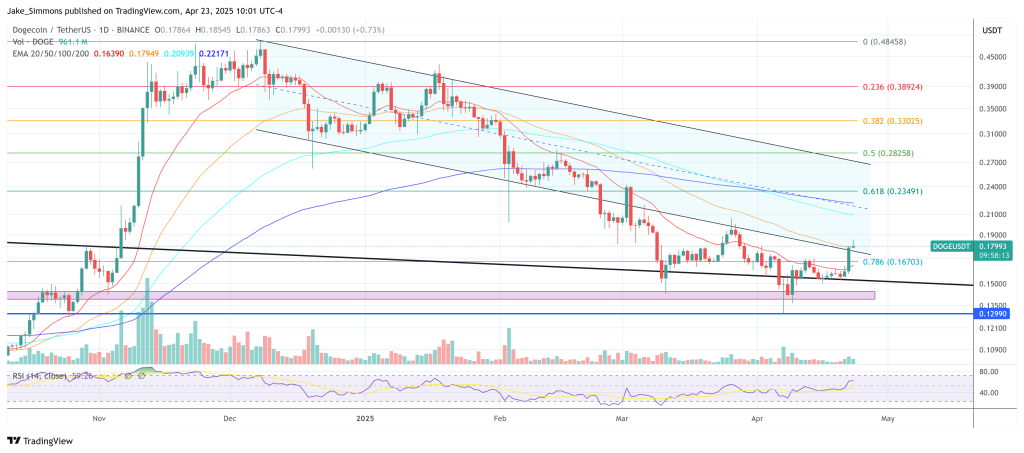
Dogecoin price
Disclaimer: For information purposes only. Past performance is not indicative of future results.
placeholder
October hike odds climb toward 60% as Goldman and BofA both flip — what Warsh's "dose of accommodation" really changedRate futures now price roughly 55% to 62% for a 25bp hike at the October 27-28 FOMC, up from about 30% before Chair Warsh's post-meeting framing that the Fed is merely "removing some accommodation." Goldman Sachs has added an October hike to its forecast and Bank of America now sees moves in both October and December. Here is the repricing, the language behind it, and the two data points that decide it.
Author  Irene Q.
Sep 23, Wed
Rate futures now price roughly 55% to 62% for a 25bp hike at the October 27-28 FOMC, up from about 30% before Chair Warsh's post-meeting framing that the Fed is merely "removing some accommodation." Goldman Sachs has added an October hike to its forecast and Bank of America now sees moves in both October and December. Here is the repricing, the language behind it, and the two data points that decide it.
placeholder
Four jobs reports in five days: what JOLTS, ADP, claims and the September payrolls mean for the October Fed decisionThe US labour market faces its densest data week of the month. JOLTS job openings land Tuesday (7.2 million expected), ADP on Wednesday (70,000 expected), initial claims on Thursday and the September non-farm payrolls on Friday (100,000 expected, down from 162,000). Markets price a 64%-70% chance of another quarter-point Fed hike on October 28. The dollar index sits at 100.77 and the S&P 500 at 7,729.8.
Author  Mitrade
Sep 28, Mon
The US labour market faces its densest data week of the month. JOLTS job openings land Tuesday (7.2 million expected), ADP on Wednesday (70,000 expected), initial claims on Thursday and the September non-farm payrolls on Friday (100,000 expected, down from 162,000). Markets price a 64%-70% chance of another quarter-point Fed hike on October 28. The dollar index sits at 100.77 and the S&P 500 at 7,729.8.
placeholder
Nvidia's $150 billion buyback landed — and the AI sector fell anyway. That's the signal worth tradingNvidia closed up 1.68% at $228.86 on 28 September after announcing a $150 billion share repurchase authorisation, the largest single corporate buyback on record, while the rest of the AI complex sold off: AMD -3.6%, Micron -2.6%, Meta -4.8% and the Philadelphia Semiconductor Index -1.61%. The divergence is not noise. Capital is rotating toward cash-flow certainty, not abandoning the AI theme. With Micron reporting after the close on 30 September, here is what the split means.
Author  Irene Q.
Sep 29, Tue
Nvidia closed up 1.68% at $228.86 on 28 September after announcing a $150 billion share repurchase authorisation, the largest single corporate buyback on record, while the rest of the AI complex sold off: AMD -3.6%, Micron -2.6%, Meta -4.8% and the Philadelphia Semiconductor Index -1.61%. The divergence is not noise. Capital is rotating toward cash-flow certainty, not abandoning the AI theme. With Micron reporting after the close on 30 September, here is what the split means.
placeholder
【Daily Brief】30-year Treasury tops 5.59%, S&P 500 slips to 7,670 and gold holds $4,180 — PCE lands tonightThe 30-year Treasury yield closed at 5.59%, its highest since June 2002, and the Dow fell 131.59 points to 51,349.92. US consumer confidence dropped to 81.9, a 12-year low, and JOLTS job openings fell to 7.1 million. August PCE and Q3 GDP both land at 8:30am ET tonight.
Author  Suzie
Sep 30, Wed
The 30-year Treasury yield closed at 5.59%, its highest since June 2002, and the Dow fell 131.59 points to 51,349.92. US consumer confidence dropped to 81.9, a 12-year low, and JOLTS job openings fell to 7.1 million. August PCE and Q3 GDP both land at 8:30am ET tonight.
placeholder
Gold falls to near $4,150 as higher Treasury yields, oil prices outweigh softer PCE inflationGold price (XAU/USD) tumbles to near $4,150 during the early Asian session on Thursday, pressured by elevated US Treasury bond yields. Traders await the US September employment data for fresh impetus, which will be released later on Friday. 
Author  FXStreet
22 hours ago
Gold price (XAU/USD) tumbles to near $4,150 during the early Asian session on Thursday, pressured by elevated US Treasury bond yields. Traders await the US September employment data for fresh impetus, which will be released later on Friday. 
goTop
quote