

Bitcoin Market May ‘Cool Off’ In 4 To 6 Weeks — But Here’s What Needs To Happen

Source Newsbtc

Over the years, investor sentiment has been one reliable way to analyze the Bitcoin and cryptocurrency market. Based on recent on-chain data, an analyst has pointed out how the changing investor sentiment could affect the world’s largest cryptocurrency over the next few weeks.

Can BTC Price Charge To New All-Time High?

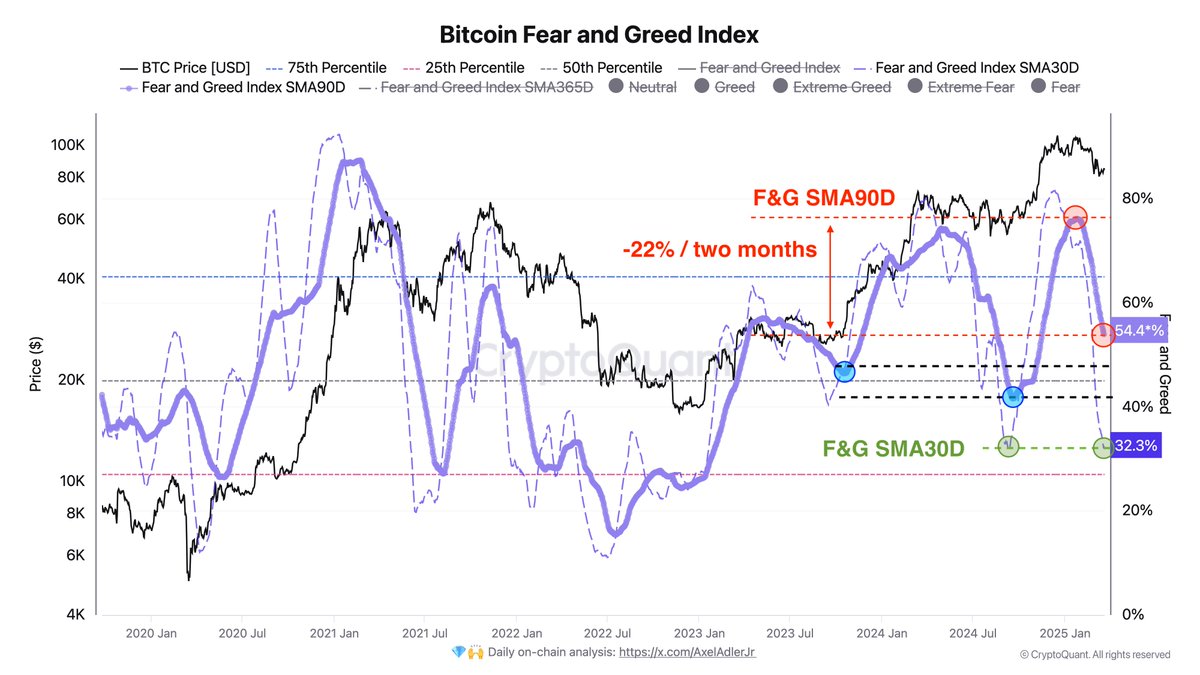
In a recent post on X, crypto analyst Axel Adler Jr explained how the Bitcoin market dynamics could significantly shift in the coming weeks. This projection is based on recent changes in the “Bitcoin Fear and Greed Index.

The Bitcoin Fear and Greed Index refers to a metric that aggregates the average sentiment of investors in the BTC market. The indicator is divided into five zones, including extreme fear, fear, neutral, greed, and extreme greed.

Extreme fear signals that traders and investors are moving with high caution, while extreme greed suggests an overheating market condition with traders flooding in with new positions. Historically, periods of extreme fear have been correlated with market bottoms while price corrections usually occur during extreme greed.

According to Adler Jr., the 90-day simple moving average (SMA) of the Bitcoin Fear and Greed Index has fallen by approximately 22 percentage points over the past two months. This decline has seen the BTC metric shift from extreme greed to a more moderate level of greed.
Bitcoin

Going further, the on-chain analyst mentioned that if the Bitcoin Fear and Greed Index drops by another 10 to 15 points in the near future, the market may experience a cooling-off period where participants could have become accustomed to negative factors and emotional price movements may even subside.

Adler Jr added in his post:

At the current pace, it may take approximately 4 to 6 weeks for the index to drop by an additional 10–15 points.

The analyst also highlighted that the 30-day (monthly) moving average appears to be reaching a local bottom, one seen at the end of the Bitcoin price correction to $54,000. The last time the Fear and Greed Index monthly SMA reached this level, the premier cryptocurrency climbed to a new all-time high price. If this historical pattern holds, investors could see the BTC price break out of its consolidation range.

Bitcoin Price At A Glance

As of this writing, the price of BTC is just beneath the $84,000 level, reflecting a 0.5% decline in the past 24 hours. 

Bitcoin
Disclaimer: For information purposes only. Past performance is not indicative of future results.
placeholder
Fed hike odds near 90% into Wednesday's decision — how to trade the dollar, gold and the S&P 500A 0.3% monthly core CPI print has lifted the market-implied probability of a 25bp Fed hike on 16 September to roughly 86.5% ~ 90%, which would be the first increase since July 2023. Here is the decision timeline, the pricing versus the forecasts, both scenarios, and the key levels for the dollar, gold and the S&P 500.
Author  Suzie
Sep 14, Mon
A 0.3% monthly core CPI print has lifted the market-implied probability of a 25bp Fed hike on 16 September to roughly 86.5% ~ 90%, which would be the first increase since July 2023. Here is the decision timeline, the pricing versus the forecasts, both scenarios, and the key levels for the dollar, gold and the S&P 500.
placeholder
Bitcoin falls below $75,000 as the CLARITY Act fails in the Senate — what the vote means for cryptoThe US Senate blocked the Digital Asset Market CLARITY Act in a 49-50 procedural vote, sending Bitcoin briefly below $75,000 — its biggest one-day drop since June. Ethereum fell more than 8%, Coinbase slid 10% and $75 billion of crypto market value evaporated. Here is what the vote was, why it failed, and the levels that matter now.
Author  Suzie
Sep 16, Wed
The US Senate blocked the Digital Asset Market CLARITY Act in a 49-50 procedural vote, sending Bitcoin briefly below $75,000 — its biggest one-day drop since June. Ethereum fell more than 8%, Coinbase slid 10% and $75 billion of crypto market value evaporated. Here is what the vote was, why it failed, and the levels that matter now.
placeholder
Dollar index tops 100 for the first time since July as the Fed's hawkish dot plot sinks inThe U.S. dollar index broke back above 100 for the first time since 31 July after the Fed delivered its first rate hike since 2023, with the dot plot showing 16 of 18 officials expect at least one more increase this year. Here are the levels that matter for DXY, the currencies feeling it most, and what to watch next.
Author  Irene Q.
Sep 17, Thu
The U.S. dollar index broke back above 100 for the first time since 31 July after the Fed delivered its first rate hike since 2023, with the dot plot showing 16 of 18 officials expect at least one more increase this year. Here are the levels that matter for DXY, the currencies feeling it most, and what to watch next.
placeholder
Gold rebounds to near $4,350 on weaker US Dollar, falling oil pricesGold price (XAU/USD) rises to near $4,345 during the early Asian session on Friday. The precious metal rebounds from a six-week low amid falling oil prices and a weaker US Dollar (USD). Traders continue to assess the latest Federal Reserve (Fed) rate hike and policy cues.
Author  FXStreet
Yesterday 01: 32
Gold price (XAU/USD) rises to near $4,345 during the early Asian session on Friday. The precious metal rebounds from a six-week low amid falling oil prices and a weaker US Dollar (USD). Traders continue to assess the latest Federal Reserve (Fed) rate hike and policy cues.
placeholder
US to delay new "overcapacity" tariffs on China — what the pause means for trade, inflation and the dollarWashington is expected to hold off announcing new tariffs over Chinese "overcapacity" until after the 24 September summit, according to Bloomberg. The postponed plan would have added 7.5% to Chinese goods, taking second-term US tariffs to around 20%. Here is what is on the table, and what a deal versus no deal would mean for the yuan, Hong Kong equities and the dollar.
Author  Mitrade
Yesterday 07: 43
Washington is expected to hold off announcing new tariffs over Chinese "overcapacity" until after the 24 September summit, according to Bloomberg. The postponed plan would have added 7.5% to Chinese goods, taking second-term US tariffs to around 20%. Here is what is on the table, and what a deal versus no deal would mean for the yuan, Hong Kong equities and the dollar.
goTop
quote