

Rebound Alert: US Bitcoin ETF Interest Picks Up Speed In 2025

Source Newsbtc

Demand for US Bitcoin ETFs has significantly increased as we enter 2025, signifying a notable reversal following a lackluster start to the year.

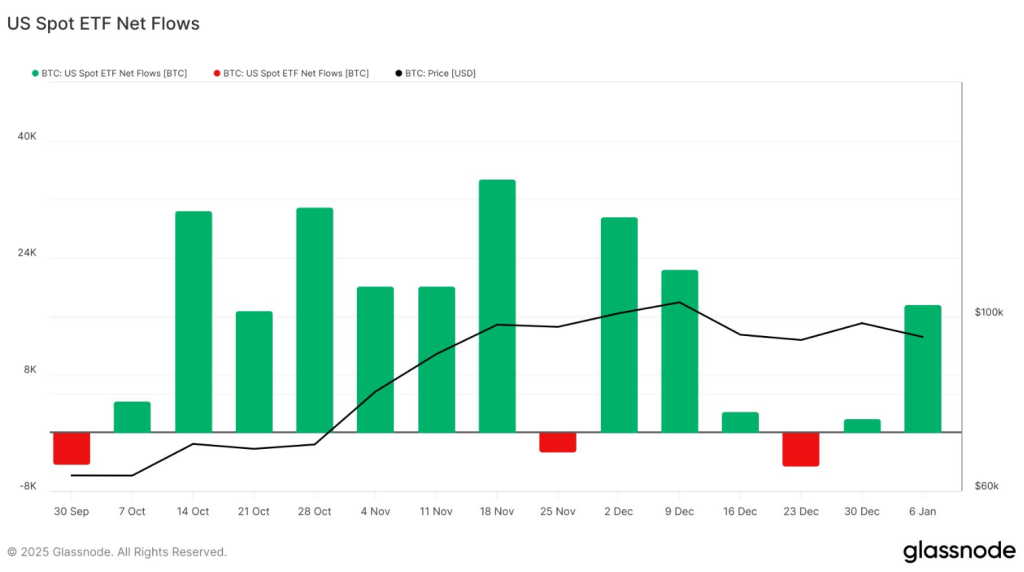
Based on recent figures from Glassnode, net inflows for the week ending January 6 amounted to 17,567 BTC, equivalent to around $1.7 billion.

This increase surpasses the weekly average inflows of 15,900 BTC documented in the final quarter of 2024 and indicates a resurgence of investor enthusiasm.

A Turbulent Journey Of Inflows

Inflows into Bitcoin ETFs have shown an erratic pattern. These inflows showed notable fluctuations in late 2024. In September, there was a significant decline as Bitcoin prices dropped below $64,000, leading to large withdrawals.

Nevertheless, things began to change by October. Inflows increased dramatically; in few weeks, they topped 24,000 BTC. With the average weekly inflow settling at around 15,900 BTC, the increase continued into November and December, demonstrating the high demand for Bitcoin investments.

As the price of Bitcoin increased, so did ETF inflows. In December 2024, the most popular digital asset in the world reached a record-breaking high of $108,135.

This association suggests that as more people switched to exchange-traded funds, investors’ confidence in Bitcoin’s worth grew, leading to a positive market sentiment.
Bitcoin ETFs: Who Possesses The Most?

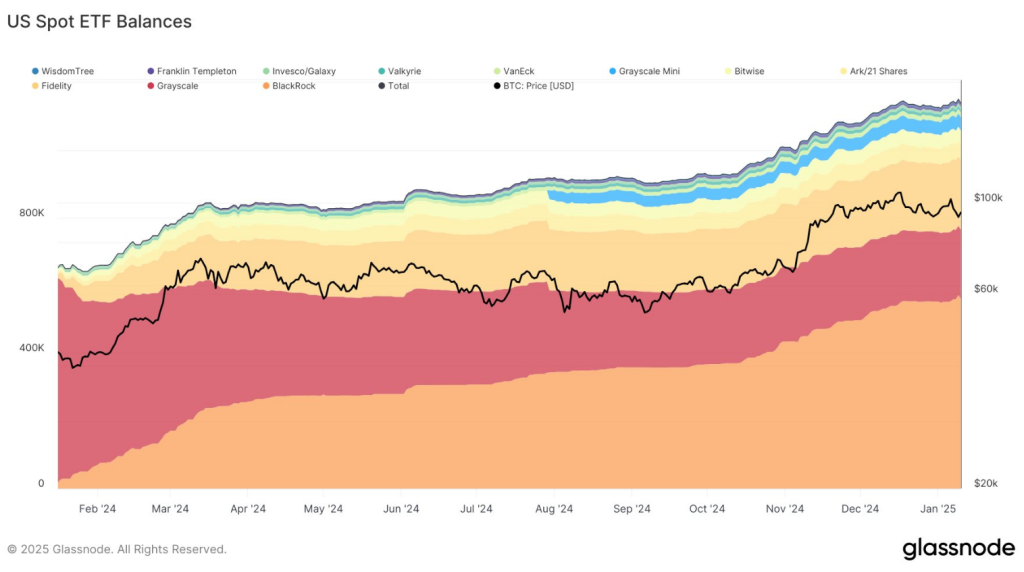
The total holdings of US spot Bitcoin ETFs as of early January 2025 are approximately 1.13 million BTC. Grayscale has 204,300 BTC, Fidelity holds 205,488 BTC, and BlackRock has 559,673 BTC, making it the largest holding.

In 2024, BlackRock’s Bitcoin ETF (IBIT) garnered attention by accumulating $37.25 billion in assets during its inaugural year, securing the third position on the Top 20 ETF Leaderboard for that year. This significant surge highlights the rising institutional demand for cryptocurrency-backed financial solutions.
Will 2025 Be A Good Year For ETFs?

Bitcoin ETFs look like they will do well in 2025. Experts in the field think that this year there may be a lot of new, innovative offerings on the market.

There will be at least 50 new bitcoin ETFs this year, according to Nate Geraci of the ETF Store. These will cover a wide range of strategies, such as covered call ETFs and Bitcoin-denominated equity ETFs.

Furthermore, there is conjecture that Bitcoin spot ETFs may soon exceed physical gold ETFs in asset size. This would represent a pivotal advancement in the development of digital assets as conventional investment instruments.

Such a change would highlight a rising confidence in Bitcoin as a valid store of value and investment tool, therefore challenging the long-held view of gold as the best hedge.

As financial institutions such as Vanguard investigate cryptocurrency ETF alternatives, it underscores a wider trend of acceptance and incorporation of cryptocurrencies into established financial systems.

Featured image from Reuters, chart from TradingView

Disclaimer: For information purposes only. Past performance is not indicative of future results.
placeholder
Natural Gas sinks to pivotal level as China’s demand slumpsNatural Gas price (XNG/USD) edges lower and sinks to $2.56 on Monday, extending its losing streak for the fifth day in a row. The move comes on the back of China cutting its Liquified Natural Gas (LNG) imports after prices rose above $3.0 in June. It
Author  FXStreet
Jul 01, 2024
Natural Gas price (XNG/USD) edges lower and sinks to $2.56 on Monday, extending its losing streak for the fifth day in a row. The move comes on the back of China cutting its Liquified Natural Gas (LNG) imports after prices rose above $3.0 in June. It
placeholder
Bitcoin briefly loses 2025 gains as crypto plunges over the weekend.Bitcoin experienced a sharp decline this weekend, briefly erasing its 2025 gains and dipping below its year-opening value of $93,507. The cryptocurrency fell to a low of $93,029 on Sunday, representing a 25% drop from its all-time high in October. Although it has rebounded slightly to around $94,209, the pressures on the market remain significant. The downturn occurred despite the reopening of the U.S. government on Thursday, which many had hoped would provide essential support for crypto markets. This year initially appeared promising for cryptocurrencies, particularly after the inauguration of President Donald Trump, who has established the most pro-crypto administration thus far. However, ongoing political tensions—including Trump's tariff strategies and the recent government shutdown, lasting a historic 43 days—have contributed to several rapid price pullbacks for Bitcoin throughout the year. Market dynamics are also being influenced by Bitcoin whales—investors holding large amounts of Bitcoin—who have been offloading portions of their assets, consequently stalling price rallies even as positive regulatory developments emerge. Despite these sell-offs, analysts from Glassnode argue that this behavior aligns with typical patterns seen among long-term investors during the concluding stages of bull markets, suggesting it is not indicative of a mass exodus. Notably, Bitcoin is not alone in its struggles, as Ethereum and Solana have also recorded declines of 7.95% and 28.3%, respectively, since the start of the year, while numerous altcoins have faced even steeper losses. Looking ahead, questions linger regarding the viability of the four-year cycle thesis, particularly given the increasing institutional support and regulatory frameworks now in place in the crypto landscape. Matt Hougan, chief investment officer at Bitwise, remains optimistic, suggesting a potential Bitcoin resurgence in 2026 driven by the “debasement trade” thesis and a broader trend toward increased adoption of stablecoins, tokenization, and decentralized finance. Hougan emphasized the soundness of the underlying fundamentals, pointing to a positive outlook for the sector in the longer term.
Author  Mitrade
Nov 17, 2025
Bitcoin experienced a sharp decline this weekend, briefly erasing its 2025 gains and dipping below its year-opening value of $93,507. The cryptocurrency fell to a low of $93,029 on Sunday, representing a 25% drop from its all-time high in October. Although it has rebounded slightly to around $94,209, the pressures on the market remain significant. The downturn occurred despite the reopening of the U.S. government on Thursday, which many had hoped would provide essential support for crypto markets. This year initially appeared promising for cryptocurrencies, particularly after the inauguration of President Donald Trump, who has established the most pro-crypto administration thus far. However, ongoing political tensions—including Trump's tariff strategies and the recent government shutdown, lasting a historic 43 days—have contributed to several rapid price pullbacks for Bitcoin throughout the year. Market dynamics are also being influenced by Bitcoin whales—investors holding large amounts of Bitcoin—who have been offloading portions of their assets, consequently stalling price rallies even as positive regulatory developments emerge. Despite these sell-offs, analysts from Glassnode argue that this behavior aligns with typical patterns seen among long-term investors during the concluding stages of bull markets, suggesting it is not indicative of a mass exodus. Notably, Bitcoin is not alone in its struggles, as Ethereum and Solana have also recorded declines of 7.95% and 28.3%, respectively, since the start of the year, while numerous altcoins have faced even steeper losses. Looking ahead, questions linger regarding the viability of the four-year cycle thesis, particularly given the increasing institutional support and regulatory frameworks now in place in the crypto landscape. Matt Hougan, chief investment officer at Bitwise, remains optimistic, suggesting a potential Bitcoin resurgence in 2026 driven by the “debasement trade” thesis and a broader trend toward increased adoption of stablecoins, tokenization, and decentralized finance. Hougan emphasized the soundness of the underlying fundamentals, pointing to a positive outlook for the sector in the longer term.
placeholder
ECB Policy Outlook for 2026: What It Could Mean for the Euro’s Next MoveWith the ECB likely holding rates steady at 2.15% and the Fed potentially extending cuts into 2026, EUR/USD may test 1.20 if Eurozone growth proves resilient, but weaker growth and an ECB pivot could pull the pair back toward 1.13 and potentially 1.10.
Author  Mitrade
Dec 26, 2025
With the ECB likely holding rates steady at 2.15% and the Fed potentially extending cuts into 2026, EUR/USD may test 1.20 if Eurozone growth proves resilient, but weaker growth and an ECB pivot could pull the pair back toward 1.13 and potentially 1.10.
placeholder
My Top 5 Stock Market Predictions for 2026Five 2026 market predictions written in a native, news-style voice: AI’s winners and losers, broader sector leadership, dividend demand, valuation cooling as the Shiller CAPE sits at 39 (Dec. 31, 2025), and quantum-computing bursts—while keeping all original facts and numbers unchanged.
Author  Mitrade
Jan 06, Tue
Five 2026 market predictions written in a native, news-style voice: AI’s winners and losers, broader sector leadership, dividend demand, valuation cooling as the Shiller CAPE sits at 39 (Dec. 31, 2025), and quantum-computing bursts—while keeping all original facts and numbers unchanged.
placeholder
Gold Price Forecast: Oil Price Breaking $100 Fuels Inflation Concerns, Will Gold Prices Fall Further?As of the Asian session on July 24, gold prices ( XAUUSD) fell continuously during intraday trading, briefly approaching the $4,000 mark. Looking at the chart, gold prices rebounded this
Author  TradingKey
Jul 24, Fri
As of the Asian session on July 24, gold prices ( XAUUSD) fell continuously during intraday trading, briefly approaching the $4,000 mark. Looking at the chart, gold prices rebounded this
goTop
quote