

Crypto laundering soars to $1.3 billion in 2024, a 280% surge – PeckShield

Source Cryptopolitan

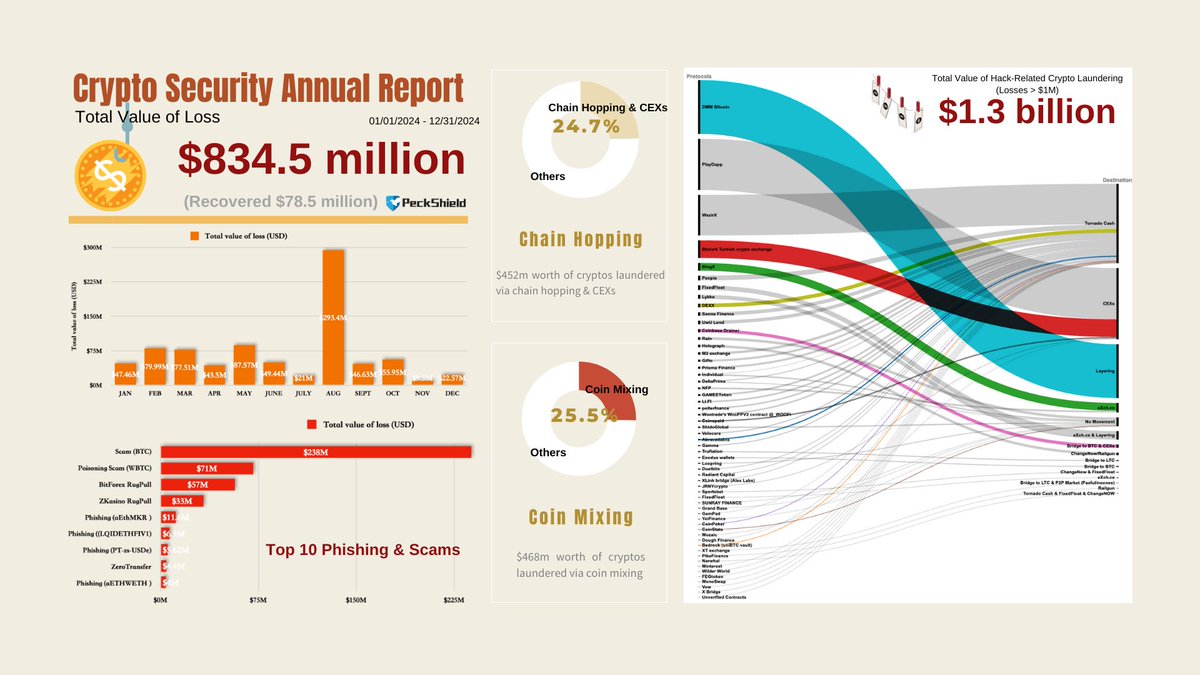
Cryptocurrency laundering reached $1.3 billion in 2024, marking a 280% increase from the $342 million recorded in 2023, according to a new report from blockchain security firm PeckShield.

The surge in laundering activities coincides with the broader upward trend in cryptocurrency prices throughout the year. The total impact of crypto security breaches in 2024 exceeded $3.01 billion, representing a 15% increase from the $2.61 billion stolen in 2023.

The scale of crypto security breaches

Cryptocurrency hacks in 2024 surpassed 300 recorded incidents, with total losses reaching $2.15 billion. This is a 30% increase from the $1.51 billion stolen in 2023. May emerged as the most volatile month, with attackers stealing $574.6 million across 28 separate hacks.

The Ethereum blockchain bore the heaviest losses, accounting for 47.3% of the total value stolen and 34.8% of all incidents. The gaming sector faced particular pressure, with losses totaling $502 million, primarily due to the PlayDapp exploit, which resulted in a $290 million theft.
Image

Source: PeckShield

The data from PeckShield indicates a shift in attack patterns, with hackers increasingly targeting organizational infrastructure rather than protocol vulnerabilities. This trend now represents 46% of all attacks, up from 33% in 2023. Bitcoin-related thefts also increased, correlating with the cryptocurrency’s price appreciation throughout the year.

Recovery efforts managed to secure $488.5 million of the stolen funds, though this represents only 23% of the total losses. The persistence of these attacks, despite enhanced security measures, underscores the ongoing challenges faced by the cryptocurrency industry in protecting digital assets.

Laundering mechanisms by crypto hackers

PeckShield’s analysis reveals two primary methods criminals used to obscure stolen cryptocurrency in 2024. Chain hopping combined with centralized exchange (CEX) transfers accounted for 24.7% of laundering activities, processing approximately $452 million worth of stolen assets. Coin mixing services handled 25.5% of illicit funds, processing $468 million throughout the year.

The rise in crypto prices created additional opportunities for laundering operations, as higher valuations made it easier to process large amounts through multiple smaller transactions. Criminals used increasingly complex routes, often splitting stolen funds across multiple chains and services to avoid detection. The analysis tracked money flows through more than 50 different platforms and services.

On-chain data shows criminals frequently used cross-chain bridges and decentralized exchanges as intermediate steps before reaching their final destinations. The complexity of these operations often delayed fund recovery efforts, with law enforcement and security teams requiring extensive resources to track and freeze compromised assets.

From Zero to Web3 Pro: Your 90-Day Career Launch Plan

Disclaimer: For information purposes only. Past performance is not indicative of future results.
placeholder
Fed hike odds near 90% into Wednesday's decision — how to trade the dollar, gold and the S&P 500A 0.3% monthly core CPI print has lifted the market-implied probability of a 25bp Fed hike on 16 September to roughly 86.5% ~ 90%, which would be the first increase since July 2023. Here is the decision timeline, the pricing versus the forecasts, both scenarios, and the key levels for the dollar, gold and the S&P 500.
Author  Suzie
Sep 14, Mon
A 0.3% monthly core CPI print has lifted the market-implied probability of a 25bp Fed hike on 16 September to roughly 86.5% ~ 90%, which would be the first increase since July 2023. Here is the decision timeline, the pricing versus the forecasts, both scenarios, and the key levels for the dollar, gold and the S&P 500.
placeholder
Bitcoin falls below $75,000 as the CLARITY Act fails in the Senate — what the vote means for cryptoThe US Senate blocked the Digital Asset Market CLARITY Act in a 49-50 procedural vote, sending Bitcoin briefly below $75,000 — its biggest one-day drop since June. Ethereum fell more than 8%, Coinbase slid 10% and $75 billion of crypto market value evaporated. Here is what the vote was, why it failed, and the levels that matter now.
Author  Suzie
Sep 16, Wed
The US Senate blocked the Digital Asset Market CLARITY Act in a 49-50 procedural vote, sending Bitcoin briefly below $75,000 — its biggest one-day drop since June. Ethereum fell more than 8%, Coinbase slid 10% and $75 billion of crypto market value evaporated. Here is what the vote was, why it failed, and the levels that matter now.
placeholder
Dollar index tops 100 for the first time since July as the Fed's hawkish dot plot sinks inThe U.S. dollar index broke back above 100 for the first time since 31 July after the Fed delivered its first rate hike since 2023, with the dot plot showing 16 of 18 officials expect at least one more increase this year. Here are the levels that matter for DXY, the currencies feeling it most, and what to watch next.
Author  Irene Q.
Sep 17, Thu
The U.S. dollar index broke back above 100 for the first time since 31 July after the Fed delivered its first rate hike since 2023, with the dot plot showing 16 of 18 officials expect at least one more increase this year. Here are the levels that matter for DXY, the currencies feeling it most, and what to watch next.
placeholder
Gold rebounds to near $4,350 on weaker US Dollar, falling oil pricesGold price (XAU/USD) rises to near $4,345 during the early Asian session on Friday. The precious metal rebounds from a six-week low amid falling oil prices and a weaker US Dollar (USD). Traders continue to assess the latest Federal Reserve (Fed) rate hike and policy cues.
Author  FXStreet
Yesterday 01: 32
Gold price (XAU/USD) rises to near $4,345 during the early Asian session on Friday. The precious metal rebounds from a six-week low amid falling oil prices and a weaker US Dollar (USD). Traders continue to assess the latest Federal Reserve (Fed) rate hike and policy cues.
placeholder
US to delay new "overcapacity" tariffs on China — what the pause means for trade, inflation and the dollarWashington is expected to hold off announcing new tariffs over Chinese "overcapacity" until after the 24 September summit, according to Bloomberg. The postponed plan would have added 7.5% to Chinese goods, taking second-term US tariffs to around 20%. Here is what is on the table, and what a deal versus no deal would mean for the yuan, Hong Kong equities and the dollar.
Author  Mitrade
Yesterday 07: 43
Washington is expected to hold off announcing new tariffs over Chinese "overcapacity" until after the 24 September summit, according to Bloomberg. The postponed plan would have added 7.5% to Chinese goods, taking second-term US tariffs to around 20%. Here is what is on the table, and what a deal versus no deal would mean for the yuan, Hong Kong equities and the dollar.
goTop
quote