

Jordan Approves Blockchain Policy to Modernize Government Operations

Source Beincrypto

The Jordanian Council of Ministers approved a major Blockchain Technology Policy for 2025. This legislation seeks to enhance public trust in government performance by promoting economic modernization, increased data security, and wider transparency. 

The government wants to amplify blockchain adoption in the country to improve its operational efficiency while safeguarding citizens’ privacy. 

A Strong Focus on Transparency and Security

According to the latest announcement, the government wants to implement blockchain in managing public administration operations. The aim is to increase public confidence in government performance and reduce time and cost in governmental transactions.

The new policy will also support blockchain start-ups, build capabilities, and develop specialized skills in the industry. It’s part of Jordan’s wider digital transformation initiative for 2025. The policy prioritizes the security and privacy of citizen data as the global need for solid digital protections grows.

By leveraging blockchain’s capabilities for real-time transaction automation and verification, the government aims to streamline administrative procedures. This would reduce operating costs and improve the efficiency of public services, benefiting both businesses and residents.

This initiative aligns with Jordan’s broader economic modernization plan. Improved public service efficiency will contribute to a more competitive economy and have positive ripple effects across various sectors.

Also, the new blockchain policy is expected to improve the country’s public services and infrastructure and attract foreign investment, contributing to Jordan’s economic diversification and establishing the country as a competitive player in the global digital economy.

Furthermore, this isn’t the first time that the country has turned to blockchain to address its national challenges. Back in 2022, citizens of the country increased crypto trading and investment to tackle the critical unemployment crisis.
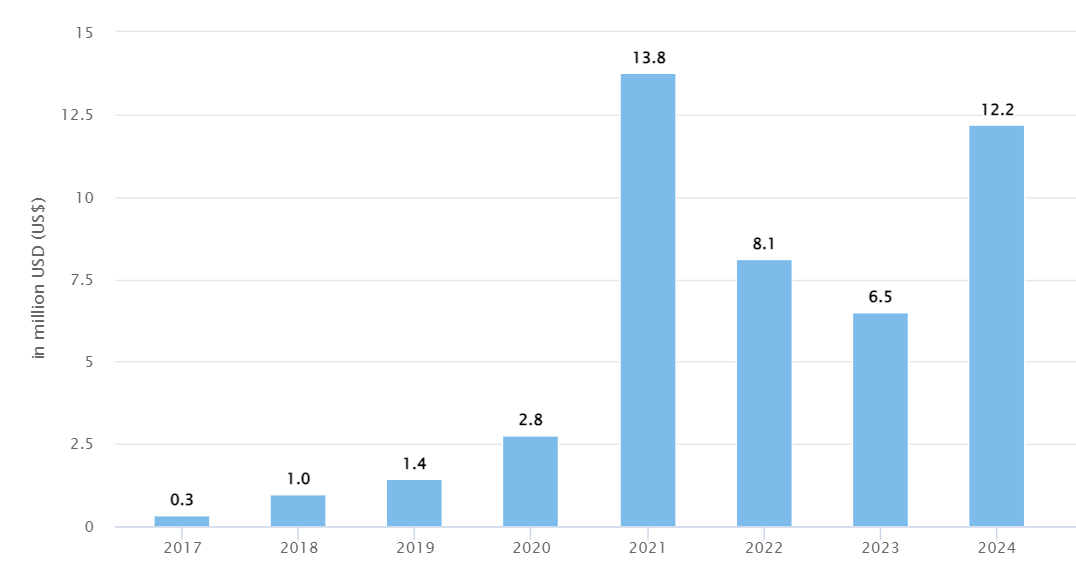
Jordan crypto revenueCrypto Revenue in Jordan from 2017 to 2024. Source: Statista

A Broader Trend in the Middle East

Jordan’s implementation of blockchain technology in government procedures reflects a broader ripple effect in the Middle East.

Earlier today, Syria’s transitional government announced that it is considering a proposal to legalize Bitcoin and digitize the Syrian pound. This move is a potential strategy to stabilize the country’s economy—which is significantly impacted by ongoing conflict—and attract international investment.

“The central bank will oversee this process, ensuring a secure and accountable framework,” the Syrian Center for Economic Research (SCER) said.

In October, the Dubai Financial Services Authority (DFSA) granted Ripple in-principle approval to expand its operations within the Dubai International Financial Centre (DIFC). The approval allows Ripple to offer a full suite of end-to-end payment services within the United Arab Emirates.

Following suit, the TON Foundation registered with the Abu Dhabi Global Market (ADGM) in December, leveraging its regulatory framework for decentralized ledger technology (DLT) foundations to establish a structured legal footing for its operations and governance.

Disclaimer: For information purposes only. Past performance is not indicative of future results.
placeholder
Bitcoin falls below $75,000 as the CLARITY Act fails in the Senate — what the vote means for cryptoThe US Senate blocked the Digital Asset Market CLARITY Act in a 49-50 procedural vote, sending Bitcoin briefly below $75,000 — its biggest one-day drop since June. Ethereum fell more than 8%, Coinbase slid 10% and $75 billion of crypto market value evaporated. Here is what the vote was, why it failed, and the levels that matter now.
Author  Suzie
Sep 16, Wed
The US Senate blocked the Digital Asset Market CLARITY Act in a 49-50 procedural vote, sending Bitcoin briefly below $75,000 — its biggest one-day drop since June. Ethereum fell more than 8%, Coinbase slid 10% and $75 billion of crypto market value evaporated. Here is what the vote was, why it failed, and the levels that matter now.
placeholder
US to delay new "overcapacity" tariffs on China — what the pause means for trade, inflation and the dollarWashington is expected to hold off announcing new tariffs over Chinese "overcapacity" until after the 24 September summit, according to Bloomberg. The postponed plan would have added 7.5% to Chinese goods, taking second-term US tariffs to around 20%. Here is what is on the table, and what a deal versus no deal would mean for the yuan, Hong Kong equities and the dollar.
Author  Mitrade
Sep 18, Fri
Washington is expected to hold off announcing new tariffs over Chinese "overcapacity" until after the 24 September summit, according to Bloomberg. The postponed plan would have added 7.5% to Chinese goods, taking second-term US tariffs to around 20%. Here is what is on the table, and what a deal versus no deal would mean for the yuan, Hong Kong equities and the dollar.
placeholder
Gold ends three-week slide at the $4,400 line — eight straight days of ETF inflows vs a 5% 10-year and a 100 dollarSpot gold closed Friday at $4,378.39, up 0.84% on the day and about 0.8% for the week — its first weekly gain in four weeks — with the intraday high of $4,399.67 leaving it 33 cents shy of the $4,400 line. Gold ETFs have now logged eight straight sessions of inflows, but with the 10-year back above 5% and the dollar index near 100, here is what decides whether this is a reversal or a bounce.
Author  Suzie
Sep 20, Sun
Spot gold closed Friday at $4,378.39, up 0.84% on the day and about 0.8% for the week — its first weekly gain in four weeks — with the intraday high of $4,399.67 leaving it 33 cents shy of the $4,400 line. Gold ETFs have now logged eight straight sessions of inflows, but with the 10-year back above 5% and the dollar index near 100, here is what decides whether this is a reversal or a bounce.
placeholder
Bitcoin squeezes back above $80,000 — 110,000 traders liquidated as the hawkish Fed and CLARITY setback fail to hold it down; is $83,000 next?Bitcoin closed above $80,000 on Friday for the first time since September 7, and pushed to $81,299 over the weekend, triggering about $603 million of liquidations — $523 million of them shorts — across more than 110,000 traders. With the Fed's hike already priced and the SEC and CFTC advancing crypto rules after the CLARITY Act failed, here is what stands between BTC and the $83,000 gate.
Author  Suzie
Sep 20, Sun
Bitcoin closed above $80,000 on Friday for the first time since September 7, and pushed to $81,299 over the weekend, triggering about $603 million of liquidations — $523 million of them shorts — across more than 110,000 traders. With the Fed's hike already priced and the SEC and CFTC advancing crypto rules after the CLARITY Act failed, here is what stands between BTC and the $83,000 gate.
placeholder
Brent slides below $102 after Houthis' first strike on Riyadh — why oil can't hold $100Houthi forces struck Riyadh for the first time on September 19 and hit Yanbu facilities — yet Brent opened at $104.71, peaked at $104.90 and settled at $101.68 (-1.63% on the day). Here is the four-way data tug-of-war between strike escalation and supply recovery, and the two switches that decide where oil goes next.
Author  Irene Q.
Yesterday 02: 59
Houthi forces struck Riyadh for the first time on September 19 and hit Yanbu facilities — yet Brent opened at $104.71, peaked at $104.90 and settled at $101.68 (-1.63% on the day). Here is the four-way data tug-of-war between strike escalation and supply recovery, and the two switches that decide where oil goes next.
goTop
quote