

SHIB Price Likely Bound for Correction Despite 10% Hike in October

Source Beincrypto

In October, Shiba Inu’s (SHIB) price increased by 10%, driving speculation that the token could extend this rally. But as November began, things seemed to have changed. 

As of this writing, SHIB’s price is $0.000018. Here is why the cryptocurrency’s value could be lower within the next few weeks.

Investor Interaction with Shiba Inu Drops

Throughout most of last month, Shiba Inu’s Daily Active Addresses (DAA) divergence stayed positive, reflecting steady price growth alongside increased user interaction. The price DAA metric gauges how user engagement correlates with SHIB’s price performance. When both rise together, it indicates that active user involvement is bolstering the price trend.

However, recent data from Santiment shows a shift, with the price DAA divergence falling by 20%. This drop suggests a decline in active addresses engaging with SHIB, a trend historically linked to price drops. If this decrease in DAA persists, Shiba Inu may face further declines, potentially testing support levels below $0.000018.

Read more: 12 Best Shiba Inu (SHIB) Wallets in 2024
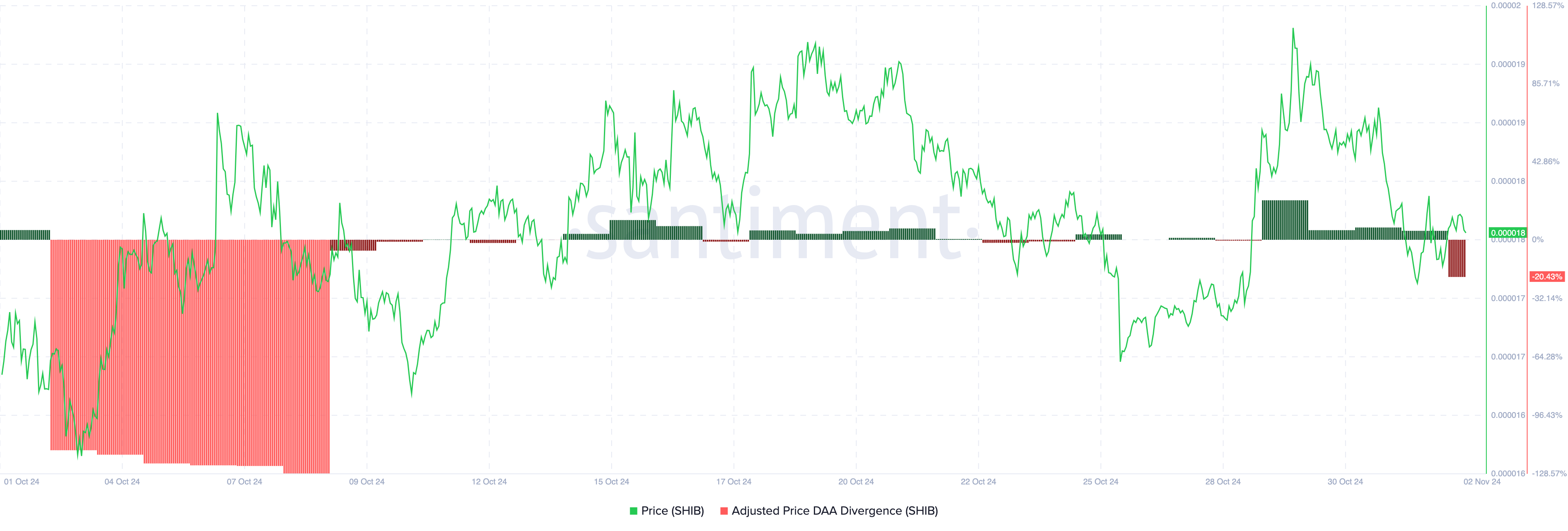
SHIB flashes sell signalShiba Inu Price DAA Divergence. Source: Santiment

In addition, on-chain data from IntoTheBlock indicates a decrease in Shiba Inu’s Coins Holding Time over the past week. This metric reflects the average duration that SHIB coins are held before being sold. 

A decline in Coins Holding Time suggests that SHIB investors are becoming more active in selling rather than holding onto them for longer periods.

This trend can be interpreted as a sign of weakening investor confidence, indicating that holders may be looking to liquidate their positions amid a perceived lack of upward momentum. If this pattern continues, it could further exert downward pressure on SHIB’s price, especially with the previously mentioned drop in active addresses.
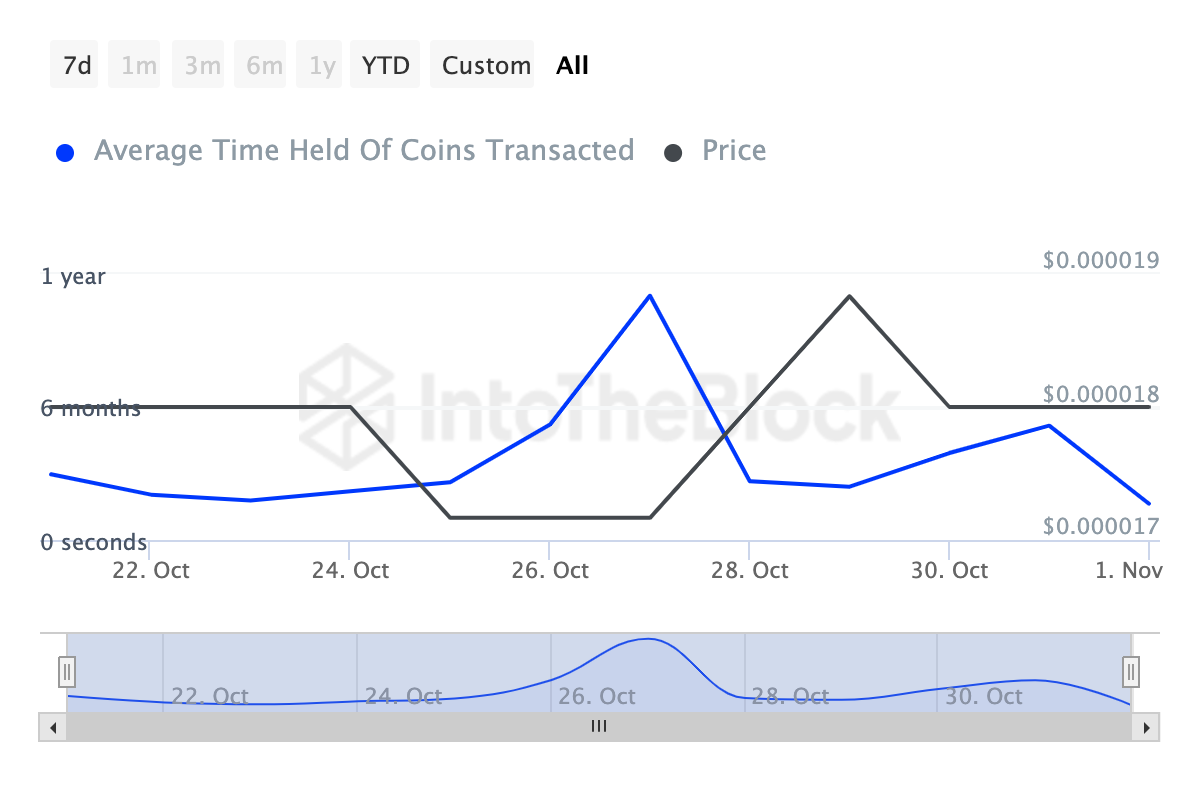
SHIB holders sellingShiba Inu Coins Holding Time. Source: IntoTheBlock

SHIB Price Prediction: Buyers Trapped, Decline Ahead

On the daily chart, SHIB’s price broke out of a descending triangle pattern on October 29. This breakout is often seen as a bullish signal, suggesting that the price could potentially trend upward.

However, SHIB’s price has fallen back into the descending triangle pattern, indicating that the initial breakout surge may have been a fakeout. 

A fakeout occurs when the price briefly moves above a resistance level or pattern only to reverse quickly, trapping buyers who anticipated further gains. Furthermore, the Relative Strength Index (RSI) reading has also dropped, indicating a decline in bullish momentum.

Read more: Shiba Inu (SHIB) Price Prediction 2024/2025/2030
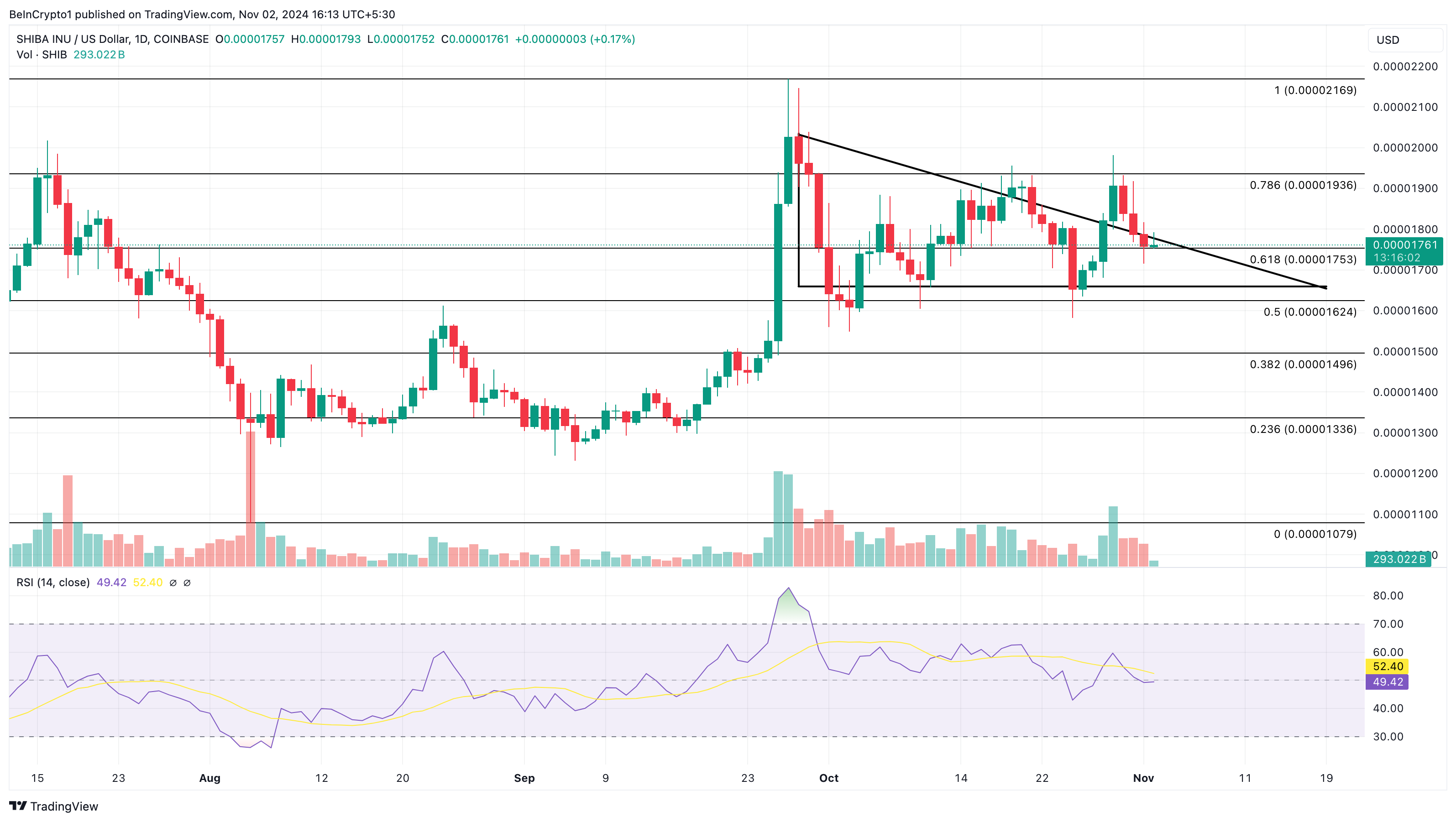
SHIB price analysisShiba Inu Daily Analysis. Source: TradngView

As it stands, the price might decrease to $0.000015, and SHIB investors might have to cope with losses. However, if the token rises above the triangle pattern again, the value might climb to $0.000022.

Disclaimer: For information purposes only. Past performance is not indicative of future results.
placeholder
WTI (USOIL) Is down 2.03% on Sep 25: Here Is WhyWTI (USOIL) is down 2.03% at Sep 24 22:20(UTC+0), now at $92.517, with a 7-day down of 3.63%.What is driving WTI (USOIL)’s stock price down today?The drop in WTI crude oil prices was primarily driven by
Author  TradingKey
Sep 25, Fri
WTI (USOIL) is down 2.03% at Sep 24 22:20(UTC+0), now at $92.517, with a 7-day down of 3.63%.What is driving WTI (USOIL)’s stock price down today?The drop in WTI crude oil prices was primarily driven by
placeholder
Silver Price Forecast: XAG/USD remains steady near $64.00 as oil prices easeSilver price (XAG/USD) inches higher after two days of losses, trading around $63.90 per troy ounce during Asian hours on Friday. Non-yielding Silver is finding underlying support as inflation concerns ease following a pullback in crude oil prices.
Author  FXStreet
Sep 25, Fri
Silver price (XAG/USD) inches higher after two days of losses, trading around $63.90 per troy ounce during Asian hours on Friday. Non-yielding Silver is finding underlying support as inflation concerns ease following a pullback in crude oil prices.
placeholder
Gold Price Forecast: Gold Drops Below $4,300, Will It Continue to Fall? As of the European session on September 24, gold prices (XAUUSD) extended their correction, dipping below $4,300 intraday to hit a low of $4,262.45. After previously rebounding close to $
Author  TradingKey
Sep 24, Thu
As of the European session on September 24, gold prices (XAUUSD) extended their correction, dipping below $4,300 intraday to hit a low of $4,262.45. After previously rebounding close to $
placeholder
Yen touches 158.37 as Tokyo reopens, then slips back — ¥15.4 trillion of intervention and the 200-day line stand between here and 160USD/JPY reached 158.37 overnight, its highest since early September, then eased to 157.88 as Japanese markets reopened after a three-day holiday. The Ministry of Finance has spent ¥15.4 trillion defending the yen since late July and the BOJ ran a rate check on September 18. The 200-day average sits at 158.43.
Author  Irene Q.
Sep 24, Thu
USD/JPY reached 158.37 overnight, its highest since early September, then eased to 157.88 as Japanese markets reopened after a three-day holiday. The Ministry of Finance has spent ¥15.4 trillion defending the yen since late July and the BOJ ran a rate check on September 18. The 200-day average sits at 158.43.
placeholder
US input costs rose at the fastest pace in four years — the September flash PMI beat is an inflation story, not a growth storyUS September flash PMIs came in far above expectations, with the composite at 58.4, a five-year high. But the detail that moved markets was input cost inflation at its fastest since October 2022, driven by fuel, transport and supply shortages. Brent is back above $100 and the 10-year Treasury yield has hit its highest since 2007.
Author  Suzie
Sep 24, Thu
US September flash PMIs came in far above expectations, with the composite at 58.4, a five-year high. But the detail that moved markets was input cost inflation at its fastest since October 2022, driven by fuel, transport and supply shortages. Brent is back above $100 and the 10-year Treasury yield has hit its highest since 2007.
goTop
quote