

Week Ahead: This week’s altcoin narrative and Bitcoin's fourth halving targets

Source Fxstreet
  • Bitcoin price is key to sustaining altcoin rallies This week.
  • Investors can expect altcoin categories like AI and newly launched coins to take the spotlight. 
  • Bitcoin’s fourth halving could extend the 2023 rally and potentially trigger new all-time highs for BTC. 

With Bitcoin spot ETF approved, investors are eyeing two major events – BTC’s fourth halving and Ethereum’s spot ETF approval. While the latter will take time, considering the US Securities and Exchange Commission’s (SEC) on-the-fence stance regarding the classification of ETH. So, in this newsletter, let’s take a look at Bitcoin halving and how it affects price.

Read more: Grayscale’s Bitcoin sale unlikely to have driven BTC price lower, profit taking is likely driver

What to expect next week? 

The macroeconomic market is going to be silent, but with the launch of new crypto tokens, the volatility is extremely high, and altcoins seem to be highly wound. 

So the focus for day traders should be on 

  1. Newly launched coins – ONDO, MANTA, MYRO, SARSO
  2. AI coins – RNDR, FET, GPT, and ROSE due to NVIDIA's approaching all-time high and Apple’s Vision Pro launch.
  3. Chinese coins and related meme coins due to the Spring Festival – NEO, ACH and FIL. 

While the short-term narrative-based plays are interesting, investors need to focus on the most anticipated event of the year – Bitcoin halving.

Read more: Bitcoin whales rise in numbers signaling strong confidence in BTC rally or positioning for profit taking

What is Bitcoin halving?

Bitcoin blockchain’s rewards are halved once every four years or after 210,000 blocks are mined. So far, BTC has undergone three halvings, reducing its block reward from 50 to 6.25 BTC. The fourth halving is estimated to occur on April 24, 2024, which would further slash the miner reward per block to 3.125 BTC.

Why does BTC halving matter?

Due to the anticipation of this negative supply shock event, investors generally invest ahead of the halving, causing a massive price rally. Considering that BTC ended its bear market in 2023 and has kickstarted a bull run, the halving event is likely going to catapult the pioneer crypto to extend its rally. 

A negative supply shock, simply put, is when the demand remains the same or increases, but the supply is reduced. This causes the underlying asset’s demand, aka market value, to surge.

What to expect from fourth Bitcoin halving?

Comparing the last three halvings gives investors a good idea of what to expect, although the past performance does not guarantee future returns. For this experiment, I will be comparing the BTC price action of the halving year. 

As seen in the below chart, the first halving for BTC took place on November 28, 2012, and the start of 2012 saw Bitcoin price crash in the first half but continued to rally even after halving.

The second halving was on July 9, 2016, and the start of this year also saw a steep correction but was eventually followed by a swift uptrend that formed a top three weeks before the halving. The correction continued roughly for another three weeks, after which Bitcoin price continued its uptrend. 

The third halving was similar to the first halving, where Bitcoin price crashed in the first half, albeit this was caused by the pandemic. Regardless, BTC saw a positive close to the year with remarkable performance. 
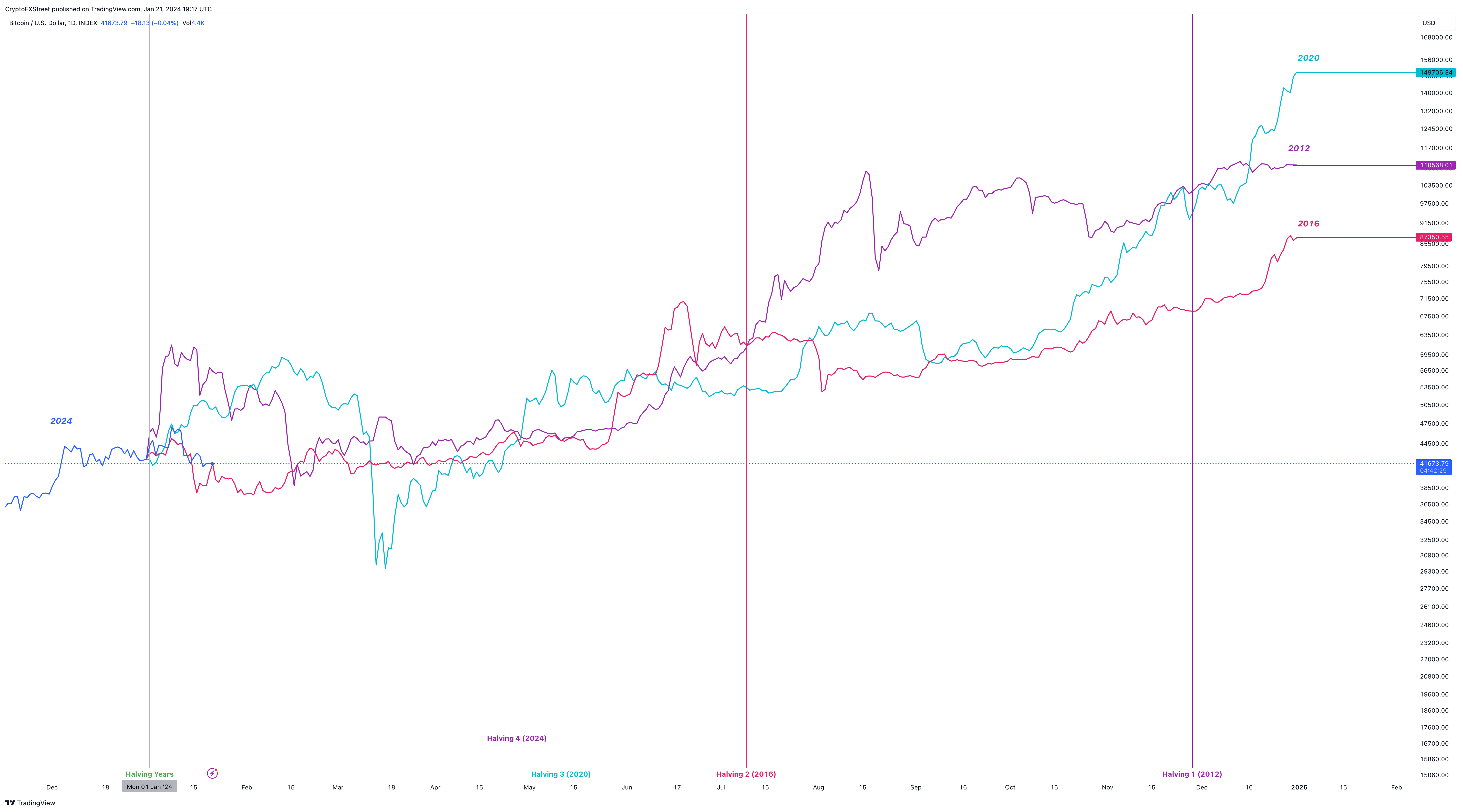
BTC/USD 1-day chart

BTC/USD 1-day chart

With this information, one can expect a crude crash in the first two quarters of 2024, following which the pioneer crypto is likely to continue its 2023 bull rally. If not a steep correction, at least a sideways movement in Bitcoin price two-to-four weeks before and after the halving.

How high will Bitcoin price go after the fourth halving? 

If history were to repeat itself, although it doesn’t, and we get a similar performance to

  • The first halving in 2012:  Bitcoin price could hit $110,568 at the end of 2024. This move would forecast a roughly 167% gain from the current position, which is not unheard of in the crypto realm. 
  • The second halving of 2016: Bitcoin price could set up a new all-time high at $87,350, suggesting another 108% rally from the current position. 
  • The third halving of 2020: Bitcoin price could hit an all-time high at $149,706, indicating that it could inflate by 259%. 

As always, this forecast has to be taken with a grain of salt. 

Disclaimer: For information purposes only. Past performance is not indicative of future results.
placeholder
Gold Price Forecast: XAU/USD drifts higher above $4,200 as Fed delivers expected cutGold price (XAU/USD) gains momentum to around $4,235 during the early Asian session on Thursday. The precious metal extends its upside after the US Federal Reserve (Fed) delivered an expected third consecutive interest rate cut and maintained its outlook for just one cut in 2026.
Author  FXStreet
Dec 11, Thu
Gold price (XAU/USD) gains momentum to around $4,235 during the early Asian session on Thursday. The precious metal extends its upside after the US Federal Reserve (Fed) delivered an expected third consecutive interest rate cut and maintained its outlook for just one cut in 2026.
placeholder
Ethereum Price Slips Lower — $3,000 Looms as the Key BattlegroundEthereum is attempting to recover from a $3,026 low but remains below $3,200 and the 100-hour SMA, with a bearish trend line near $3,175 capping rebounds as bulls need a clean break above $3,200 to target $3,250–$3,400, while a drop below $3,050 risks a retest of $3,000 and $2,940.
Author  Mitrade
Dec 15, Mon
Ethereum is attempting to recover from a $3,026 low but remains below $3,200 and the 100-hour SMA, with a bearish trend line near $3,175 capping rebounds as bulls need a clean break above $3,200 to target $3,250–$3,400, while a drop below $3,050 risks a retest of $3,000 and $2,940.
placeholder
Macro Analysts: Hawkish Japan Could Push Bitcoin Below $70KAnalysts predict Bitcoin may face further declines towards the $70,000 mark if the Bank of Japan raises interest rates as expected.
Author  Mitrade
Dec 15, Mon
Analysts predict Bitcoin may face further declines towards the $70,000 mark if the Bank of Japan raises interest rates as expected.
placeholder
Bitcoin Slides 5% as Sellers Lean In — Can BTC Reclaim $88,000?Bitcoin has dropped back below $88,000 after rolling over from $90,500, with price still trading under the 100-hour Simple Moving Average. The sell-off found a floor at $85,151, and BTC is now consolidating near that base, but rebounds are facing pressure from a bearish trend line around $89,000. Bulls need to retake $88,000–$89,000 to ease downside risk; failure to do so keeps $85,500–$85,000 and then $83,500 in play, with $80,000 as the deeper “line in the sand.” Bitcoin (BTC) is back in damage-control mode after a sharp pullback wiped out recent gains. The price failed to reclaim the $90,000–$90,500 band, rolled over, and slid through $88,500 before briefly dipping under $87,000. Buyers did show up around $85,000, but the rebound so far looks more like stabilization than a clear trend reversal. Bitcoin dips hard, finds a bid near $85,000(h3) BTC’s latest move lower began when it couldn’t build follow-through above $90,000 and $90,500. Once that upside stalled, sellers took control and pushed price down through $88,500. The slide accelerated enough to spike below $87,000, but the market didn’t free-fall. Bulls defended the $85,000 zone, printing a low at $85,151. Since then, Bitcoin has been consolidating below the 23.6% Fibonacci retracement of the drop from the $93,560 swing high to the $85,151 low — a clue that the bounce is still shallow and that sellers haven’t fully backed off yet. Structurally, BTC is still on the back foot: It’s trading below $88,000, and It remains below the 100-hour Simple Moving Average, keeping short-term trend pressure pointed downward. Resistance is layered, and $89,000 is the problem area(h3) If bulls try to turn this into a recovery, they’ll have to climb through multiple ceilings in quick succession. First, BTC faces resistance around $87,150, followed by a more meaningful barrier near $87,500. From there, the market’s attention snaps back to $88,000 — the level BTC just lost and now needs to reclaim. A close back above $88,000 would improve the tone, but it doesn’t solve the bigger issue: there’s a bearish trend line on the hourly BTC/USD chart (Kraken feed) with resistance near $89,000, which also lines up with the next technical hurdle. If BTC can push through $89,000 and hold, the rebound could extend toward $90,000, with follow-through targets at $91,000 and $91,500. But until price clears that $88,000–$89,000 zone, rallies are at risk of being sold rather than chased. If BTC fails to reclaim resistance, the downside path is clear(h3) The near-term bear case is simple: if Bitcoin can’t climb back above the $87,000 area and keep traction, sellers may attempt another leg lower. Support levels line up like this: Immediate support: $85,500 First major support: $85,000 Next support: $83,500 Then $82,500 in the near term Below that, the major “don’t break this” level is still $80,000. If BTC slips under $80,000, the risk of acceleration to the downside increases significantly — not because it’s magic, but because it’s the kind of psychological and structural level that tends to trigger forced de-risking. Indicators: momentum still leans bearish(h3) The intraday indicators aren’t offering much comfort yet: Hourly MACD is losing pace in the bearish zone. Hourly RSI remains below 50, suggesting sellers still have the upper hand on short timeframes. So while the $85,000 defense held for now, the market hasn’t flipped bullish — it’s just stopped bleeding.
Author  Mitrade
Yesterday 02: 56
Bitcoin has dropped back below $88,000 after rolling over from $90,500, with price still trading under the 100-hour Simple Moving Average. The sell-off found a floor at $85,151, and BTC is now consolidating near that base, but rebounds are facing pressure from a bearish trend line around $89,000. Bulls need to retake $88,000–$89,000 to ease downside risk; failure to do so keeps $85,500–$85,000 and then $83,500 in play, with $80,000 as the deeper “line in the sand.” Bitcoin (BTC) is back in damage-control mode after a sharp pullback wiped out recent gains. The price failed to reclaim the $90,000–$90,500 band, rolled over, and slid through $88,500 before briefly dipping under $87,000. Buyers did show up around $85,000, but the rebound so far looks more like stabilization than a clear trend reversal. Bitcoin dips hard, finds a bid near $85,000(h3) BTC’s latest move lower began when it couldn’t build follow-through above $90,000 and $90,500. Once that upside stalled, sellers took control and pushed price down through $88,500. The slide accelerated enough to spike below $87,000, but the market didn’t free-fall. Bulls defended the $85,000 zone, printing a low at $85,151. Since then, Bitcoin has been consolidating below the 23.6% Fibonacci retracement of the drop from the $93,560 swing high to the $85,151 low — a clue that the bounce is still shallow and that sellers haven’t fully backed off yet. Structurally, BTC is still on the back foot: It’s trading below $88,000, and It remains below the 100-hour Simple Moving Average, keeping short-term trend pressure pointed downward. Resistance is layered, and $89,000 is the problem area(h3) If bulls try to turn this into a recovery, they’ll have to climb through multiple ceilings in quick succession. First, BTC faces resistance around $87,150, followed by a more meaningful barrier near $87,500. From there, the market’s attention snaps back to $88,000 — the level BTC just lost and now needs to reclaim. A close back above $88,000 would improve the tone, but it doesn’t solve the bigger issue: there’s a bearish trend line on the hourly BTC/USD chart (Kraken feed) with resistance near $89,000, which also lines up with the next technical hurdle. If BTC can push through $89,000 and hold, the rebound could extend toward $90,000, with follow-through targets at $91,000 and $91,500. But until price clears that $88,000–$89,000 zone, rallies are at risk of being sold rather than chased. If BTC fails to reclaim resistance, the downside path is clear(h3) The near-term bear case is simple: if Bitcoin can’t climb back above the $87,000 area and keep traction, sellers may attempt another leg lower. Support levels line up like this: Immediate support: $85,500 First major support: $85,000 Next support: $83,500 Then $82,500 in the near term Below that, the major “don’t break this” level is still $80,000. If BTC slips under $80,000, the risk of acceleration to the downside increases significantly — not because it’s magic, but because it’s the kind of psychological and structural level that tends to trigger forced de-risking. Indicators: momentum still leans bearish(h3) The intraday indicators aren’t offering much comfort yet: Hourly MACD is losing pace in the bearish zone. Hourly RSI remains below 50, suggesting sellers still have the upper hand on short timeframes. So while the $85,000 defense held for now, the market hasn’t flipped bullish — it’s just stopped bleeding.
placeholder
December Santa Claus Rally: New highs in sight for US and European stocks?Historical data show a rising trend of US and European stocks in December. If the momentum is strong, fund managers may rush in with a buying frenzy.
Author  Mitrade
5 hours ago
Historical data show a rising trend of US and European stocks in December. If the momentum is strong, fund managers may rush in with a buying frenzy.
goTop
quote