


Grayscale Ethereum Trust outflows send ETH crashing
- Ethereum ETFs saw $133.16 million in net outflows after the end of Wednesday's second day of trading.
- Ethereum Foundation is rumored to have moved 92,000 ETH in the past few hours.
- Grayscale's ETHE strong outflows could push Ethereum to test the support level of around $2,800.
Ethereum is down 8% on Thursday as Grayscale's Ethereum Trust outflows, combined with the general stock market decline, weighed down its price.
Daily Digest Market Movers: Ethereum ETFs see outflows
Ethereum ETFs experienced $133.16 million in net outflows on Wednesday, their second day of trading, following massive sell pressure on Grayscale Ethereum Trust (ETHE), according to data from SoSoValue. The "new eight" experienced a net inflow of $193.69 million, but ETHE's $326.86 million outflows swallowed their flows. The move also brought ETH ETFs to a total net outflow of $26.38 million.
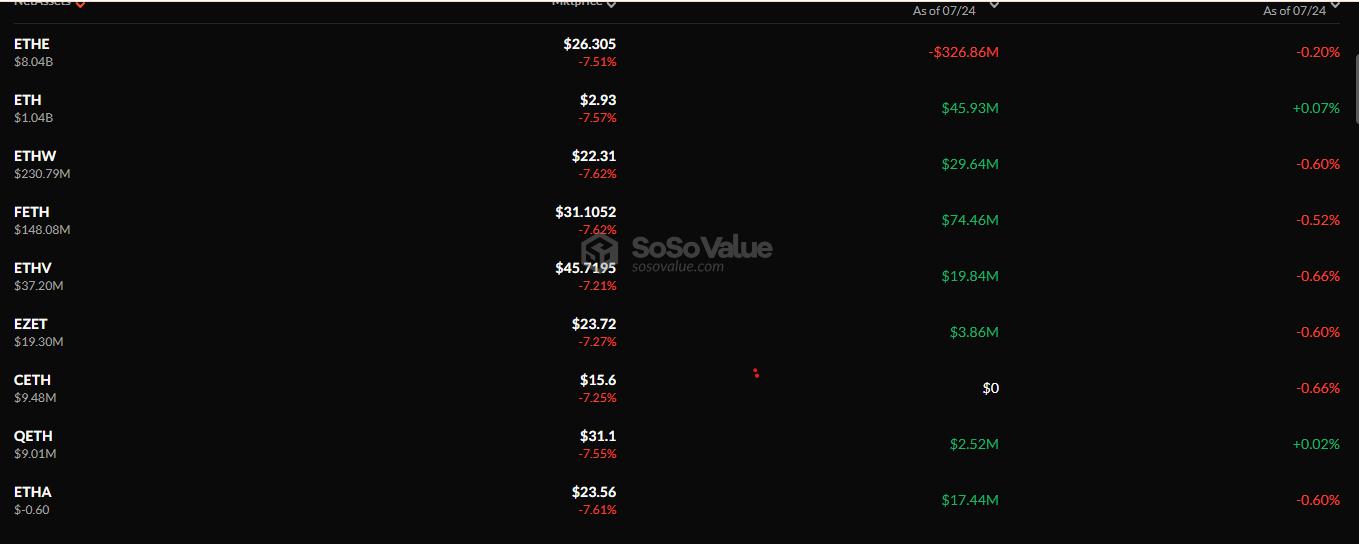
Ethereum ETFs flows
The total trading volume of ETH ETFs on Wednesday was at $1.05 billion.
Ethereum ETFs' weak showing compared to their first-day launch is typical of ETFs, as flows tend to slow after excitement surrounding their launch, noted one analyst. The general decline across the US stock market may also have played a role in slowing down its flows.
Furthermore, in an interview with CoinDesk, BlackRock's head of digital assets, Rob Mitchnick, noted that the SEC isn't discussing the possibility of issuers staking ETH as it already made its stance clear. Ethereum ETF issuers removed language related to staking from their applications after reports that the SEC wasn't comfortable with the concept.
Nate Geraci, President of the ETF Store, believes staking within ETH ETFs is a matter of "when" and not "if," especially as most politicians are turning pro-crypto to win the support of crypto-centric voters.
Meanwhile, rumors have flooded X that an Ethereum Foundation-related wallet moved 92,000 ETH worth about $289 million to another address after seven years. Traders often interpret such transfers as a potential sale. If the move is true, ETH may experience a slight decline as the Ethereum Foundation's sales have historically triggered a decrease in ETH's price.
ETH Technical Analysis: Ethereum could drop to test key support level
Ethereum is trading around $3,140 on Wednesday, down nearly 8% on the day. The 8% sharp decline has seen ETH sustain $124.78 million worth of liquidations in the past 24 hours — about 25% higher than that of Bitcoin. Long liquidations surged to $117.81 million, while short liquidations were just shy of $7 million.
ETH broke the $3,205 key support as it's now trading within the $2,852 to $3,357 key range, where it traded for more than one month — April 12 to May 19. ETH's price is following the same pattern as Bitcoin post-ETF launch, when BTC dropped about 15% before rebounding. ETH has dropped by 11% since reaching a high of $3,562 on Sunday. A similar 15% drop will see ETH approach the $3,000 psychological level.
It's important to note that intense outflows from Grayscale's GBTC largely triggered BTC's post-ETF price decline. However, BTC quickly recovered and surged by 92% within two months after GBTC outflows diminished.
In the case of ETH, the outflows from Grayscale's Ethereum Trust (ETHE) have been strong due to its current trading at net asset value, unlike GBTC, which was trading at a discount when BTC ETFs launched. Grayscale still holds 2,489,075 ETH worth about $7.9 billion.
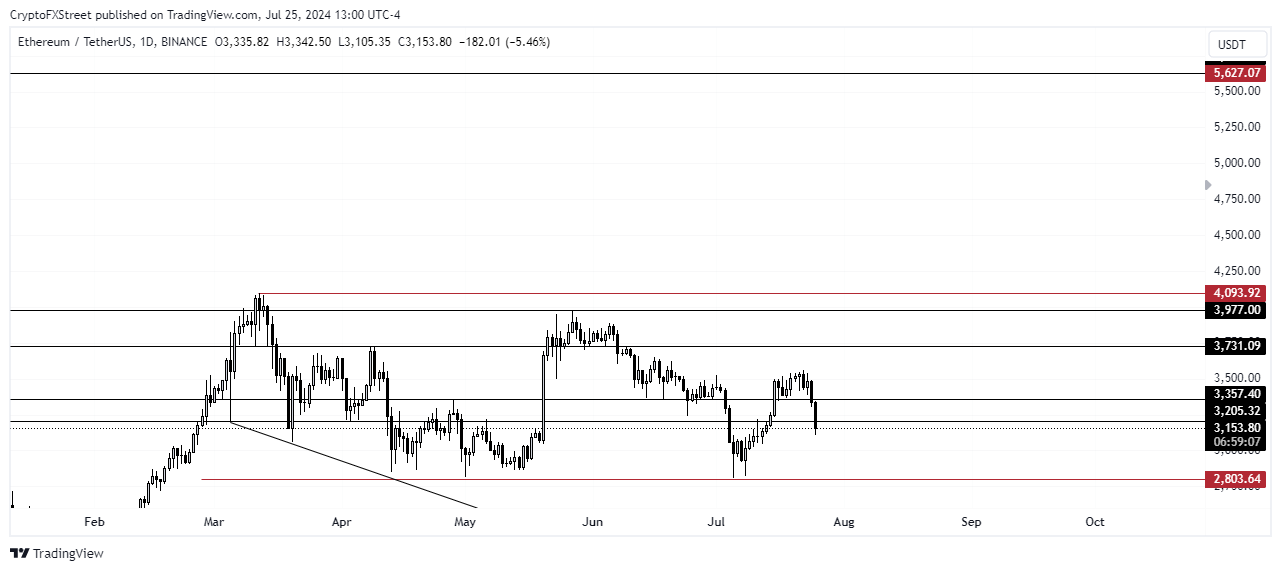
ETH/USDT daily chart
As a result, outflows from ETHE may push ETH to test support ranging from $2,852 to $2,800 before rebounding to potentially set a new all-time high above $5,000.
A daily candlestick close above $3,357 will invalidate the bearish thesis.
Ethereum FAQs
Ethereum is a decentralized open-source blockchain with smart contracts functionality. Serving as the basal network for the Ether (ETH) cryptocurrency, it is the second largest crypto and largest altcoin by market capitalization. The Ethereum network is tailored for scalability, programmability, security, and decentralization, attributes that make it popular among developers.
Ethereum uses decentralized blockchain technology, where developers can build and deploy applications that are independent of the central authority. To make this easier, the network has a programming language in place, which helps users create self-executing smart contracts. A smart contract is basically a code that can be verified and allows inter-user transactions.
Staking is a process where investors grow their portfolios by locking their assets for a specified duration instead of selling them. It is used by most blockchains, especially the ones that employ Proof-of-Stake (PoS) mechanism, with users earning rewards as an incentive for committing their tokens. For most long-term cryptocurrency holders, staking is a strategy to make passive income from your assets, putting them to work in exchange for reward generation.
Ethereum transitioned from a Proof-of-Work (PoW) to a Proof-of-Stake (PoS) mechanism in an event christened “The Merge.” The transformation came as the network wanted to achieve more security, cut down on energy consumption by 99.95%, and execute new scaling solutions with a possible threshold of 100,000 transactions per second. With PoS, there are less entry barriers for miners considering the reduced energy demands.
Recommended Articles


