

Bitcoin sets the stage for a potential “destruction of fiat currency“

Source Fxstreet
  • Bitcoin price action against the US Money Stock is similar to the 1970s Stagflation Era, according to Peter Brandt's recent tweet.
  • Brandt's post suggests that the end of this consolidation could see BTC ascend rapidly.
  • The veteran trader suggests that the devaluation of fiat currencies could propel Bitcoin.

In a recent tweet on the social media platform X, formerly Twitter, Peter Brandt, a seasoned analyst, suggested that Bitcoin (BTC) price could be due for a massive uptrend. He compared the current BTC consolidation to the Stagflation Crisis of 1970.

Bitcoin price action vs stagflation of the past

Instead of comparing the bare-bones chart of Bitcoin price against the stock market, as many would, Peter Brandt used BTC against the total US Money Stock. This provides context to the massive expansion of the money supply and the unprecedented monetary policies implemented by central banks in response to the COVID-19 pandemic. 

This comparison puts in perspective how the two events, the COVID-19 and stagflation era, although spread far apart from each other, could have had a similar effect devaluating effect on fiat currencies. It is clear that the events that occurred in 1970 demonstrated two important facets of fiat currencies – fragility and the potential for their devaluation in the face of economic turmoil and misguided policies

The only difference between the 1970s and 2024 is the presence of a better currency—Bitcoin. Not only is BTC’s supply fixed and limited, but it could emerge as a viable alternative to fiat currencies and a hedge against inflation. Additionally, the institutions already see it as an alternative, which also explains the recent regulatory developments that have led to the approval of not one but two spot crypto ETFs. 

So, Brandt’s post states that if history rhymes, BTC’s market value could ascend rapidly,much like the post-1970s stagflation. This aligns with Bitcoin’s core argument, i.e., " destruction of fiat currencies.”
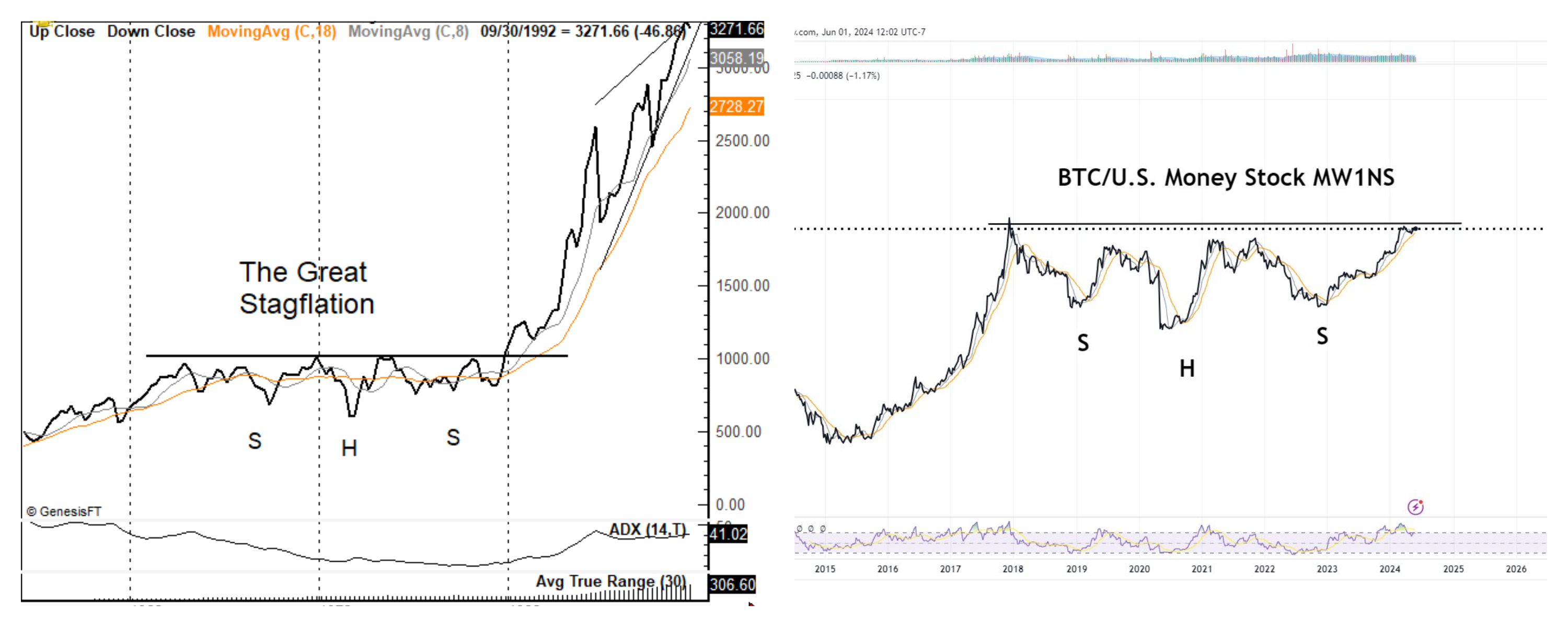
BTCUSD/WM1NS 1-week chart

BTCUSD/WM1NS 1-week chart

BTC target if history repeats

Due to the comparison of BTC against US Money Stock, it is unlikely to find targets based on simple chart pattern projections. The long-term target of Bitcoin price continues to remain mysterious, with forecasts from industry experts that range from $100,000 to $1 million per BTC. 

For a short-term target and how BTC could play out, refer to the following FXStreet posts.

  • Bitcoin Weekly Forecast: BTC likely to provide another buying opportunity
  • Bitcoin Weekly Forecast: BTC struggles, but $80K is at striking distance
  • Bitcoin Weekly Forecast: Is BTC out of the woods?
Disclaimer: For information purposes only. Past performance is not indicative of future results.
placeholder
Fed hike odds near 90% into Wednesday's decision — how to trade the dollar, gold and the S&P 500A 0.3% monthly core CPI print has lifted the market-implied probability of a 25bp Fed hike on 16 September to roughly 86.5% ~ 90%, which would be the first increase since July 2023. Here is the decision timeline, the pricing versus the forecasts, both scenarios, and the key levels for the dollar, gold and the S&P 500.
Author  Suzie
Sep 14, Mon
A 0.3% monthly core CPI print has lifted the market-implied probability of a 25bp Fed hike on 16 September to roughly 86.5% ~ 90%, which would be the first increase since July 2023. Here is the decision timeline, the pricing versus the forecasts, both scenarios, and the key levels for the dollar, gold and the S&P 500.
placeholder
Bitcoin falls below $75,000 as the CLARITY Act fails in the Senate — what the vote means for cryptoThe US Senate blocked the Digital Asset Market CLARITY Act in a 49-50 procedural vote, sending Bitcoin briefly below $75,000 — its biggest one-day drop since June. Ethereum fell more than 8%, Coinbase slid 10% and $75 billion of crypto market value evaporated. Here is what the vote was, why it failed, and the levels that matter now.
Author  Suzie
Sep 16, Wed
The US Senate blocked the Digital Asset Market CLARITY Act in a 49-50 procedural vote, sending Bitcoin briefly below $75,000 — its biggest one-day drop since June. Ethereum fell more than 8%, Coinbase slid 10% and $75 billion of crypto market value evaporated. Here is what the vote was, why it failed, and the levels that matter now.
placeholder
Dollar index tops 100 for the first time since July as the Fed's hawkish dot plot sinks inThe U.S. dollar index broke back above 100 for the first time since 31 July after the Fed delivered its first rate hike since 2023, with the dot plot showing 16 of 18 officials expect at least one more increase this year. Here are the levels that matter for DXY, the currencies feeling it most, and what to watch next.
Author  Irene Q.
Sep 17, Thu
The U.S. dollar index broke back above 100 for the first time since 31 July after the Fed delivered its first rate hike since 2023, with the dot plot showing 16 of 18 officials expect at least one more increase this year. Here are the levels that matter for DXY, the currencies feeling it most, and what to watch next.
placeholder
Gold rebounds to near $4,350 on weaker US Dollar, falling oil pricesGold price (XAU/USD) rises to near $4,345 during the early Asian session on Friday. The precious metal rebounds from a six-week low amid falling oil prices and a weaker US Dollar (USD). Traders continue to assess the latest Federal Reserve (Fed) rate hike and policy cues.
Author  FXStreet
Yesterday 01: 32
Gold price (XAU/USD) rises to near $4,345 during the early Asian session on Friday. The precious metal rebounds from a six-week low amid falling oil prices and a weaker US Dollar (USD). Traders continue to assess the latest Federal Reserve (Fed) rate hike and policy cues.
placeholder
US to delay new "overcapacity" tariffs on China — what the pause means for trade, inflation and the dollarWashington is expected to hold off announcing new tariffs over Chinese "overcapacity" until after the 24 September summit, according to Bloomberg. The postponed plan would have added 7.5% to Chinese goods, taking second-term US tariffs to around 20%. Here is what is on the table, and what a deal versus no deal would mean for the yuan, Hong Kong equities and the dollar.
Author  Mitrade
18 hours ago
Washington is expected to hold off announcing new tariffs over Chinese "overcapacity" until after the 24 September summit, according to Bloomberg. The postponed plan would have added 7.5% to Chinese goods, taking second-term US tariffs to around 20%. Here is what is on the table, and what a deal versus no deal would mean for the yuan, Hong Kong equities and the dollar.
Related Instrument
goTop
quote