

Bitcoin Layer 2 Merlin chain TVL climbs 20%, defying broad market correction

Source Fxstreet
  • Merlin chain’s TVL added 20% this week, and crossed $800 million on Thursday. 
  • Bitcoin Layer 2 assets noted double-digit losses in the past week. 
  • Stacks, Elastos, SatoshiVM, BVM are hit by a correction as Bitcoin hovers around $61,000. 

Merlin Chain, a Bitcoin Layer 2 solution, has amassed $814 million in total value of assets locked (TVL) in under two months, according to DeFiLlama data. The increase came despite Bitcoin’s decline to the $61,000 level, which dragged down the prices of other BTC Layer 2 solutions such as Stacks (STX), Elastos (ELA), SatoshiVM (SVM) and BVM (BVM). 

New Bitcoin Layer 2 chain announces airdrop, amasses over $800 million TVL

Bitcoin Layer 2 chain Merlin experienced a 20% increase in its TVL this week despite the broad correction in BTC and its ecosystem tokens. BTC price has declined by around 13% in the weekly timeframe, dragging down its Layer 2 tokens with it. 

STX, ELA, SVM and BVM prices declined between 25% and 30% in the past week, according to CoinGecko data. Despite these developments in Bitcoin, Layer 2 solution Merlin chain has amassed $814 million in TVL, with a steady increase throughout this week. 
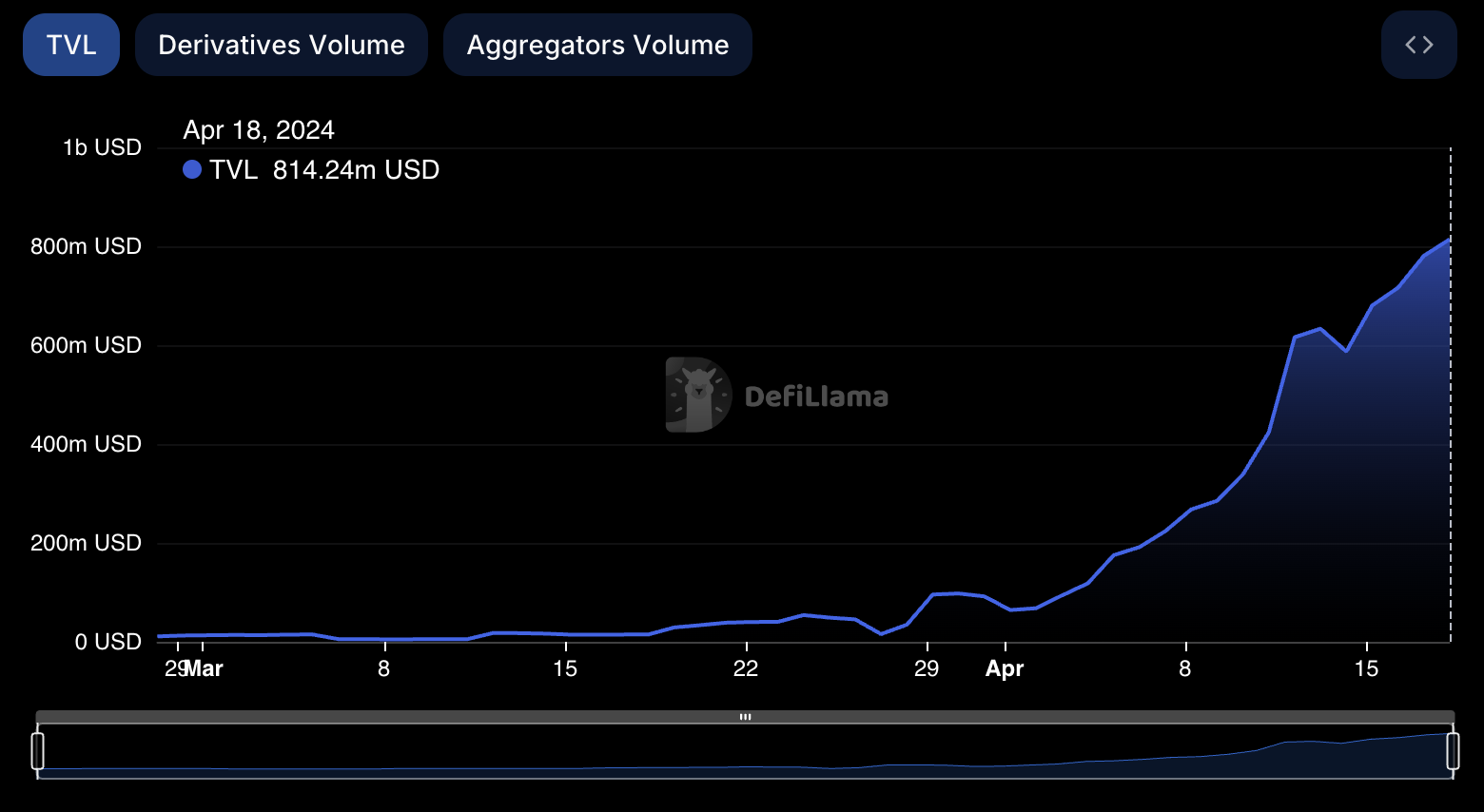
Merlin

Merlin TVL 

The increase in Merlin Chain could be attributed to the fact that its governance token MERL is expected to go live on several crypto exchanges, including OKX, on Friday. Alongside its exchange listing, Merlin announced an airdrop for eligible users on the OKX exchange, announced in an official tweet on X. 

Traders need to exercise caution when participating in airdrops and when clicking on links associated with airdrop announcements. There have been several scams where participants lose their investment when attempting to claim airdrops, due to phishing scams and fake accounts on X. 

The upcoming Bitcoin mining difficulty adjustment, known as the halving event, is likely the driver of the market correction. BTC holders and traders are likely offloading their risk assets prior to the scheduled halving on April 20. 

In the last two weeks of March and the first ten days of April, Bitcoin rallied in response to net positive inflow to the Exchange Traded Funds (ETFs) and institutional interest in the asset. The halving and macroeconomic events have likely catalyzed the recent decline in the asset’s price, with Layer 2 assets and ecosystem tokens feeling the ripple effect. 

Disclaimer: For information purposes only. Past performance is not indicative of future results.
placeholder
Fed hike odds near 90% into Wednesday's decision — how to trade the dollar, gold and the S&P 500A 0.3% monthly core CPI print has lifted the market-implied probability of a 25bp Fed hike on 16 September to roughly 86.5% ~ 90%, which would be the first increase since July 2023. Here is the decision timeline, the pricing versus the forecasts, both scenarios, and the key levels for the dollar, gold and the S&P 500.
Author  Suzie
Sep 14, Mon
A 0.3% monthly core CPI print has lifted the market-implied probability of a 25bp Fed hike on 16 September to roughly 86.5% ~ 90%, which would be the first increase since July 2023. Here is the decision timeline, the pricing versus the forecasts, both scenarios, and the key levels for the dollar, gold and the S&P 500.
placeholder
Bitcoin falls below $75,000 as the CLARITY Act fails in the Senate — what the vote means for cryptoThe US Senate blocked the Digital Asset Market CLARITY Act in a 49-50 procedural vote, sending Bitcoin briefly below $75,000 — its biggest one-day drop since June. Ethereum fell more than 8%, Coinbase slid 10% and $75 billion of crypto market value evaporated. Here is what the vote was, why it failed, and the levels that matter now.
Author  Suzie
Sep 16, Wed
The US Senate blocked the Digital Asset Market CLARITY Act in a 49-50 procedural vote, sending Bitcoin briefly below $75,000 — its biggest one-day drop since June. Ethereum fell more than 8%, Coinbase slid 10% and $75 billion of crypto market value evaporated. Here is what the vote was, why it failed, and the levels that matter now.
placeholder
Dollar index tops 100 for the first time since July as the Fed's hawkish dot plot sinks inThe U.S. dollar index broke back above 100 for the first time since 31 July after the Fed delivered its first rate hike since 2023, with the dot plot showing 16 of 18 officials expect at least one more increase this year. Here are the levels that matter for DXY, the currencies feeling it most, and what to watch next.
Author  Irene Q.
Sep 17, Thu
The U.S. dollar index broke back above 100 for the first time since 31 July after the Fed delivered its first rate hike since 2023, with the dot plot showing 16 of 18 officials expect at least one more increase this year. Here are the levels that matter for DXY, the currencies feeling it most, and what to watch next.
placeholder
Gold rebounds to near $4,350 on weaker US Dollar, falling oil pricesGold price (XAU/USD) rises to near $4,345 during the early Asian session on Friday. The precious metal rebounds from a six-week low amid falling oil prices and a weaker US Dollar (USD). Traders continue to assess the latest Federal Reserve (Fed) rate hike and policy cues.
Author  FXStreet
Sep 18, Fri
Gold price (XAU/USD) rises to near $4,345 during the early Asian session on Friday. The precious metal rebounds from a six-week low amid falling oil prices and a weaker US Dollar (USD). Traders continue to assess the latest Federal Reserve (Fed) rate hike and policy cues.
placeholder
US to delay new "overcapacity" tariffs on China — what the pause means for trade, inflation and the dollarWashington is expected to hold off announcing new tariffs over Chinese "overcapacity" until after the 24 September summit, according to Bloomberg. The postponed plan would have added 7.5% to Chinese goods, taking second-term US tariffs to around 20%. Here is what is on the table, and what a deal versus no deal would mean for the yuan, Hong Kong equities and the dollar.
Author  Mitrade
Sep 18, Fri
Washington is expected to hold off announcing new tariffs over Chinese "overcapacity" until after the 24 September summit, according to Bloomberg. The postponed plan would have added 7.5% to Chinese goods, taking second-term US tariffs to around 20%. Here is what is on the table, and what a deal versus no deal would mean for the yuan, Hong Kong equities and the dollar.
Related Instrument
goTop
quote