


USD/INR holds steady as traders await fresh catalysts
- The Indian Rupee trades sideways in Monday’s Asian session.
- Foreign equity inflows drag the INR lower, but lower crude oil prices and likely RBI intervention could cap its downside.
- Investors brace for India’s October CPI inflation report, which is due on Tuesday.
The Indian Rupee (INR) flats lines on Monday after falling to a record low in the previous session. The local currency remains vulnerable amid the sustained outflows from local stocks and expectations of a stronger Greenback and higher US bond yields after Donald Trump won the US election.
On the other hand, the decline in crude oil prices might help limit the INR’s losses as India is the world's third-largest oil consumer. Additionally, the routine intervention by the Reserve Bank of India (RBI) to sell USD might prevent the INR from significant depreciation in the near term. Traders will keep an eye on India’s October Consumer Price Index (CPI), which is due on Tuesday. On the US docket, the CPI inflation report will be released on Wednesday.
Daily Digest Market Movers: Indian Rupee trades flat amid multiple headwinds
- Foreign investors have withdrawn more than $1.5 billion from Indian equities so far in November, adding to the $11 billion outflow in October.
- Benchmark Indian equity indexes Nifty 50 and BSE Sensex ended down by 0.2% and 0.1% on Friday, respectively, marking the fifth weekly decline in six weeks. The Nifty is down 8.1% from its record high in late September.
- The Indian CPI inflation is expected to rise to 5.80% YoY in October from 5.49% in September.
- The preliminary University of Michigan's Consumer Sentiment Index improved to 73.0 in November from 70.5 in October, better than the market expectation of 71.0. This figure is the highest in seven months.
- Minneapolis Fed President Neel Kashkari said the US economy has remained remarkably strong as the Fed progressed in beating back inflation, but the US central bank was still “not all the way home,” per Bloomberg.
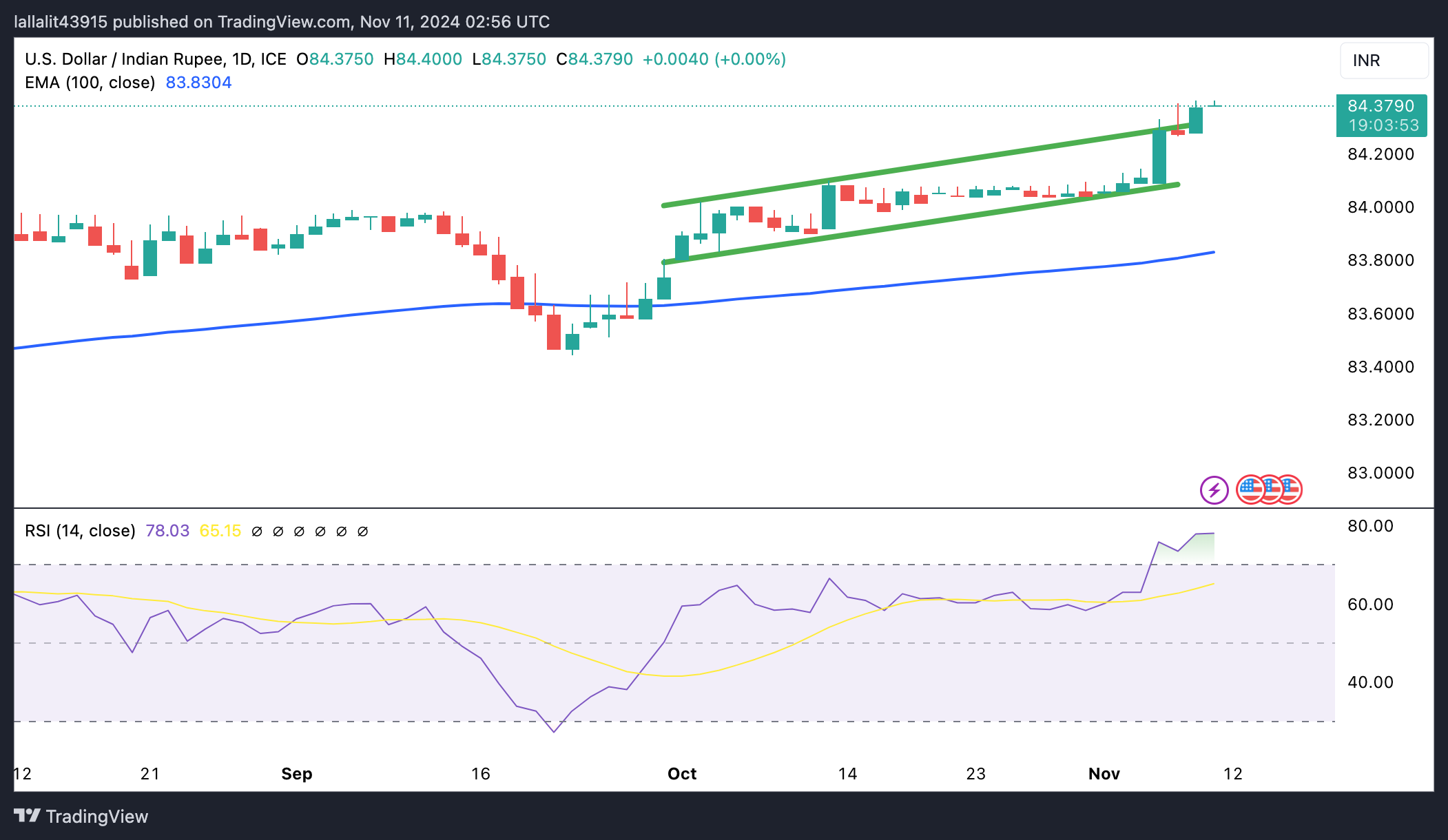
Technical Analysis: USD/INR’s constructive outlook remains in place, eyes on overbought RSI
The Indian Rupee trades on a flat note on the day. The bullish outlook of the USD/INR pair remains in play, with the pair holding above the key 100-day Exponential Moving Average (EMA) on the daily timeframe. However, additional consolidation should not be ruled out before positioning for any short-term USD/INR appreciation as the 14-day Relative Strength Index (RSI) is over the midline near 77.75, indicating an overbought condition.
A sustained buying momentum could take USD/INR to the next upside barrier at 84.50. Further north, the next hurdle emerges at the 85.00 psychological level.
On the downside, a move below the lower limit of the trend channel and the high of October 11 in the 84.05-84.10 zone could pave the way for a selloff to 83.83, the 100-day EMA. The additional downside level to watch is 83.46, the low of September 24.
Indian Rupee FAQs
The Indian Rupee (INR) is one of the most sensitive currencies to external factors. The price of Crude Oil (the country is highly dependent on imported Oil), the value of the US Dollar – most trade is conducted in USD – and the level of foreign investment, are all influential. Direct intervention by the Reserve Bank of India (RBI) in FX markets to keep the exchange rate stable, as well as the level of interest rates set by the RBI, are further major influencing factors on the Rupee.
The Reserve Bank of India (RBI) actively intervenes in forex markets to maintain a stable exchange rate, to help facilitate trade. In addition, the RBI tries to maintain the inflation rate at its 4% target by adjusting interest rates. Higher interest rates usually strengthen the Rupee. This is due to the role of the ‘carry trade’ in which investors borrow in countries with lower interest rates so as to place their money in countries’ offering relatively higher interest rates and profit from the difference.
Macroeconomic factors that influence the value of the Rupee include inflation, interest rates, the economic growth rate (GDP), the balance of trade, and inflows from foreign investment. A higher growth rate can lead to more overseas investment, pushing up demand for the Rupee. A less negative balance of trade will eventually lead to a stronger Rupee. Higher interest rates, especially real rates (interest rates less inflation) are also positive for the Rupee. A risk-on environment can lead to greater inflows of Foreign Direct and Indirect Investment (FDI and FII), which also benefit the Rupee.
Higher inflation, particularly, if it is comparatively higher than India’s peers, is generally negative for the currency as it reflects devaluation through oversupply. Inflation also increases the cost of exports, leading to more Rupees being sold to purchase foreign imports, which is Rupee-negative. At the same time, higher inflation usually leads to the Reserve Bank of India (RBI) raising interest rates and this can be positive for the Rupee, due to increased demand from international investors. The opposite effect is true of lower inflation.
Recommended Articles


