


Pound Sterling rally stalls as focus shifts to US core PCE inflation data
- The Pound Sterling drops after facing selling pressure near 1.2800 due to multiple tailwinds.
- A soft UK inflation outlook could prompt the BoE to start unwinding higher interest rates.
- The US Dollar recovers amid uncertainty ahead of the US core PCE price index.
The Pound Sterling (GBP) corrects to 1.2750 against the US Dollar (USD) in Wednesday’s London session after posting a fresh 10-week high at 1.2800 on Tuesday. The rally in the GBP/USD pair stalls as the United Kingdom (UK) inflation outlook softens and the US Dollar (USD) comes out of the woods.
UK shop price inflation data from the British Retail Consortium (BRC) indicated that prices of food and non-food items eased significantly in May. Annual shop price changes in the popular retail outlets in the UK grew by 0.6%, the slowest pace since November 2021, from the prior reading of 0.8%. Food price inflation dropped for the 13th straight month, declining to 3.2% from 3.4% in April. The agency noted that retailers are passing the benefit of lower prices to consumers.
A softer UK inflation outlook would boost expectations of rate cuts by the Bank of England (BoE), which has been maintaining a restrictive interest rate stance since December 2021. Currently, investors expect that the BoE could use the August meeting as the earliest point to begin the policy-normalization process.
Daily digest market movers: Pound Sterling falls as Fed maintains hawkish interest rate guidance
- The Pound Sterling falls to 1.2750 against the US Dollar as the market sentiment turns cautious. The appeal for risk-perceived assets has become uncertain as investors expect that the Federal Reserve (Fed) will not start reducing interest rates before the fourth quarter of the year. S&P 500 futures have posted significant losses in the Asian session, reflecting a risk-off market mood. The US Dollar Index (DXY), which tracks the Greenback’s value against six major currencies, recovers to 104.70
- Traders redeemed their bets that the Fed to begin lowering borrowing costs from their current levels in the September meeting. The reason traders unwind their bets is that Fed policymakers want to see price pressures decline for months before considering interest rate cuts.
- The CME FedWatch tool shows that the probability of interest rates coming down from their current levels in September has declined to 44% from 58% recorded a week ago. On Tuesday, Minneapolis Fed Bank President Neel Kashkari said that the possibility of more rate hikes is quite low but has not been taken off the table. Kashkari emphasized that the Fed should wait for significant progress in disinflation before moving to rate cuts.
- This week, investors will focus on the core Personal Consumption Expenditure Price Index (PCE) data for April, which will be published on Friday, to get fresh cues about the Federal Reserve interest rate outlook. The Fed’s preferred inflation measure is estimated to have grown steadily on a monthly and annual basis at 0.3% and 2.8%, respectively. Steady inflation growth would prompt the likelihood of interest rates remaining at higher levels.
Technical Analysis: Pound Sterling faces pressure near 1.2800
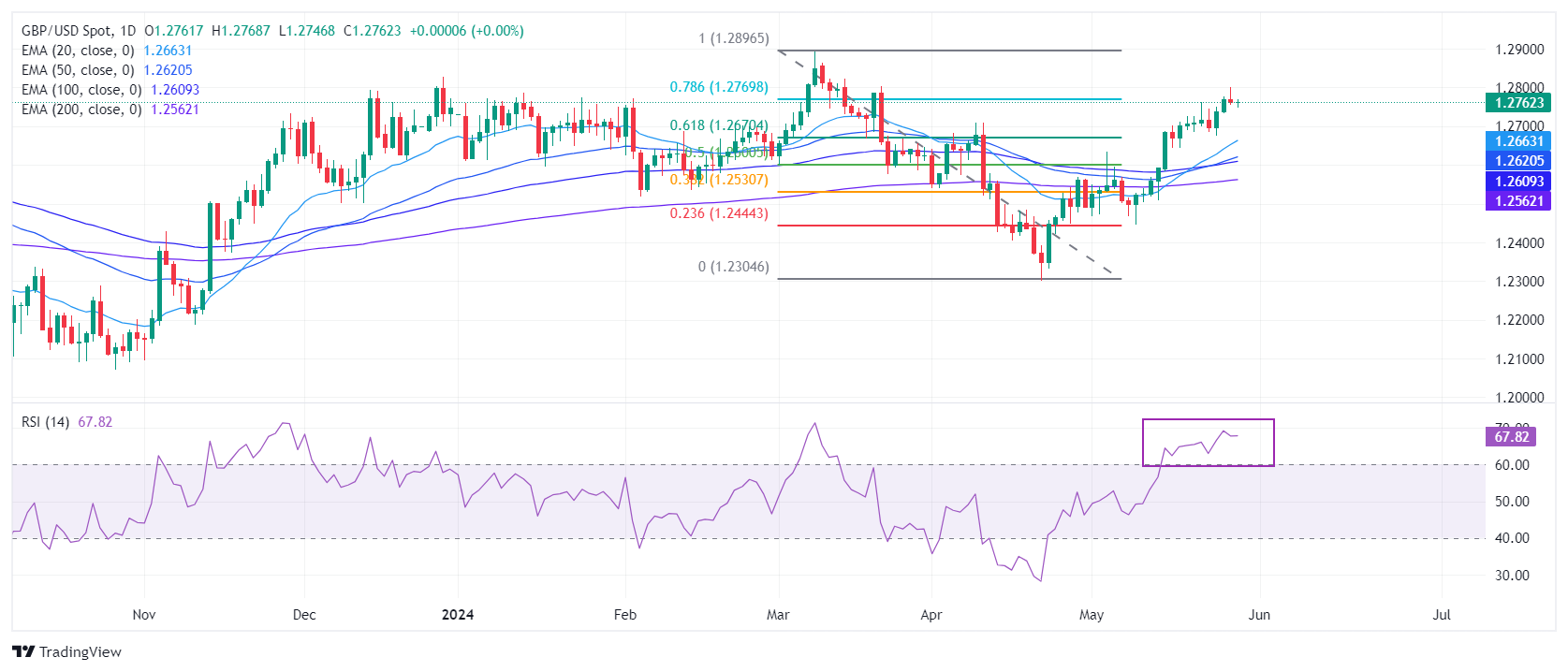
The Pound Sterling faces selling pressure near the round-level resistance of 1.2800. The GBP/USD pair is expected to remain volatile ahead of the release of the Fed’s preferred inflation gauge on Friday. However, the near-term outlook of the Cable remains firm as it holds the 61.8% Fibonacci retracement (plotted from the March 8 high of 1.2900 to the April 22 low at 1.2300) at 1.2670.
The Cable is expected to continue in the bullish trajectory as all short-to-long-term Exponential Moving Averages (EMAs) are sloping higher, suggesting a strong uptrend.
The 14-period Relative Strength Index (RSI) has shifted into the bullish range of 60.00-80.00, suggesting that the momentum has leaned toward the upside.
Pound Sterling FAQs
The Pound Sterling (GBP) is the oldest currency in the world (886 AD) and the official currency of the United Kingdom. It is the fourth most traded unit for foreign exchange (FX) in the world, accounting for 12% of all transactions, averaging $630 billion a day, according to 2022 data. Its key trading pairs are GBP/USD, aka ‘Cable’, which accounts for 11% of FX, GBP/JPY, or the ‘Dragon’ as it is known by traders (3%), and EUR/GBP (2%). The Pound Sterling is issued by the Bank of England (BoE).
The single most important factor influencing the value of the Pound Sterling is monetary policy decided by the Bank of England. The BoE bases its decisions on whether it has achieved its primary goal of “price stability” – a steady inflation rate of around 2%. Its primary tool for achieving this is the adjustment of interest rates. When inflation is too high, the BoE will try to rein it in by raising interest rates, making it more expensive for people and businesses to access credit. This is generally positive for GBP, as higher interest rates make the UK a more attractive place for global investors to park their money. When inflation falls too low it is a sign economic growth is slowing. In this scenario, the BoE will consider lowering interest rates to cheapen credit so businesses will borrow more to invest in growth-generating projects.
Data releases gauge the health of the economy and can impact the value of the Pound Sterling. Indicators such as GDP, Manufacturing and Services PMIs, and employment can all influence the direction of the GBP. A strong economy is good for Sterling. Not only does it attract more foreign investment but it may encourage the BoE to put up interest rates, which will directly strengthen GBP. Otherwise, if economic data is weak, the Pound Sterling is likely to fall.
Another significant data release for the Pound Sterling is the Trade Balance. This indicator measures the difference between what a country earns from its exports and what it spends on imports over a given period. If a country produces highly sought-after exports, its currency will benefit purely from the extra demand created from foreign buyers seeking to purchase these goods. Therefore, a positive net Trade Balance strengthens a currency and vice versa for a negative balance.
Recommended Articles


