


Mexican Peso gains after weak manufacturing PMI data hits peers
- The Mexican Peso is trading higher in most key pairs after the release of weak manufacturing data hits its counterparts.
- Manufacturing PMI data out on Tuesday was lower than expected across the board.
- USD/MXN’s short-term trend has probably reversed from bullish to bearish.
The Mexican Peso (MXN) trades higher in most pairs midweek following widespread weakness among the majors after the release of disappointing Manufacturing Purchasing Manager Index (PMI) data weighed, especially on the US Dollar (USD).
Mexican Peso benefits from subdued Manufacturing data in US, Europe
The Mexican Peso gained its key pairs – USD/MXN, EUR/MXN and GBP/MXN – after the release of PMI data showed cracks in most developed economies. The Manufacturing PMI gauges were particularly low, and in the US it fell unexpectedly into contraction territory below 50.0, clocking in at 49.9, which was well below the estimated 52.0 and March’s print at 51.9.
In the UK, the manufacturing PMI also fell below 50, coming in at 48.7, from 50.3 previously, while in the Eurozone it fell to 45.6, missing estimates of an increase to 46.5.
Conversely, services sector PMIs rose by a greater-than-expected margin in most countries – bar the US.
Despite this, markets dialed forward their expectations for interest rate cuts by major central banks, especially the Federal Reserve (Fed).
Markets may be being optimistic about rate cuts, however, according to analysts at Rabobank, who quote a paragraph in the PMI reports stating that factory-cost pressures remain elevated.
“Yesterday’s manufacturing PMIs shouted ‘stagflation’, even if some heard ‘rate cuts’,” the Rabobank note said.
“..but its (the PMI report’s) fine print said: ‘Manufacturing has now registered the steeper rate of price increases in three of the past four months, with factory cost pressures intensifying in April amid higher raw material and fuel prices, contrasting with the wage-related services-led price pressures seen throughout much of 2023’,” the Rabobank note continues, suggesting the impact on FX could be short-lived.
Mexican Inflation data on tap
Mexican mid-month inflation data for April, out on Wednesday at 12:00 GMT, could adjust expectations for the Banxico’s policy approach going forward, given its insistence on data-dependency, as revealed in the last meeting’s minutes.
Mexican 1st half-month inflation in March is expected to steady at 4.48% on a year-over-year basis. On month, prices are expected to decline by 0.03% after rising 0.27% in the previous reading.
1st half-month core inflation is forecast to decline to 4.39% YoY in March from 4.69% previously. On a monthly basis, inflation is set to fall to 0.16% from 0.33%.
A higher-than-previous result is likely to further lower the probability of the central bank following up the March rate cut with another cut in the near term, and vice versa for a lower-than-previous result.
Higher interest rates generally appreciate a currency by attracting more inflows of foreign capital and the opposite for lower interest rates.
Technical Analysis: USD/MXN short-term trend now likely down
USD/MXN has probably reversed its short-term uptrend after breaking below the key 17.00 hurdle, the previous higher low – and more weakness is now expected as bears take control.
USD/MXN 4-hour Chart
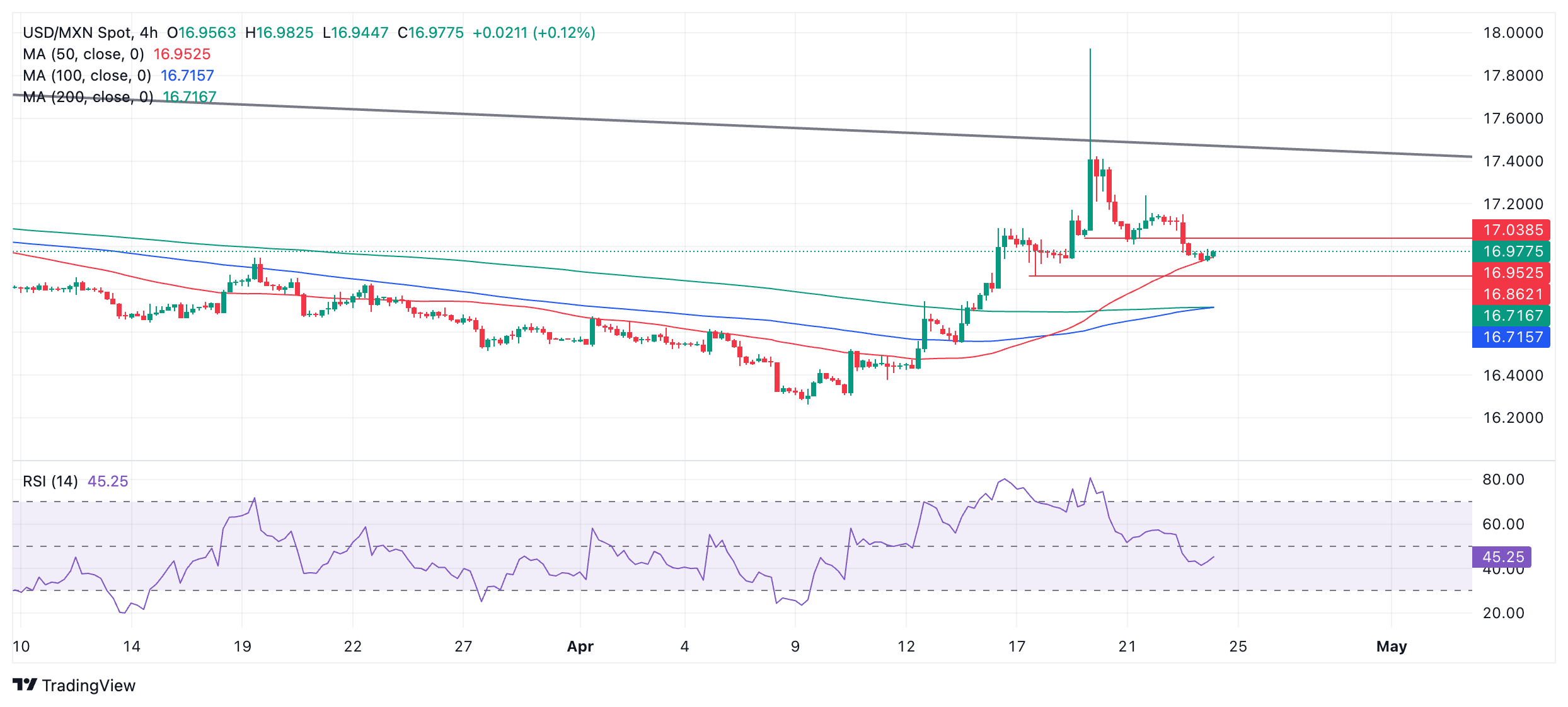
The next key support level lies at 16.86, where a major Moving Average also sits, providing dynamic support on a higher time frame chart. A decisive break below could usher in further weakness to 16.50 and then the April 9 lows at 16.26.
It will now take a decisive break above the major trendline for the long-term downtrend at roughly 17.45 to give bulls renewed confidence, and activate an upside target at roughly 18.15.
A decisive break would be one characterized by a longer-than-average green daily candlestick that pierces above the trendline and closes near its high, or three green candlesticks in a row that pierce above the level.
Economic Indicator
1st half-month Inflation
The 1st half-month core inflation index released by the Bank of Mexico is a measure of price movements by the comparison between the retail prices of a representative shopping basket of goods and services. The purchase power of Mexican Peso is dragged down by inflation. The inflation index is a key indicator since it is used by the central bank to set interest rates. Generally speaking, a high reading is seen as positive (or bullish) for the Mexican Peso, while a low reading is seen as negative (or Bearish).
Read more.Next release: Wed Apr 24, 2024 12:00
Frequency: Monthly
Consensus: -0.03%
Previous: 0.27%
Source: National Institute of Statistics and Geography of Mexico
Recommended Articles


