


Should You Buy or Sell Meta Stock After Its $95 Billion Bombshell Announcement?
Key Points
Meta is raising more money to build out its AI computing capacity.
Meta's results haven't been as good as some investors have hoped.
- Motley Fool Issues Rare "Total Conviction" Buy Alert ›
Meta Platforms (NASDAQ: META) just made a major announcement after its latest earnings report: It's planning to raise $95 billion. There's no secret about what this funding will be used for: building artificial intelligence (AI) computing capacity. Meta is choosing to do this through an equity sale, which poses problems for shareholders.
So, is Meta Platforms a buy or sell after this news? The stock market has already voted; Meta's shares were down about 2% the day of this announcement, when most of the market was up about 1%. This means the market kind of shrugged off this news, but should you?
Missed AI’s "Act 1"? Act 2 Could Be 15x Bigger. Most investors think they missed the AI boat because they didn't buy Nvidia in 2005. But according to our analysts, we’re only at the end of "Act 1"—the R&D phase. "Act 2" is the global rollout. Continue »

Image source: The Motley Fool.
Meta shareholders are getting diluted
With an equity sale, Meta is issuing new shares of stock to raise money. When more shares are introduced into the stock market, the total number of shares increases, so a single share now has a smaller claim on the company than before. This decreases its value because of shareholder dilution. This effect is very similar to how a government printing more money causes the purchasing power of currency to fall, as the U.S. has experienced. While this may seem like a large negative with no upside for existing shareholders, that's not necessarily the case.
The idea is that Meta will raise money by selling equity instead of taking on debt, which is a far more expensive form of capital. If Meta took on debt, it would need to pay principal and interest each month, just like if you or I took out a loan. However, Meta can also just issue shares to create new capital, and the cost of that is practically free for Meta. This is the smart way to raise capital, but investors will only tolerate so many equity raises before losing confidence in a company. This one may be large, but it might be the right move.
Meta is planning on using this money to fund its AI computing capacity build-out. While Meta has large cash flows to cover the majority of its expenses, its plans are far more ambitious than its current cash flows, so it needs to raise capital in order to fulfill them. Meta has seen huge increase in use of Meta Muse, its personal AI agent. This is Meta's primary pathway to monetizing its AI facilities, although it has other avenues it's also pursuing.
So, if you believe in what Meta is doing on the AI front, this is great news, as it will allow Meta to greatly expand its computing build-out plans. If you weren't a fan of how Meta is approaching AI, then this news shows that it's doubling down on previous plans, and now may be the time to jump ship.
What am I doing? I think I may be heading for the exits.
Meta Platforms' earnings are shrinking
Meta Platforms reported Q3 earnings last week and delivered strong 26% revenue growth. However, the cost of its operations is rising, and its operating margin has collapsed due to how much money it is paying for talent.
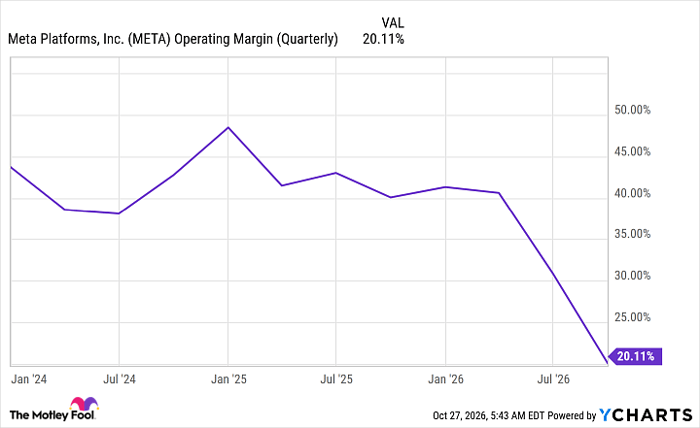
META Operating Margin (Quarterly) data by YCharts
That's not the efficient and profit-first Meta I invested in a couple of years ago, and it has me concerned that it's going too far into the AI realm without having a lot to show for it in terms of revenue growth, as some other big tech companies have. The stock isn't the most expensive at 21 times forward earnings, but it's far from cheap.
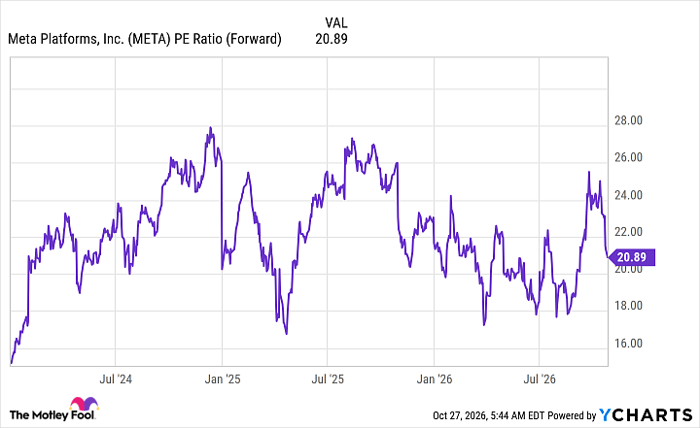
META PE Ratio (Forward) data by YCharts
As a result, I'll probably move on from Meta's stock in the near future. There are other investment options that are far more attractive right now, and Meta's capital raise plans are a bit too aggressive for my liking compared to the return on investment I'm seeing from the stock.
Should you buy stock in Meta Platforms right now?
Before you buy stock in Meta Platforms, consider this:
The Motley Fool Stock Advisor analyst team just identified what they believe are the 10 best stocks for investors to buy now… and Meta Platforms wasn’t one of them. The 10 stocks that made the cut could produce monster returns in the coming years.
Consider when Netflix made this list on December 17, 2004... if you invested $1,000 at the time of our recommendation, you’d have $334,308!* Or when Nvidia made this list on April 15, 2005... if you invested $1,000 at the time of our recommendation, you’d have $1,323,413!*
Now, it’s worth noting Stock Advisor’s total average return is 897% — a market-crushing outperformance compared to 213% for the S&P 500. Don't miss the latest top 10 list, available with Stock Advisor, and join an investing community built by individual investors for individual investors.
See the 10 stocks »
*Stock Advisor returns as of October 30, 2026.
Keithen Drury has positions in Meta Platforms. The Motley Fool has positions in and recommends Meta Platforms. The Motley Fool has a disclosure policy.
Recommended Articles


