


Nvidia Shareholders Have a Major Reason to Be Bullish After Jensen Huang's Latest Announcement
Key Points
Nvidia CEO Jensen Huang recently highlighted his company's ability to deliver complete AI factory performance.
The company's expanded hardware offerings are creating new revenue opportunities.
Huang believes that delays for AI factory build-outs will result in customers missing out on substantial sales opportunities.
- 10 stocks we like better than Nvidia ›
Nvidia's (NASDAQ: NVDA) GTC Conference in Berlin ran from Oct. 20 through Oct. 22, and CEO Jensen Huang shared some interesting insights into the evolution of the artificial intelligence (AI) market. In addition to expounding on the importance of AI technologies for European countries and companies, Huang detailed the significance of new technologies from his company.
Huang's keynote at the GTC event focused heavily on data centers transitioning into "AI factories" -- and he highlighted a new Nvidia product that's set to be central to the transformation. Here's why Nvidia's recent shifts in approach to the AI data center market look like a bullish development for shareholders.
Missed AI’s "Act 1"? Act 2 Could Be 15x Bigger. Most investors think they missed the AI boat because they didn't buy Nvidia in 2005. But according to our analysts, we’re only at the end of "Act 1"—the R&D phase. "Act 2" is the global rollout. Continue »
Image source: Getty Images.
Nvidia is broadening its exposure to AI trends
Huang used the occasion of GTC to spotlight Nvidia's new comprehensive server racks and their ability to deliver full AI factory performance. The product combines 72 of Nvidia's next-generation Vera Rubin graphics processing units (GPUs) with 256 new custom language processing unit chips.
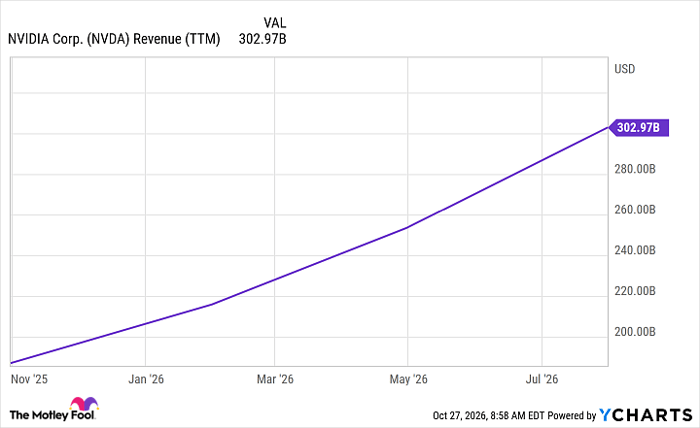
Crucially, the servers aren't just built around its Vera Rubin graphics processing units -- they also include the company's Vera family central processing units (CPUs). Through the integration of the company's CPUs and other hardware, Nvidia sees its monetization of AI compute applications broadening substantially. During the company's recent quarterly call, management said that its sales opportunity per gigawatt of compute has expanded from $18 billion with Hopper to $25 billion with Blackwell to $40 billion with the Vera Rubin family.
NVDA Revenue (TTM) data by YCharts.
The big increase in expected sales per gigawatt of compute is being aided substantially by Nvidia's CPU integrations, and the company expects that the increasing importance of AI inference will power new market share gains. While advanced GPUs are the crucial hardware for training advanced AI models, high-performance CPUs can often carry out the inference processes needed to actually run the models in ways that are more efficient in terms of hardware and energy costs.
Speaking on the company's new comprehensive server rack product at the company's previous GTC event in March, Huang said, "This is the AI future. This is where AI wants to go. It's designed for inference, this one workload. And this workload is what drives AI factories."
At the more recent GTC event in Berlin, Huang said that a 1-gigawatt AI factory would cost operators about $50 billion to set up. Meanwhile, he estimates that such a facility would generate roughly $40 billion in annual revenue, and that delaying bringing the AI factory online by just three months would result in the loss of $10 billion in potential sales.
The risk of missing out on tech breakthroughs and revenue has been central to the rapid build-out of AI infrastructure, and it does appear to be a meaningful one. Recent concerns about a valuation bubble in the AI space have created volatility for many stocks in the category, but Huang is highlighting a dynamic that could see players left behind if they don't spend sufficiently on AI compute capabilities.
Should you buy stock in Nvidia right now?
Before you buy stock in Nvidia, consider this:
The Motley Fool Stock Advisor analyst team just identified what they believe are the 10 best stocks for investors to buy now… and Nvidia wasn’t one of them. The 10 stocks that made the cut could produce monster returns in the coming years.
Consider when Netflix made this list on December 17, 2004... if you invested $1,000 at the time of our recommendation, you’d have $337,166!* Or when Nvidia made this list on April 15, 2005... if you invested $1,000 at the time of our recommendation, you’d have $1,339,143!*
Now, it’s worth noting Stock Advisor’s total average return is 904% — a market-crushing outperformance compared to 213% for the S&P 500. Don't miss the latest top 10 list, available with Stock Advisor, and join an investing community built by individual investors for individual investors.
See the 10 stocks »
*Stock Advisor returns as of October 29, 2026.
Keith Noonan has no position in any of the stocks mentioned. The Motley Fool has positions in and recommends Nvidia. The Motley Fool has a disclosure policy.
Recommended Articles


