


Japanese Yen flattens against US Dollar, BoJ policy takes centre stage
- Japanese Yen ranges around 157.80 against the US Dollar ahead of the BoJ’s policy decision.
- The BoJ is expected to hold interest rates steady at 1.25%.
- Investors also await key US data releases, and Tokyo CPI data.
The Japanese Yen (JPY) trades almost flat against the US Dollar (USD) at around 157.80 during the European trade on Thursday. The USD/JPY pair consolidates as investors shift their focus to the Bank of Japan’s (BoJ) monetary policy announcement on Friday.
BoJ meeting seen as a placeholder as markets focus on December Yen implications
Analysts at Commerzbank note that markets anticipate “the overnight rate remaining at 1.25%, and none of the economists surveyed by Bloomberg expects a hike this week,” leaving investors to focus instead on the policy outlook into year-end.
For FX markets, Commerzbank argues that “the more important question will therefore be what the BoJ signals about December.” They highlight that “markets currently price an around 80% probability of a rate hike by then, in line with our own expectation that the BoJ will raise the policy rate to 1.5%.” In their view, “recent BoJ communication, alongside the economic backdrop, increasingly suggests that the next step towards policy normalization is approaching.”
Interestingly, the Commerzbank highlighted that “additional support for this view” is coming from the BoJ’s semi-annual report on risks to the financial system, which they describe as “hardly the most obvious source of monetary policy signals.” Nonetheless, the bank underscores that “the report suggests that higher rates should remain manageable for Japan's financial system.” In particular, “in its stress test, the BoJ finds that even a rise in the policy rate to 2% should not pose major problems for Japanese banks and companies.” They add that “the increase to 1.25% has already been absorbed without significant disruption, as has the rise in longer-term government bond yields.”
Commerzbank stresses that the BoJ is careful not to present this as guidance, noting that “the BoJ stresses that the 2% assumption is not a forecast but merely part of the stress test scenario.” Even so, they judge that “the message for FX markets is noteworthy: financial stability does not appear to be a binding constraint on further policy normalization.” As a result, while “Friday itself may therefore provide only limited fresh momentum for the yen,” Commerzbank concludes that “our structurally constructive view on the Japanese currency remains intact.”
On Friday, market participants will also focus on the Tokyo Consumer Price Index (CPI) data for October, which will be published before the BoJ’s monetary policy decision. Tokyo CPI ex. Fresh Food is seen lower at 2.6% Year-on-Year (YoY) from 2.7% in September.
Meanwhile, the US Dollar trades slightly higher ahead of the United States (US) flash Q3 Gross Domestic Product (GDP) and Personal Consumption Expenditure (PCE) Price Index data for September, which will be published at 12:30 GMT.
As of writing, the US Dollar Index (DXY), which gauges the Greenback’s value against six major currencies, trades 0.1% higher to near 102.20.
According to TD Securities, incoming data should confirm that "Q3 GDP [will] show robust underlying growth," with "GDP growth [having] picked up in Q3 to 2.5% from 2.2% previously with underlying activity remaining robust." TD Securities notes that "consumption likely remained resilient while decelerating slightly," and that "fixed investment [was] also strong in large part due to AI." On the downside, they judge that "net exports likely acted as a major drag on GDP growth while being partially offset by a rebound in inventories," leaving the overall growth picture solid but uneven beneath the headline.
The US Dollar corrected on Wednesday after the Federal Reserve’s (Fed) monetary policy announcement, in which held interest rates steady in the 3.75%-4.00% range, as expected.
USD/JPY Technical Analysis
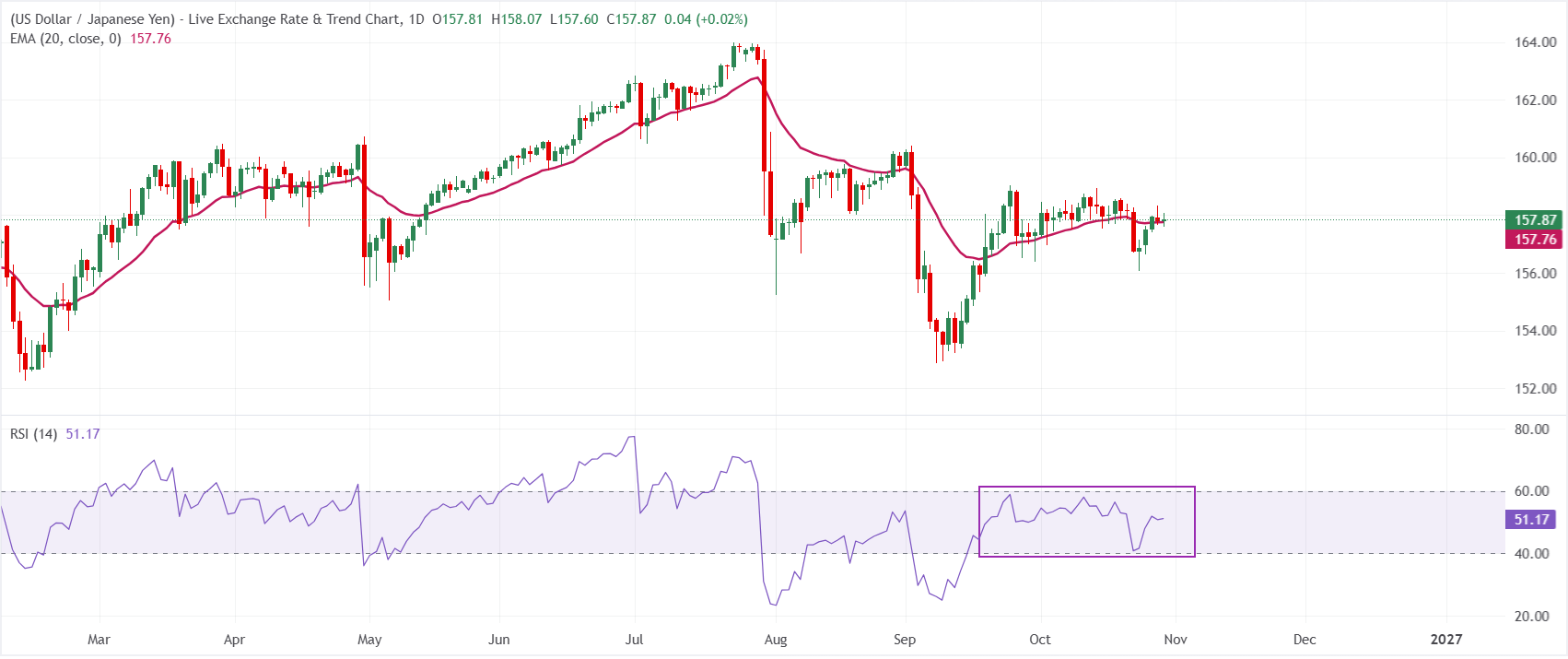
In the daily chart, USD/JPY trades at 157.87. The pair holds above the 20-period exponential moving average (EMA) at 157.76, which acts as immediate trend support and keeps the near-term bias mildly bullish. Momentum, as reflected by the Relative Strength Index (RSI) around 51, remains neutral to slightly positive, suggesting that buyers retain a modest advantage while avoiding overbought conditions.
On the downside, initial support is seen at the 20-day EMA clustered near 157.76, where a daily close below would hint at a deeper corrective phase toward recent lows. As long as USD/JPY defends this moving average on a closing basis, the broader constructive tone is likely to persist, leaving scope for the pair to probe higher levels that are not yet defined by nearby technical resistance.
(The technical analysis of this story was written with the help of an AI tool. Know more.)
Economic Indicator
BoJ Interest Rate Decision
The Bank of Japan (BoJ) announces its interest rate decision after each of the Bank’s eight scheduled annual meetings. Generally, if the BoJ is hawkish about the inflationary outlook of the economy and raises interest rates it is bullish for the Japanese Yen (JPY). Likewise, if the BoJ has a dovish view on the Japanese economy and keeps interest rates unchanged, or cuts them, it is usually bearish for JPY.
Read more.Next release: Fri Oct 30, 2026 03:00
Frequency: Irregular
Consensus: 1.25%
Previous: 1.25%
Source: Bank of Japan
Recommended Articles


