




What ASX August 2026 Earnings Season Revealed About the Australian Economy and What Comes Next
The most important month on the ASX calendar is almost done. More than 250 listed companies have delivered their full-year FY2026 results till now, providing the most comprehensive read of Australian corporate health since the last reporting cycle. Resources companies reported their strongest financial year since 2006. Australia's largest bank posted record cash profit. Telstra delivered its fourth consecutive year of dividend growth. And a clear pattern emerged across the winners: the companies that hit the reset button in FY2026 are the ones whose shares outperformed the market.
This guide covers what the key results actually showed, the themes that defined the season, which sectors beat and which disappointed, and what the final major results from Wesfarmers and Qantas will mean for how this season is ultimately judged.
The Dominant Theme: Reset Companies Won
The clearest pattern of August 2026 earnings season is that investors rewarded companies that went through structural change in FY2026 and delivered on their reset promises, often more than they rewarded companies that simply posted large profits.
Investors who kept faith with Australian companies pursuing restructuring and leadership changes are reaping the rewards, as signs of progress unveiled during the August earnings season sent their stocks soaring. CSL, ANZ Group, Treasury Wine Estates, and ASX Limited are among companies that hit the reset button during the 2026 financial year and now appear on track to deliver on their goals, with their shares outperforming the broader market as a result.
The second theme that defined the season is that forward guidance mattered more than backward profit numbers. ASX reporting season rewards clarity more than it rewards size. Zip posted a record FY26 cash EBTDA of $268.9 million, up 57.9%, and still reversed hard in the session after results as markets questioned FY27 guidance. Northern Star delivered a record profit but flagged materially higher costs ahead and got sold. A company could beat FY26 consensus and still underperform if its forward guidance is disappointing. That is the single most important lesson Australian traders took from this season.
BHP: Copper Overtook Iron Ore for the First Time
BHP (BHP.AU) delivered the headline result of the season on August 18.
BHP Group delivered higher earnings and cash generation for the year ended 30 June 2026, supported by improved realised commodity prices, production performance and cost management. The mining group reported attributable profit of US$9.8 billion, a 9% increase from US$9.0 billion in FY25. Underlying attributable profit exceeded US$13 billion, representing a 30% increase from the previous year.
Copper became BHP's biggest earnings driver for the first time, accounting for 54% of group underlying earnings, as higher copper prices pushed it ahead of iron ore. BHP declared FY26 total dividends of US$1.72 per share, the highest in four years, beating analyst estimates by 7.5% to 9%. The market responded positively. BHP now trades at $67.99 AUD, up 49.42% year to date, reflecting the full impact of the copper earnings shift on investor sentiment.
CBA: Record Cash Profit and the First Time Any Major Bank Has Done This in 15 Years
CBA (CBA.AU) reported on August 12 and delivered one of the standout results of the entire season.
Cash net profit after tax increased 7% to $11 billion, pre-provision profit increased 6% to $16.5 billion, and return on equity rose to 14.0%. In FY26, CBA grew at or above system in each of its five core domestic product categories: home lending, business lending, consumer finance, household deposits and business deposits. It is the first time CBA has achieved this and the first time any major Australian bank has done so in the past 15 years.
Statutory net profit after tax grew by 8% to $10.9 billion and net interest margin held broadly stable at 2.05%. The Board declared a final dividend of $2.70 per share, fully franked, bringing the FY26 full-year dividend to $5.05 per share, up 4% from the prior year. For the FY26 annual dividend of $5.05 per share, that translates into a dividend yield of 2.9% excluding franking credits and 4.2% including franking credits.
Telstra: Four Consecutive Years of Dividend Growth
Telstra (TLS.AX) reported on August 13 and delivered exactly what income investors expected: growing profits, growing dividends, and capital returns.
Telstra Group reported a 3% rise in reported EBITDAaL to $8.2 billion, a 2.7% increase in net profit after tax to $2.4 billion, and unveiled a new on-market share buyback program of up to $1 billion. The total full-year dividend of 21 cents per share marks a 10.5% increase on a cash basis from the prior year. The final dividend of 10.5 cents per share is 90.5% franked. Earnings per share climbed 5.3% to 19.9 cents.
Telstra also confirmed the completion of its $1.25 billion on-market share buyback in June 2026 and launched a new buyback of up to $1 billion. The strategic NPS rose to positive 20 in FY26, the highest year-end score since NPS measurement began, reflecting the operational improvement that has underpinned four consecutive years of dividend growth.
The Season's Surprise: Gold Miners
The sector that most Australian retail investors were not watching closely enough going into August delivered some of the strongest single-session gains of the entire reporting period.
A 1.41% gain in the All Ordinaries Gold Index as spot bullion added 1.04% to US$4,619 an ounce on August 21 lifted RSG.AU 5.93%, VAU.AU 4.47%, and GMD.AU 3.87% in a single session. Gold miners benefited from two simultaneous tailwinds during August: the ongoing recovery in the gold price from its July lows and the strong operational results each company delivered. The gold sector proved that the commodity correlation between falling oil and rising gold is not a short-term phenomenon but a structural theme for the remainder of 2026.
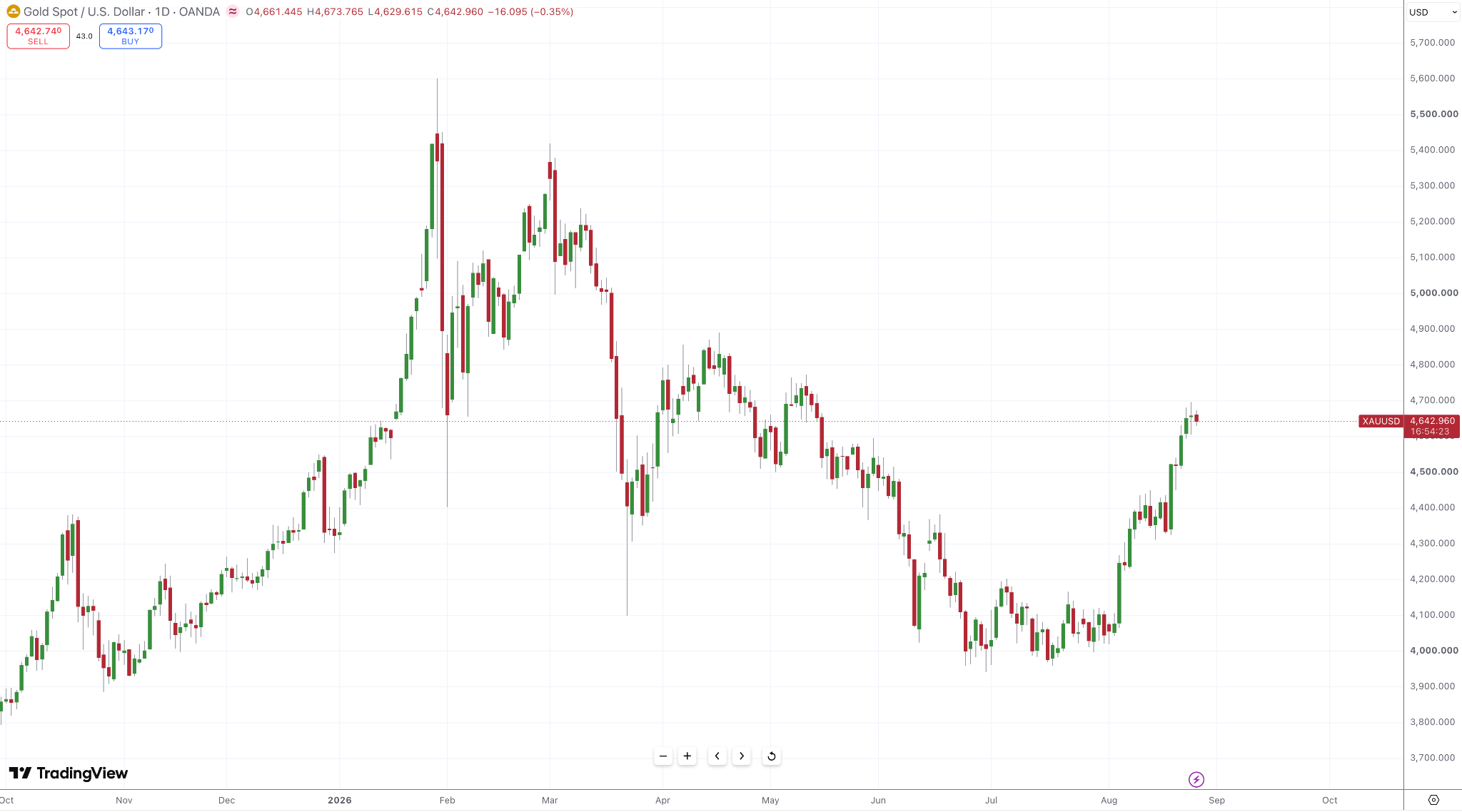
TradingView (Gold XAU/USD Daily Chart)
Consumer Stocks: Household Cost Pressures Were Real
The three RBA rate hikes to 4.35% in 2026 were not abstract to the companies that serve Australian households directly. They showed up in earnings.
Inghams Group fell 7.21% on its FY26 result, with earnings below the prior year and FY27 framed around approximately $130 million of incremental cost inflation from feed and Middle East exposure. The consumer discretionary and consumer staples sectors broadly faced the same challenge: revenue held up in many cases as higher prices sustained top-line numbers, but margin compression from input costs, wages, and energy squeezed profits below analyst models.
Higher borrowing costs and persistent inflation continued to place pressure on household budgets, with consumer-facing companies reporting softer sales volumes even where higher prices supported headline revenue.
What’s Yet To Come: The Season's Final Results
The ASX earnings season closes before August 31, with some of the biggest names on the board.
Wesfarmers (WES.AU) reports soon with a broker consensus NPAT of $2,851.8 million, representing 251.4 cents EPS and 210.9 cents DPS, the largest AUD-denominated consensus NPAT figure of the final week. The Bunnings and Kmart performance will determine whether the result beats or misses, and forward guidance on FY27 will move the stock regardless of the profit headline.
Qantas (QAN.AX) also reports on August 27 with a consensus NPAT of $1,417.6 million and a 38.9 cent DPS, marking the carrier's continued dividend normalisation after the pandemic-era suspension. The market will focus specifically on international capacity, fuel cost guidance, and whether Loyalty revenue growth has accelerated. South32 (S32.AX) also reports soon, adding a broader resources picture to the season's final day.
How Australian Traders Used CFDs Around Earnings Season on Mitrade
Mitrade, regulated by ASIC under licence AFSL 398528, offers BHP, CBA, and Wesfarmers as CFD instruments from a single zero-commission account. Earnings season creates some of the most clearly defined trading setups of the year because every result date is a known volatility event. Traders who go long before a result they expect to beat and short before a result they expect to disappoint have a concrete catalyst to position around rather than relying purely on technical levels or macro signals.
The key lesson from August 2026 is that the direction of the profit miss or beat mattered less than the FY27 guidance. Traders who exited positions before guidance commentary rather than just before the headline profit figure consistently made better decisions this season. For the two remaining results, Wesfarmers and Qantas, the same principle applies. A free demo account with $50,000 in virtual funds lets you practise positioning around results events with no financial risk before going live.
Sign up on Mitrade and complete identity verification.
* CFD trading involves risk and may not be suitable for all investors.
Open a Demo Account1. What are the key themes from ASX August 2026 earnings season?
Three themes defined the season. First, companies that pursued structural change and reset strategies in FY2026, including CSL, ANZ Group, and Treasury Wine Estates, outperformed the broader market as their shares were rewarded for delivering on turnaround promises. Second, FY27 guidance mattered more than FY26 profits: companies that beat the headline but guided cautiously on costs or revenue were sold despite the beat. Third, the resource sector, particularly gold miners and copper producers led by BHP, delivered its strongest financial year since 2006.
2. What did BHP report for FY2026?
BHP reported attributable profit of US$9.8 billion, up 9%, and underlying attributable profit of US$13.2 billion, up 30%. Copper overtook iron ore as BHP's biggest earnings driver for the first time, accounting for 54% of group underlying earnings, and total FY26 dividends reached US$1.72 per share, the highest in four years. BHP now trades at $67.99 AUD, up 49.42% year to date, reflecting the full impact of the copper earnings shift on investor sentiment.
3. What did Commonwealth Bank report for FY2026?
CBA's cash net profit after tax increased 7% to $11 billion and return on equity rose to 14.0%. For the first time in 15 years, a major Australian bank grew at or above system in all five core domestic product categories. Statutory net profit after tax grew 8% to $10.9 billion and the full-year dividend was $5.05 per share, up 4%.
4. What did Telstra report for FY2026?
Telstra reported a 2.7% increase in net profit after tax to $2.4 billion and EBITDAaL growth of 3% to $8.2 billion. Total FY26 dividends of 21 cents per share represent a 10.5% increase on a cash basis from the prior year. Earnings per share rose 5.3% to 19.9 cents. Telstra completed a $1.25 billion share buyback and launched a new buyback of up to $1 billion.
5. Which sectors performed best and worst in August 2026 earnings season?
Resources outperformed, delivering their strongest financial year since 2006. BHP's underlying profit rose 30% and copper became its biggest contributor for the first time. Gold miners were the surprise outperformers. Consumer-facing stocks struggled most visibly with household cost pressure from three RBA rate hikes. Inghams fell 7.21% on its result as FY26 earnings came in below the prior year and FY27 guidance pointed to $130 million in additional cost inflation.
6. Can Australian traders access ASX stocks during earnings season on Mitrade?
Yes. Mitrade offers BHP, CBA, and Wesfarmers as CFD instruments under ASIC regulation with licence AFSL 398528. Traders can go long or short on all instruments with zero commission and stop-loss controls directly on the order screen. A free demo account with $50,000 in virtual funds is available to practise positioning around results events before committing real capital.
Disclaimer: The content presented above, whether from a third party or not, is considered as general advice only. CFD trading involves significant risk of loss. Past performance does not guarantee future results. This article serves informational purposes only and does not constitute financial advice. Consider your risk tolerance before trading.


