




Jensen Huang Is Back. Is It Safe To Buy Nvidia Stock Now?
Key Points
Nvidia stock jumped more than 30% Monday morning after it reinstated Jensen Huang as CEO.
Huang's return removes much of the business risk facing Nvidia, but the federal investigations into the company will continue.
The stock looks cheap enough to make it attractive, but investors should consider diversifying into other AI stocks as well.
- Motley Fool Issues Rare "Total Conviction" Buy Alert ›
Investors wondering how much Jensen Huang was worth to Nvidia (NASDAQ:NVDA) got their answer Monday morning.
Nvidia stock jumped 30% at the open, adding roughly $1 trillion to the company's market cap.
Missed AI’s "Act 1"? Act 2 Could Be 15x Bigger. Most investors think they missed the AI boat because they didn't buy Nvidia in 2005. But according to our analysts, we’re only at the end of "Act 1"—the R&D phase. "Act 2" is the global rollout. Continue »
Huang's return comes after President Trump said on social media that Nvidia should bring him back, and after Treasury Secretary Scott Bessent said on Face the Nation Sunday morning that Nvidia should consider reinstating him, reversing his earlier position that the company should tap an outsider CEO to lead the company.
It's not clear why Bessent changed his mind, but the stock market's plunge on Friday, President Trump's support for Huang's return, and calls from a number of top investors and business leaders for Huang to return likely contributed to his reversal.
The news comes as a shock to investors, as just six days earlier on the company's earnings call, board Chair Harvey Jones told investors, "The Nvidia Board unanimously accepted his resignation and does not intend to reinstate Jensen as CEO."
In the statement reinstating Huang this morning, Jones said, "The Board believes Jensen is the right person to lead Nvidia, and that his reinstatement is in the best interests of our stockholders, employees, partners, and customers. We have every confidence in Jensen and look forward to working with him as he resumes his leadership of the company."
The board's decision was unanimous and came after extensive discussions with Huang. It also discussed the matter with senior U.S. government officials who indicated that reinstating Huang would not pose a national security risk.
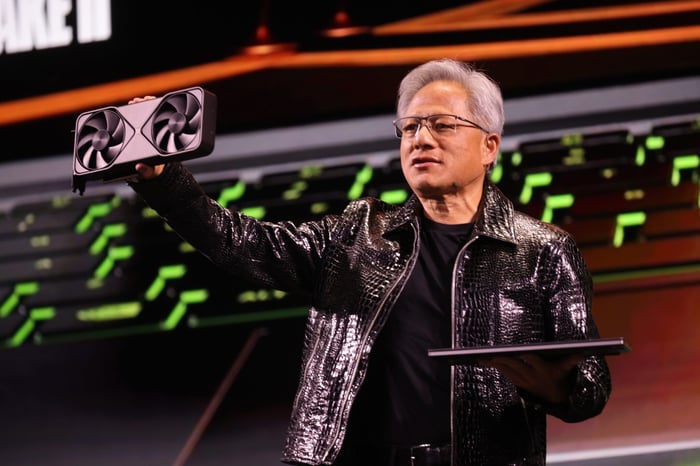
Jensen Huang. Image source: Nvidia.
What it means for investors
The board said that the investigation it had previously announced into Huang's involvement with a Chinese intelligence agent will continue until it's concluded. Additionally, it's forming a committee on national security and export control to oversee trade compliance and national security risks.
Nvidia investors are certainly enjoying the surge in the stock on Monday, but shares are still down more than 10% from where they were when the news about Huang's affair with a Chinese intelligence agent first broke on Nov. 8.
Huang's return seems to solve one set of problems for the AI chip leader. It no longer needs to search for a new CEO, and any concerns about how the loss of Huang's leadership and his network of relationships with customers, suppliers, and governments would impact the company are removed.
Huang may not be a national security risk, but the investigations announced in the wake of his scandal will still proceed, and he's still expected to testify before Congress, including a closed-door interview with three House committees on Dec. 1.
There's also a question of whether Huang will face any meaningful reputational damage both within Nvidia and externally that could undermine his effectiveness as a leader. The company will likely face more scrutiny from the media in the coming months as well.
In other words, Huang's reinstatement doesn't erase the events of the last two weeks.
Is it safe to buy Nvidia now?
Nvidia continues to look unbelievably cheap even after the 30% surge today, and the guidance hike it gave for fiscal 2028 carries more credibility with Huang back in the CEO chair. Analyst estimates on Nvidia jumped after that report, and even after today's pop, the stock trades at just 10 times next year's expected earnings per share, a year in which Nvidia expects 75% revenue growth.
Overall, Huang's return is a net positive for Nvidia, and during his absence, the board may have realized it had no good options to replace him. However, Nvidia still faces an elevated risk, which now includes an SEC investigation into accounting issues, according to Reuters.
Depending on your current exposure to Nvidia, I think buying the stock here makes sense. However, it's a good idea to get exposure to related AI stocks that don't face the same investigative risks as Nvidia as well, such as TSMC, which jumped 16% this morning on the Nvidia news. Another option worth considering is the VanEck Semiconductor ETF, which counts Nvidia as its biggest holding but offers exposure to a wide range of chip and AI stocks.
The worst appears to be over for Nvidia, but investors shouldn't discount the risks still facing the company. The Huang episode is a good reminder of why diversification matters.
Should you buy stock in Nvidia right now?
Before you buy stock in Nvidia, consider this:
The Motley Fool Stock Advisor analyst team just identified what they believe are the 10 best stocks for investors to buy now… and Nvidia wasn’t one of them. The 10 stocks that made the cut could produce monster returns in the coming years.
Consider when Netflix made this list on December 17, 2004... if you invested $1,000 at the time of our recommendation, you’d have $305,941!* Or when Nvidia made this list on April 15, 2005... if you invested $1,000 at the time of our recommendation, you’d have $771,325!*
Now, it’s worth noting Stock Advisor’s total average return is 719% — a market-crushing outperformance compared to 192% for the S&P 500. Don't miss the latest top 10 list, available with Stock Advisor, and join an investing community built by individual investors for individual investors.
See the 10 stocks »
*Stock Advisor returns as of November 23, 2026.
Jeremy Bowman has positions in Nvidia, Taiwan Semiconductor Manufacturing, and VanEck ETF Trust - VanEck Semiconductor ETF. The Motley Fool has positions in and recommends Nvidia and Taiwan Semiconductor Manufacturing. The Motley Fool has a disclosure policy.
Recommended Articles


