




Johnson & Johnson vs. Pfizer: Which Healthcare Stock Is a Better Buy for 2027?
Key Points
Johnson & Johnson maintains a diversified business model balancing pharmaceutical innovation with a massive medical technology segment.
Pfizer is undergoing a significant transition by investing heavily in oncology and obesity pipelines to offset post-pandemic revenue declines.
Which healthcare giant offers the better risk-to-reward profile for your portfolio heading into 2027?
- Motley Fool Issues Rare "Total Conviction" Buy Alert ›
Investors seeking long-term stability often turn to the healthcare sector, yet choosing between two industry titans requires a close look at their diverging growth strategies. Is Johnson & Johnson (NYSE:JNJ) or Pfizer (NYSE:PFE) the better buy for 2027?
While both companies are foundational pieces in many retirement portfolios, they are moving in different directions. Johnson & Johnson relies on its dual-engine model of drug development and medical devices, while Pfizer is aggressively pivoting toward oncology and weight-loss treatments to secure its next era of growth.
The case for Johnson & Johnson
Johnson & Johnson operates through two primary segments, innovative medicine and medtech, reaching patients in nearly every corner of the globe. Its medtech division is a significant player among medical device stocks, providing critical solutions for surgery, orthopedics, and vision. J&J distributes its products directly to wholesalers and hospitals, bolstered by partnerships with companies like Genmab (NASDAQ:GMAB) and AbbVie (NYSE:ABBV).
In the 12 months ended Sept. 27, 2026, revenue reached nearly $99.3 billion. This represented growth of approximately 7.8% compared to the prior 12-month period. During this same time frame, the company reported net income of roughly $16.1 billion.
As of the December 2025 balance sheet, the debt-to-equity ratio was approximately 0.6. This ratio measures total debt relative to shareholders' equity, indicating the extent to which the business relies on borrowed capital. The current ratio is nearly 1, meaning the company has sufficient short-term assets to cover its immediate liabilities, and free cash flow in the fiscal year ended Dec. 28, 2025, reached close to $19.7 billion.
The case for Pfizer
Pfizer is a biopharmaceutical leader focused on discovering and manufacturing vaccines and medicines for patients in approximately 200 countries. To drive future growth, the company is investing heavily in its oncology and obesity pipelines through major acquisitions such as Seagen. In the weight-loss space, it is developing oral treatments to compete with established names like Eli Lilly (NYSE:LLY).
In the 12 months ended Sept. 27, 2026, revenue reached close to $63.6 billion, an increase of approximately 1.3% over the previous 12-month period. For this time frame, the business generated net income of nearly $4 billion.
As of the December 2025 balance sheet, Pfizer reported a debt-to-equity ratio of roughly 0.8. Its current ratio is approximately 1.2, suggesting a comfortable cushion for meeting short-term obligations, while free cash flow in the fiscal year ended Dec. 31, 2025, was close to $9.1 billion.
Risk profile comparison
Johnson & Johnson faces significant litigation risks, most notably regarding a $5.5 billion settlement offer recently proposed to resolve thousands of lawsuits related to its talc products. The business also deals with pricing pressure from government healthcare programs, which impact major revenue drivers like Darzalex and Stelara. Additionally, J&J faces the loss of patent exclusivity for Stelara and operational risks associated with the planned separation of its orthopedics business.
Pfizer contends with substantial legal and regulatory risks, including litigation related to its Depo-Provera contraceptive and recent settlements regarding its smoking cessation drug, Chantix. The company is also navigating revenue impacts from the Inflation Reduction Act, which targets high-expenditure drugs like Eliquis and Ibrance for government-negotiated pricing. Furthermore, it faces competitive erosion from generic versions of its products and the challenge of successfully integrating large acquisitions like Seagen to revitalize its oncology portfolio.
Valuation comparison
Pfizer looks significantly cheaper than Johnson & Johnson based on its forward P/E and P/S ratio, reflecting the market's cautious outlook on its future earnings estimates.
| Metric | Johnson & Johnson | Pfizer |
|---|---|---|
| Forward P/E | 24 | 9 |
| P/S ratio | 6.5 | 2.5 |
Valuation metrics include sourcing from Financial Modeling Prep (FMP) and may differ from other data providers.
Which stock would I buy for 2027?
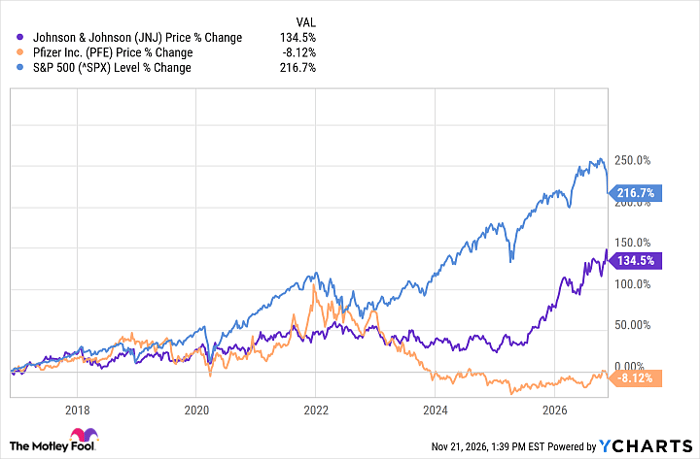
It feels a bit dicey to be picking stocks amid the market's recent meltdown. That said, long-term investors know it's not especially productive to worry about what happens in a given day, week, or even month. That's why I prefer looking at longer time frames. Here's how Pfizer and Johnson & Johnson have performed over the past decade:
JNJ data by YCharts
Both healthcare giants are trailing the S&P 500's (SNPINDEX:^GSPC) return, and Pfizer is actually sitting on a loss. Past performance is no indication of future results, of course, but it's not a good look for Pfizer.
Though I'd prefer to see stronger growth from J&J, I think it's the more attractive stock. It's a mature, established company that has increased its dividend annually for more than 60 years. Pfizer cannot say the same.
"But wait," you say. "Pfizer's dividend yields more." True, but dividend yield and share price have an inverse relationship: as a stock falls, its yield rises. On an absolute basis, J&J's dividend payout is roughly three times larger.
I doubt we'll see especially impressive revenue growth from J&J in the near future, but I think the stock can provide steady ballast for your portfolio. Johnson & Johnson gets my vote for 2027 and beyond.
Should you buy stock in Johnson & Johnson right now?
Before you buy stock in Johnson & Johnson, consider this:
The Motley Fool Stock Advisor analyst team just identified what they believe are the 10 best stocks for investors to buy now… and Johnson & Johnson wasn’t one of them. The 10 stocks that made the cut could produce monster returns in the coming years.
Consider when Netflix made this list on December 17, 2004... if you invested $1,000 at the time of our recommendation, you’d have $305,941!* Or when Nvidia made this list on April 15, 2005... if you invested $1,000 at the time of our recommendation, you’d have $771,325!*
Now, it’s worth noting Stock Advisor’s total average return is 719% — a market-crushing outperformance compared to 192% for the S&P 500. Don't miss the latest top 10 list, available with Stock Advisor, and join an investing community built by individual investors for individual investors.
See the 10 stocks »
*Stock Advisor returns as of November 22, 2026.
Erin Kennedy has no position in any of the stocks mentioned. The Motley Fool has positions in and recommends AbbVie, Eli Lilly, Genmab, and Pfizer. The Motley Fool recommends Johnson & Johnson. The Motley Fool has a disclosure policy.
Recommended Articles


