




Will a Federal Reserve Interest Rate Hike Trigger a Recession? Here's What History Says.
Key Points
Inflation remains stubbornly elevated, prompting the central bank to have a tighter grip on the economy.
Even though interest rates rose considerably in the past five years, the S&P 500 index still produced a total return of 76%.
Since it’s so easy to get caught up with what the Federal Reserve is saying or doing, investors must remember to zoom out and focus on the long term.
- 10 stocks we like better than S&P 500 Index ›
After its meeting that ended Oct. 28, the Federal Reserve decided to leave its federal funds rate unchanged. This comes after it raised the benchmark rate in September. The story hasn't changed, though. Chair Kevin Warsh and his team continue to highlight elevated inflation as the primary focus; inflation remains considerably above the central bank's 2% target.
According to CME Group's FedWatch tool, traders are pricing in a 70% probability that the federal funds rate will be higher after the December meeting. And prominent bank executives, such as SoFi Technologies' management team, assume two rate increases in 2027. Investors are trying to figure out what this could suggest for their portfolios.
Missed AI’s "Act 1"? Act 2 Could Be 15x Bigger. Most investors think they missed the AI boat because they didn't buy Nvidia in 2005. But according to our analysts, we’re only at the end of "Act 1"—the R&D phase. "Act 2" is the global rollout. Continue »
Will a Federal Reserve interest rate hike trigger an economic recession? Here's what history says.
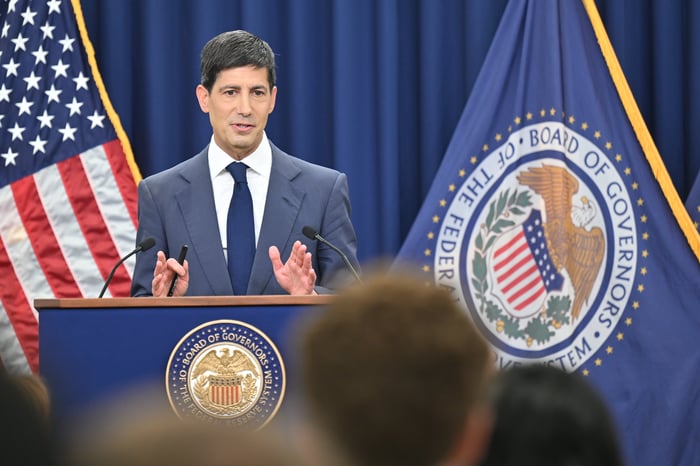
Image source: Federal Reserve.
This decade challenges the relationship
It's critical for investors to first understand that the economy, where individual spending decisions are made that directly impact other people's income, and how businesses and governments allocate resources, is different from the stock market, in which pieces of ownership stakes in businesses are traded among financial parties that can have entirely different objectives. The economy and stock market are often viewed as interchangeable topics, but they're not the same. And as a result, the impact of rate changes on each should be considered separately.
In theory, higher interest rates act as a brake on the broader economy. Borrowing money becomes more expensive, which can discourage businesses from investing in growth opportunities. And consumers might shift more toward a saving mindset at the expense of spending more freely, as interest rates on mortgages, auto loans, and credit cards, for example, rise.
Recessions aren't guaranteed to happen, though. To fight surging inflation after the pandemic, the Federal Reserve rapidly raised the federal funds rate in 2022 and 2023. The U.S. economy kept growing.
It's also believed that higher interest rates should introduce a headwind for the stock market. If companies are borrowing and investing less, it can limit their ability to grow revenue and earnings. These are key catalysts for share-price performance.
Additionally, fixed-income securities become more compelling in a diversified portfolio, potentially diverting capital from equities. And according to financial theory, higher interest rates increase the discount rate investors use to value companies. The result is a lower present value.
Again, recent history doesn't agree with this view. The federal funds rate has climbed 4,750% over the past five years, while the 10-year Treasury yield is up 224%. Still, the S&P 500 index (SNPINDEX: ^GSPC) generated a total return over that time of 76% (as of Nov. 5).
The impact that interest rates have on the economy and the stock market isn't predictable. A recession and a bear market aren't sure to happen anytime soon.
When in doubt, zoom out
Given how much attention the Federal Reserve gets from the financial media, it's assumed that the investment community must find the central bank's words and actions incredibly important in their decision-making process. It seems everyone is always trying to forecast what Warsh and his team will do next. This is a waste of time, in my opinion, especially if you're a long-term investor.
Owning high-quality stocks for years or decades is a proven strategy for building wealth. The types of businesses to buy and hold -- ones with durable competitive advantages, unmatched customer value propositions, differentiated products and services, growth potential, strong financials, and capable management teams -- shouldn't have much of a problem navigating the inevitable economic and market turmoil.
Investors who try to avoid volatility are the ones who might get in trouble. Attempting to time the market increases the likelihood that you'll make mistakes detrimental to your portfolio. This is why it's critical to stay patient and disciplined, and stick to your plan regardless of what interest rates are doing.
Should you buy stock in S&P 500 Index right now?
Before you buy stock in S&P 500 Index, consider this:
The Motley Fool Stock Advisor analyst team just identified what they believe are the 10 best stocks for investors to buy now… and S&P 500 Index wasn’t one of them. The 10 stocks that made the cut could produce monster returns in the coming years.
Consider when Netflix made this list on December 17, 2004... if you invested $1,000 at the time of our recommendation, you’d have $341,966!* Or when Nvidia made this list on April 15, 2005... if you invested $1,000 at the time of our recommendation, you’d have $1,146,819!*
Now, it’s worth noting Stock Advisor’s total average return is 852% — a market-crushing outperformance compared to 203% for the S&P 500. Don't miss the latest top 10 list, available with Stock Advisor, and join an investing community built by individual investors for individual investors.
See the 10 stocks »
*Stock Advisor returns as of November 9, 2026.
Neil Patel has no position in any of the stocks mentioned. The Motley Fool has positions in and recommends CME Group. The Motley Fool has a disclosure policy.
Recommended Articles


