




Democrats Retake the House and Senate: Here's What It Could Mean for SpaceX and Tesla
Key Points
The Democrats won a U.S. Senate seat and the governor race in Texas.
Both Space Exploration Technologies and Tesla have major operations in Texas.
The possibility of more regulatory oversight around autonomous driving platforms and space exploration could impact Elon Musk's companies.
- Motley Fool Issues Rare "Total Conviction" Buy Alert ›
Following the 2026 midterm elections, Democrats captured both chambers of Congress and won several closely watched statewide races. Perhaps one of the bigger surprises came from Texas, where Democrats won the governor's office and a Senate seat for the first time in decades.
For investors following Tesla (NASDAQ: TSLA) and Space Exploration Technologies (NASDAQ: SPCX), the election results are particularly interesting. Both companies have operations in Texas, and their futures are increasingly tied to emerging technologies that could face more regulatory oversight.
Missed AI’s "Act 1"? Act 2 Could Be 15x Bigger. Most investors think they missed the AI boat because they didn't buy Nvidia in 2005. But according to our analysts, we’re only at the end of "Act 1"—the R&D phase. "Act 2" is the global rollout. Continue »
Here's how the changing political landscape could affect Elon Musk's businesses.
Image source: The Motley Fool.
Tesla's robotaxi could hit a road bump
For most of its history, Tesla was marketed as a pioneer for electric vehicles (EVs). But in recent years, Musk has been vocal about his vision in which autonomous driving, robotaxis, and humanoid robots become major contributors to the company's business model. These ambitions come with a different set of regulatory standards that traditional automakers don't necessarily face.
In September, the National Highway Traffic Safety Administration (NHTSA) opened an investigation into whether Tesla's Cybercab complies with federal vehicle safety standards following its commercial deployment in Austin, Texas.
This investigation highlights a distinction between Tesla's existing EV business and its emerging autonomous transportation platform. Selling cars is one thing, but operating a large fleet of driverless vehicles introduces questions about passenger safety and accident reporting.
With Democrats now in control of Congress, lawmakers could pursue more comprehensive legislation around safety standards for autonomous vehicles. Such rules could increase Tesla's compliance costs or slow down the pace of its robotaxi expansion.
On the other hand, a more robust national regulatory framework could benefit Tesla in the long run by replacing inconsistent state-level requirements with more predictable standards.
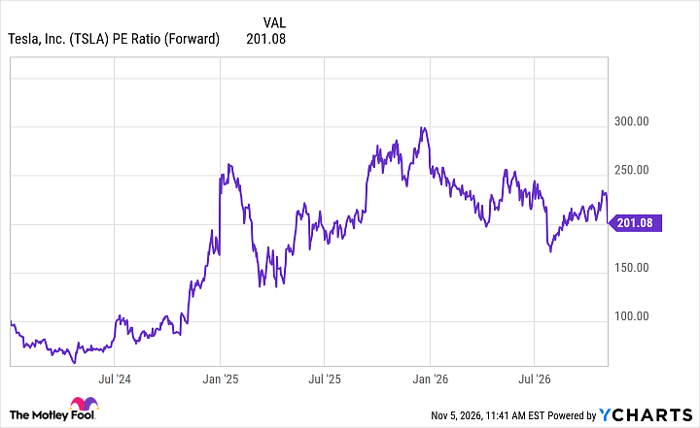
For investors, the question isn't whether more regulation is inherently good or bad. It's whether Tesla can still commercialize its autonomous vehicle technology quickly enough to justify the growth expectations reflected in its valuation.
TSLA PE Ratio (Forward) data by YCharts
SpaceX faces a different set of regulatory uncertainties
Although SpaceX operates in a different industry than Tesla, its long-term ambitions are largely tied to government oversight. The company's Starship rocket is a key component of its plans for reusable space transportation and, eventually, orbital data centers.
Expanding launch operations requires approval from the Federal Aviation Administration (FAA). Last month, the FAA announced plans for an environmental impact review covering Starship's launch and landing operations at SpaceX's Starbase facility in South Texas.
While this may seem like a nonstarter on the surface, this process is actually pretty important because SpaceX's strategy depends on increasing launch frequency while also improving the unit economics of reusable rockets.
In theory, a more demanding environmental review process could lengthen approval timelines and increase the company's operating expenses. Nevertheless, there is an important counterargument.
Remember, SpaceX provides launch services for NASA, the Department of Defense (DOD), and commercial satellite operators. Its capabilities support national security, scientific research, and America's broader objectives around space exploration. With that in mind, additional regulatory oversight doesn't necessarily translate into reduced demand for SpaceX's services.
Did Elon make the right call in choosing Texas?
The election results in Texas add an interesting dimension to this analysis. Democrat Gina Hinojosa defeated incumbent Republican Governor Greg Abbott, while James Talarico won the state's U.S. Senate race. Democrats also gained control of the Texas House, although Republicans retained the state Senate.
For Tesla and SpaceX, this introduces the possibility of changing priorities at both the state and federal levels. Tesla's headquarters and some of its major manufacturing operations are located in Austin. Meanwhile, SpaceX's Starbase complex is near Boca Chica.
While Texas lawmakers may choose to revisit policies involving autonomous vehicle safety, environmental permitting, and industrial development, the governor does not have the authority to unilaterally rewrite state law. Meanwhile, Republicans' continued control of the Texas Senate could limit sweeping legislative changes. Investors should also remember that Democrats' congressional majority doesn't necessarily guarantee new federal regulations, since President Trump retains veto powers.
Ultimately, I don't think the midterms fundamentally undermine the long-term growth opportunities for either Tesla or SpaceX. Tesla still has several manufacturing facilities around the world, while SpaceX's competitive position in launch operations and satellite infrastructure remains strong outside of Texas.
The midterms have not changed what Tesla and SpaceX are trying to accomplish in the long run. They may, however, change the regulatory environment and pace at which those ambitions unfold.
Should you buy stock in Space Exploration Technologies right now?
Before you buy stock in Space Exploration Technologies, consider this:
The Motley Fool Stock Advisor analyst team just identified what they believe are the 10 best stocks for investors to buy now… and Space Exploration Technologies wasn’t one of them. The 10 stocks that made the cut could produce monster returns in the coming years.
Consider when Netflix made this list on December 17, 2004... if you invested $1,000 at the time of our recommendation, you’d have $358,037!* Or when Nvidia made this list on April 15, 2005... if you invested $1,000 at the time of our recommendation, you’d have $1,229,708!*
Now, it’s worth noting Stock Advisor’s total average return is 897% — a market-crushing outperformance compared to 211% for the S&P 500. Don't miss the latest top 10 list, available with Stock Advisor, and join an investing community built by individual investors for individual investors.
See the 10 stocks »
*Stock Advisor returns as of November 6, 2026.
Adam Spatacco has positions in Tesla. The Motley Fool has positions in and recommends Tesla. The Motley Fool recommends Space Exploration Technologies. The Motley Fool has a disclosure policy.
Recommended Articles


