




Warren Buffett Has Called This 1 Investing Decision the Costliest Mistake of His Career. Here's How to Avoid It.
Key Points
Warren Buffett says that buying Berkshire Hathaway was a massive investing mistake.
While he's since turned the company into a success, he warns that one move cost him $200 billion.
Everyday investors could be making a similar mistake without realizing it.
- These 10 stocks could mint the next wave of millionaires ›
There are few investors as well-known and highly respected as Warren Buffett.
The former Berkshire Hathaway (NYSE: BRKA)(NYSE: BRKB) CEO and Chairman has spent most of his life investing in the stock market, famously generating the majority of his wealth after age 50 through savvy investment decisions and compound earnings.
Missed AI’s "Act 1"? Act 2 Could Be 15x Bigger. Most investors think they missed the AI boat because they didn't buy Nvidia in 2005. But according to our analysts, we’re only at the end of "Act 1"—the R&D phase. "Act 2" is the global rollout. Continue »
But even the most successful investors sometimes make mistakes. Buffett once recounted his biggest blunder, which he estimates cost him $200 billion, and offered a brilliant lesson for investors navigating the current market climate.
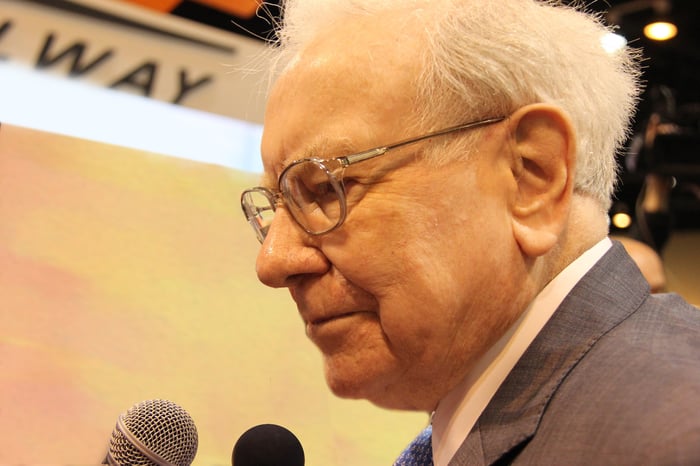
Warren Buffett. Image source: The Motley Fool.
Don't let ego drive your investing decisions
In a 2010 interview with CNBC, Buffett noted that his most expensive business mistake was actually buying Berkshire Hathaway in 1964.
At the time, Berkshire was a struggling textile company, and Buffett began buying shares to tender them back at a profit. The two parties agreed on a price for the sale, only for Berkshire management to break its agreement and reduce its offer at the last minute.
Buffett was so upset about the incident that he bought enough stock to take control of the company and fire the manager. The mistake, he noted, was that Berkshire Hathaway was not a healthy investment.
"[T]he truth is I had now committed a major amount of money to a terrible business," he said in the interview. "And for 20 years, I fought the textile business before I gave up. [If] instead of putting that money into the textile business originally, we just started out with the insurance company, Berkshire would be worth twice as much as it is now."
"And, so there you have it, the story of a $200 billion [mistake]."
Some investors may unknowingly be making the same mistake
The average investor probably won't find themselves in the position to buy out an entire company. But when you're investing in stocks, it can be tempting to buy or hold risky investments for the wrong reasons.
Sometimes companies change. Sometimes they fail to live up to expectations. Sometimes the industry changes, and a business doesn't adapt. In all of these cases, it's easy to get stuck holding a stock for years, waiting for it to turn around, rather than simply moving on to a healthier investment.
Regardless of which stocks you own, it's wise to do a portfolio check every so often to ensure each one still fits your goals, risk tolerance, and overall investing thesis. If you find that a company is making reckless decisions or has lost its competitive advantage, for example, it may no longer be a sustainable investment.
Similarly, it can be tempting to buy stocks based on hype. Popular stocks aren't always healthy stocks, though, and a soaring stock price doesn't necessarily mean that the company will be strong enough to survive a recession, bear market, or stock market crash.
The best move investors can make right now
Market valuations are climbing, and many stocks risk becoming overvalued as prices stray from their companies' underlying fundamentals. These stocks are particularly vulnerable to volatility, and when the next bear market arrives, they could be hit hard.
If there's just one move to make right now, it's to double-check that each stock you own has robust fundamentals, such as a durable competitive advantage, a competent leadership team, and healthy finances. From there, be prepared to hold these stocks for as long as they remain strong investments. Ideally, that's at least a few years or even decades.
A market downturn is coming eventually, and the smartest investors are already preparing. With a portfolio full of healthy stocks, you'll be well-positioned for whatever the market may throw at you.
Missed Nvidia in 2009? This Rare Signal Is Flashing Again
In 2009, a "Double Down" signal flashed for a little-known chipmaker called Nvidia. If you’d invested $5,000 then, you’d be sitting on $2,742,263 today.*
Now, for the first time in years, that same "Total Conviction" signal is flashing for a company 1/100th the size of Nvidia. It’s a key player in the $1.8 trillion space race, and with the stock recently sitting 20% off its highs, the window to get in early is closing fast.
Continue »
*Stock Advisor returns as of October 26, 2026.
Katie Brockman has no position in any of the stocks mentioned. The Motley Fool has positions in and recommends Berkshire Hathaway. The Motley Fool has a disclosure policy.
Recommended Articles


