




CXMT’s Advance in New DRAM Architecture Sparks Market Concerns as Elon Musk Says China’s Scaled Manufacturing May Reshape DRAM Landscape
TradingKey - Market concerns are rising over Chinese DRAM manufacturer ChangXin Memory Technologies (CXMT) advancing higher-density memory architectures, as investors begin to reassess the potential impact of Chinese makers on conventional DRAM supply, pricing, and market share.
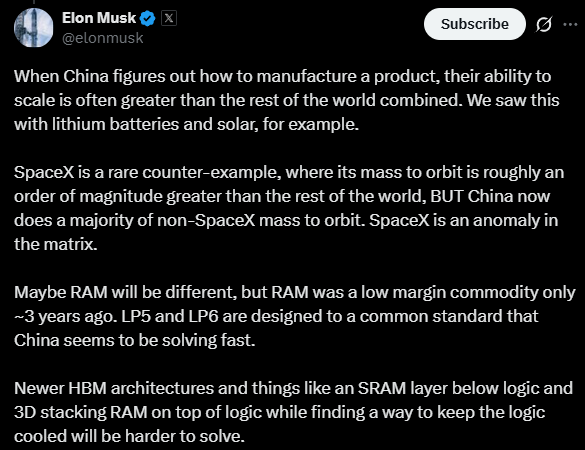
Tesla (TSLA) and SpaceX (SPCX) founder Elon Musk stated on social platform X that once China masters the manufacturing process for a product, its scaling capability far exceeds the rest of the world. Citing lithium-ion batteries and solar products as examples, he noted that China holds a distinct advantage in manufacturing scale; SpaceX is a rare exception, as the US still far surpasses the rest of the world in payload mass delivered to orbit for rocket launches.
Musk further noted that memory chips could follow a similar trajectory. He pointed out that RAM was still viewed as a low-margin commodity just a few years ago, and the standardized design of products such as LP5 and LP6 naturally favors large-scale production across different manufacturers. If Chinese makers can swiftly resolve manufacturing and yield challenges, the competitive landscape of the traditional RAM market could undergo even greater changes.
These comments come as ChangXin Memory Technologies (CXMT) accelerates the development of its next-generation DRAM architecture. The company has stated that it expects to launch next-generation DDR5 RDIMM products utilizing the 4F² architecture by the end of 2026. Compared with the current mainstream 66F² architecture, 4F² reduces the cell area of a single memory storage unit, theoretically helping to fit more storage units onto a single wafer.
[Source: X]
For DRAM manufacturers, the core value of this technology lies not only in increasing capacity but also in improving cost structures. If CXMT can maintain stable yields during mass production, the effective bit output per wafer is expected to increase, thereby lowering manufacturing costs per bit. This could give the company greater flexibility in price competition or improve profit margins at the same selling price.
However, Musk's remarks also reflect that the market is differentiating between different types of memory products. He believes that traditional RAM has a higher degree of standardization, where manufacturing capabilities and capacity expansion may be the key to competition. In contrast, next-generation HBM, as well as architectures featuring SRAM under logic circuits or 3D stacking of memory on top of logic chips, still face greater integration and thermal management challenges.
Recommended Articles


