




Warren Buffett Bought These 4 Dividend Stocks Years Ago. Here's What $1,000 in Each Would Be Worth Today.
Key Points
Warren Buffett, the former CEO of Berkshire Hathaway, liked to buy well-run businesses when they looked attractively priced.
He would then hold the stocks for the long term, allowing him to benefit from the business's growth.
To show just how powerful the buy-and-hold approach is, all you need to do is look at American Express and Coca-Cola.
- 10 stocks we like better than Chevron ›
Warren Buffett earned the nickname the Oracle of Omaha, with the 6,099,294% gain of Berkshire Hathaway (NYSE: BRKA)(NYSE: BRKB) under his leadership showing why. The S&P 500 index (SNPINDEX: ^GSPC) rose 46,061% over the same period. Looking at Buffett's approach can provide a good foundation for your own investment approach.
Simply put, Buffett liked to buy well-run businesses while they were attractively priced. But the real secret sauce is that he held for the long term, which allowed him to benefit from a business's growth over time. American Express (NYSE: AXP) and Coca-Cola (NYSE: KO) highlight why you don't want to overlook this step, even if it means holding through bear markets. Chevron (NYSE: CVX) and Bank of America (NYSE: BAC), two relatively new purchases, are building their track records.
Missed AI’s "Act 1"? Act 2 Could Be 15x Bigger. Most investors think they missed the AI boat because they didn't buy Nvidia in 2005. But according to our analysts, we’re only at the end of "Act 1"—the R&D phase. "Act 2" is the global rollout. Continue »

Image source: Getty Images.
A quick look at four long-term Buffett holdings
Before looking at the gains Buffett achieved with Chevron, Bank of America, American Express, and Coca-Cola, there are a few ground rules to keep in mind for each example. You wouldn't be able to buy exactly when Buffett did because regulatory filings are delayed. To keep things simple, the start of the year following the first purchase will be used. The most recent investment period is going to be used, noting that he invested in American Express two times. And only stock purchases will be featured, since you couldn't buy the preferred investments he's made, including the one in Bank of America. With that said, here are the impressive returns some of these dividend stocks have provided to Buffett.
Coca-Cola: 1989
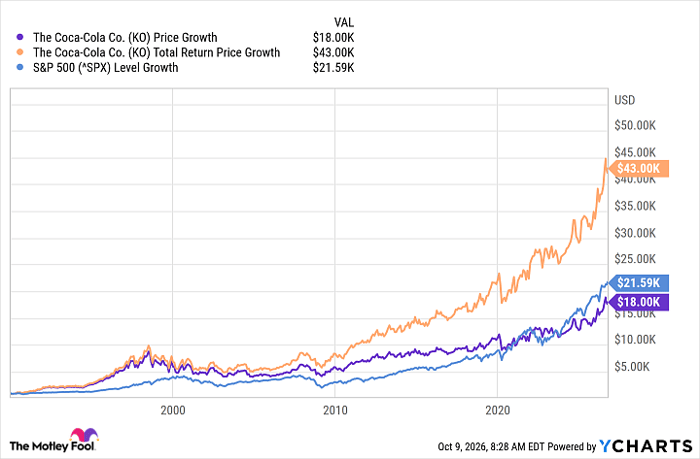
Buffett began buying Coca-Cola in 1988 and continued his original purchases into 1989. We'll use 1989 as the starting date. Today, Coca-Cola is one of the world's largest consumer staples companies, selling soda and other beverages. It has industry-leading brands, marketing, product development, and distribution. A $1,000 investment made at the start of 1989 would be worth roughly $18,000 as of this writing. That's a 1,700% return and doesn't include dividend reinvestment. That lags just behind the S&P 500. Add in dividend reinvestment, however, and that $1k would be worth an even more impressive $43,000, which is a shockingly large return of 4,200%.
KO data by YCharts
American Express: 1995
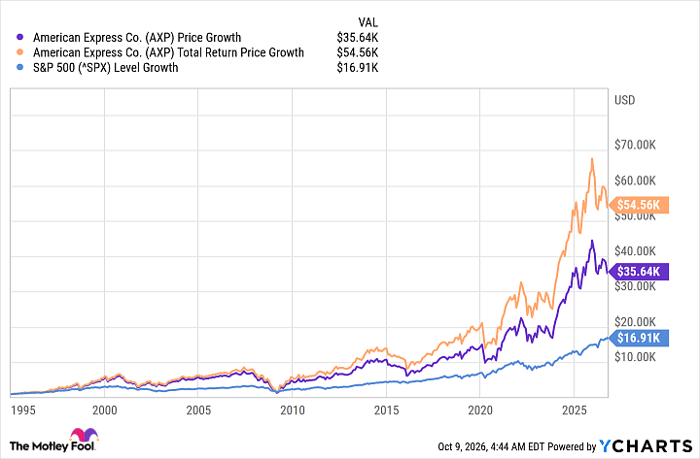
Buffett owned convertible preferred securities in American Express. They converted to stock in mid-1994, so the start date for this investment is 1995. American Express is a transaction-processing company and a credit card issuer that focuses on serving wealthy customers. A $1k investment at the start of 1995 would be worth roughly $35,640 today, not including reinvested dividends. That's a roughly 3,460% return on the stock alone, easily besting the S&P 500 over the holding period. Reinvesting the dividend would put the value of the investment at $54,560, or a return of 5,360%
AXP data by YCharts
Bank of America: 2018
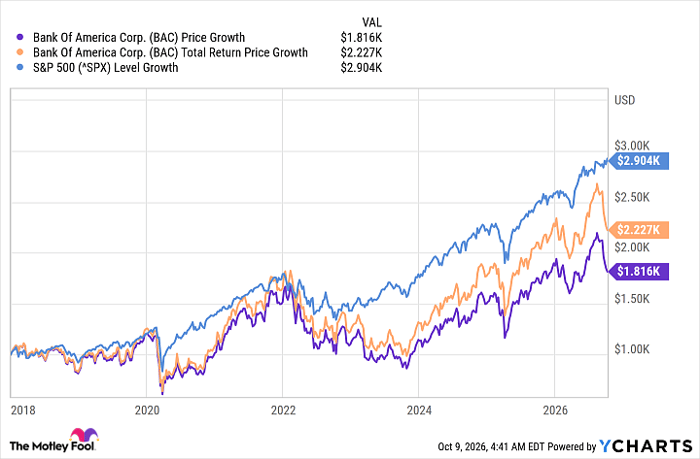
Buffett invested in Bank of America preferred shares around the time of the Great Recession, but exchanged the preferreds for the common stock in late 2017. That makes 2018 the start date for this return analysis. Bank of America is a global financial giant. A $1,000 investment at the start of 2018 would be worth $1,816, a roughly 81% return excluding dividend reinvestment. If you reinvested the dividend, however, your investment would be worth $2,220, for a total return of 122%. This investment has lagged the S&P 500, but it is also a relatively short-term investment at this point.
BAC data by YCharts
Chevron: 2021
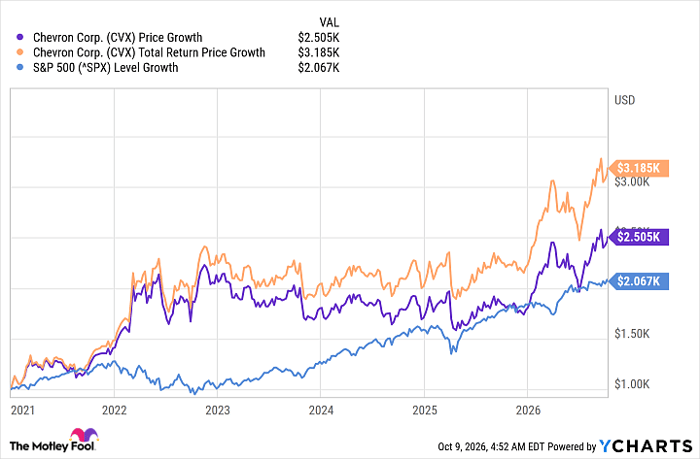
Buffett began buying Chevron in the third quarter of 2020, so 2021 marks the start of this return assessment. This is clearly a relatively new investment, with this analysis looking at a roughly five-year period. Chevron is one of the world's largest energy companies, with operations that span the energy value chain. A $1k investment at the start of 2021 would be worth roughly $2,500 as of this writing, a 150% return in a very short period. This investment has been aided by oil price increases resulting from the geopolitical conflict in the Middle East. If you add dividend reinvestment, that $1k would be worth $3,185.
CVX data by YCharts
Luck and skill for Buffett with his buy-and-hold approach
The Chevron example shows that some luck is involved in investing, since Buffett couldn't have predicted a geopolitical conflict. However, he did buy the stock during a period when the energy sector was facing low oil prices. Bank of America, meanwhile, shows that not all investments play out quite as well over the short term. However, his longest-held investments (Coca-Cola and American Express) highlight the value of long-term investing. In other words, give Bank of America some more time, and it may turn into a big winner, as well.
However, the real takeaway for investors from this analysis of some of Buffett's biggest investments is that buying and holding good businesses can be a very profitable investment approach. And it is one you can easily apply to your own portfolio, even with already well-established companies.
Should you buy stock in Chevron right now?
Before you buy stock in Chevron, consider this:
The Motley Fool Stock Advisor analyst team just identified what they believe are the 10 best stocks for investors to buy now… and Chevron wasn’t one of them. The 10 stocks that made the cut could produce monster returns in the coming years.
Consider when Netflix made this list on December 17, 2004... if you invested $1,000 at the time of our recommendation, you’d have $379,123!* Or when Nvidia made this list on April 15, 2005... if you invested $1,000 at the time of our recommendation, you’d have $1,408,822!*
Now, it’s worth noting Stock Advisor’s total average return is 950% — a market-crushing outperformance compared to 215% for the S&P 500. Don't miss the latest top 10 list, available with Stock Advisor, and join an investing community built by individual investors for individual investors.
See the 10 stocks »
*Stock Advisor returns as of October 11, 2026.
American Express is an advertising partner of Motley Fool Money. Bank of America is an advertising partner of Motley Fool Money. Reuben Gregg Brewer has no position in any of the stocks mentioned. The Motley Fool has positions in and recommends American Express, Berkshire Hathaway, and Chevron. The Motley Fool has a disclosure policy.
Recommended Articles


