




Billionaire Ray Dalio Said The AI Bubble Is Close To Popping. Could SpaceX Be the Culpirit?
Key Points
Dalio said ballooning debt balances and rising interest rates could burst the AI bubble.
Debt levels are rising at the hyperscalers, but companies like OpenAI, Anthropic, and SpaceX could be the biggest risks.
Despite Dalio's concern, the AI leaders are still delivering strong and profitable growth.
- 10 stocks we like better than Space Exploration Technologies ›
Ray Dalio is the founder of Bridgewater Associates, the largest hedge fund in the world, with assets under management between $100 billion and $125 billion.
Dalio is no longer the CEO, but given his success with Bridgewater, he's one of the most respected investors in the world. He’s also known for macroeconomic investing, including his focus on debt cycles, and geopolitical and market risks.
Missed Nvidia in 2009? This Rare Signal Is Flashing Again. In 2009, a "Double Down" signal flashed for a little-known chipmaker called Nvidia. For the first time in years, that same "Total Conviction" signal is flashing for a company 1/100th the size of Nvidia. Continue »
When Dalio makes a prediction, investors tend to listen, and he just made a bold statement about the AI boom.

Image source: Getty Images. Image source: Getty Images.
Ray Dalio thinks the AI bubble could be bursting
Speaking at the Forbes Global CEO Conference in Singapore this past week, Dalio commented on the massive amount of debt being taken on to fund AI growth, including data centers.
The billionaire called the current AI situation a "classic bubble," and pointed to rising interest rates and the need for investors to convert paper gains into cash as a potential source of pressure on AI stock valuations. Dalio believed rising rates could cause the bubble to pop, adding, "We're in the part of the cycle that is before that but approaching that. I think we're close to that."
Bond yields have risen around the world due to a range of factors, including higher energy costs and inflation, resulting from the war in Iran.
Dalio also noted that wealth taxes, such as the one proposed in California, could lead wealthy investors to convert stock gains into cash.
Where is the debt bubble coming from?
The four big hyperscalers, Amazon (NASDAQ:AMZN), Alphabet (NASDAQ:GOOG) (NASDAQ:GOOGL), Microsoft (NASDAQ:MSFT), and Meta Platforms (NASDAQ:META), are set to spend more than $700 billion on capital expenditures this year, with much of that going to AI-related investments like chips and data centers.
As the chart below shows, with the exception of Microsoft, all of these companies have added over $200 billion in debt over the last year.
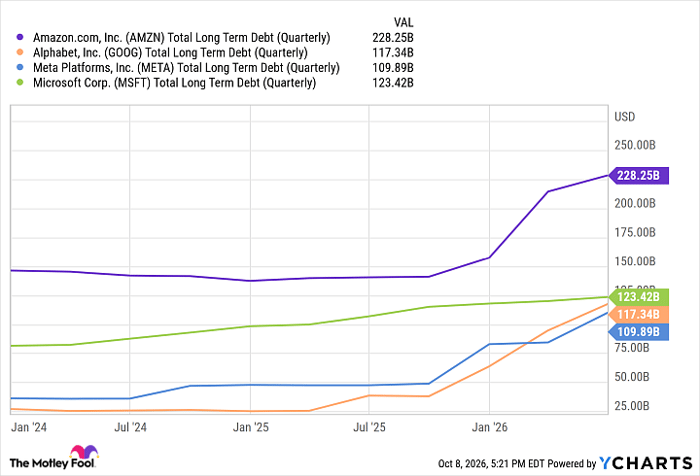
AMZN Total Long Term Debt (Quarterly) data by YCharts
However, these companies are hugely profitable and have market caps in the trillions of dollars. They can afford to make such moves on their balance sheets.
The larger risk facing the market may be from the newer wave of AI companies, which includes Anthropic, OpenAI, and Space Exploration Technologies (NASDAQ:SPCX), or SpaceX.
Though these companies are chasing valuations in the $2-trillion range, they are not consistently profitable, meaning their borrowing comes with significantly more risk.
Anthropic has committed to $518 billion in future cloud, computing, and AI infrastructure spending, with 80% of that being non-cancellable. OpenAI, meanwhile, has $665 billion in similar spending commitments.
SpaceX is the only one of the three that is currently publicly traded, and even after raising $86 billion in its IPO, Elon Musk's space company has wasted little time in raising more cash.
SpaceX's big plans
SpaceX has transformed over the last year after acquiring xAI, and the company is not currently profitable and needs funding to support its blockbuster ambitions, which include launching data centers into space and eventually colonizing Mars. It also aims to reach 10 gigawatts (GW) of computing capacity by the end of next year, which represents roughly $350 billion to $600 billion in infrastructure costs. 10 GW is also enough to power 7.5 million to 10 million homes.
Following its IPO, the company raised $25 billion in new debt and is now seeking another $40 billion, according to Financial Times. The company's debt raises are likely to continue as Morgan Stanley's Adam Jonas predicted that it would raise an average of $80 billion in debt annually through 2035. We've never seen a company that demanded that kind of financial leverage.
Will SpaceX pop the bubble?
I don't necessarily agree with Dalio's statement that we're approaching the bursting of the bubble. Growth is still strong in the chip sector and among hyperscalers, and AI adoption is clearly scaling, as evidenced by the recent success of Meta's Muse AI personal agent.
However, if the bubble does burst, I think SpaceX will be the first domino to fall. The company has unprecedented ambitions, but little ability to self-fund them. It doesn't have much debt now, but that could change considerably in the next year.
If the company remains unprofitable and interest rates continue to go up, as Dalio predicts, the pressure on SpaceX is likely to mount, and that could spell trouble for broader debt financing in the AI sector.
Should you buy stock in Space Exploration Technologies right now?
Before you buy stock in Space Exploration Technologies, consider this:
The Motley Fool Stock Advisor analyst team just identified what they believe are the 10 best stocks for investors to buy now… and Space Exploration Technologies wasn’t one of them. The 10 stocks that made the cut could produce monster returns in the coming years.
Consider when Netflix made this list on December 17, 2004... if you invested $1,000 at the time of our recommendation, you’d have $379,123!* Or when Nvidia made this list on April 15, 2005... if you invested $1,000 at the time of our recommendation, you’d have $1,408,822!*
Now, it’s worth noting Stock Advisor’s total average return is 950% — a market-crushing outperformance compared to 215% for the S&P 500. Don't miss the latest top 10 list, available with Stock Advisor, and join an investing community built by individual investors for individual investors.
See the 10 stocks »
*Stock Advisor returns as of October 11, 2026.
Jeremy Bowman has positions in Amazon and Meta Platforms. The Motley Fool has positions in and recommends Alphabet, Amazon, Meta Platforms, and Microsoft. The Motley Fool has a disclosure policy.
Recommended Articles


