




AMD vs. Nvidia: 1 Metric Tells Me Which Is Clearly the Better Buy for 2026
Key Points
Nvidia is the far larger company.
AMD's stock has several years' worth of expected growth priced into it.
- 10 stocks we like better than Nvidia ›
Nvidia (NASDAQ: NVDA) has been the AI stock to own over the past few years, but Advanced Micro Devices (NASDAQ: AMD) seems to have stolen its crown this year. So far, Nvidia has risen 20% in 2026, while AMD is up an impressive 140%. If you look back to the start of the AI race in 2023, Nvidia still holds the lead with a 1,440% gain to AMD's 695%, but both stocks have been excellent investments in recent years.
What's the best buy moving forward? In my view, there's one specific metric that vaults one in front of the other, and after you understand it, there will be no question as to which is the better buy.
Missed Nvidia in 2009? This Rare Signal Is Flashing Again. In 2009, a "Double Down" signal flashed for a little-known chipmaker called Nvidia. For the first time in years, that same "Total Conviction" signal is flashing for a company 1/100th the size of Nvidia. Continue »
Image source: The Motley Fool.
AMD has a lot of success priced into the stock
Both of these are growing their top lines at incredible paces and doing quite well. Each company is benefiting from the AI race because they both make complete systems of graphics processing units (GPUs), central processing units (CPUs), software, and networking equipment. These solutions are deployed in mass quantities inside data centers, where they power AI training and inference. Whenever reports of AI companies spending hundreds of billions of dollars surface, expect Nvidia and AMD to be two of the biggest beneficiaries.
However, these two aren't exactly on the same playing field.
Nvidia is more than six times larger than AMD, and it has built a significant lead because its GPUs were superior to AMD's at the start of the AI race. This allowed it to capture the lion's share of the early AI data center market, which made it difficult for its clients to switch to AMD's products once they eventually caught up in capabilities.
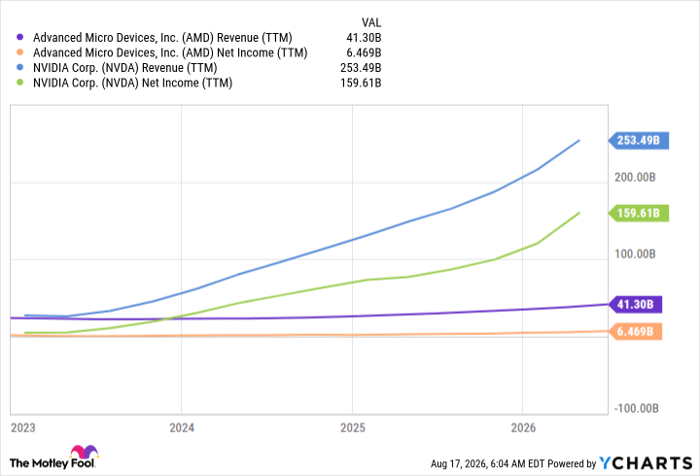
AMD Revenue (TTM) data by YCharts.
Nvidia's net income is essentially four times larger than AMD's revenue, showing just how much larger Nvidia is than AMD. Despite that, AMD is valued at a far higher level than Nvidia, and I think this is the primary reason why investors should buy Nvidia's stock over AMD's.
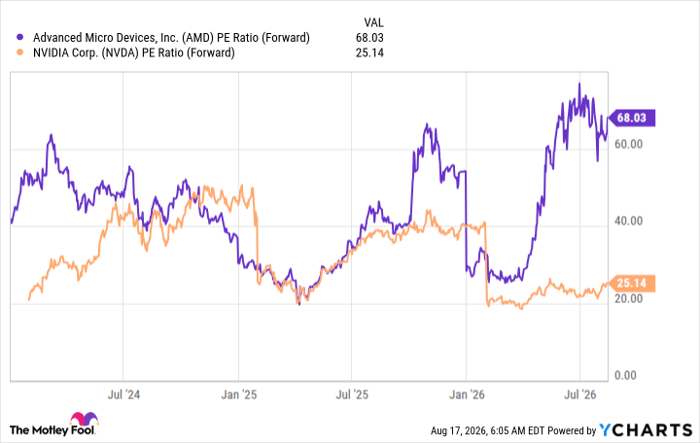
AMD PE Ratio (Forward) data by YCharts.
Nvidia is valued at nearly three times the level that Nvidia is. For the better part of the last few years, these two generally traded in the same valuation range, so this uncoupling raises a few red flags. The market is essentially saying that it prefers AMD's outlook to Nvidia's, which doesn't make sense considering that Wall Street analysts expect faster growth this year from Nvidia versus AMD. Because of that, I prefer Nvidia's stock, since it isn't nearly as pricey.
For AMD and Nvidia to be valued at the same level, AMD would need to nearly triple its earnings after this year's growth is priced in. That's a tall task, and with Nvidia continuing to dominate the AI game, I think it's an impossible one for AMD.
Should you buy stock in Nvidia right now?
Before you buy stock in Nvidia, consider this:
The Motley Fool Stock Advisor analyst team just identified what they believe are the 10 best stocks for investors to buy now… and Nvidia wasn’t one of them. The 10 stocks that made the cut could produce monster returns in the coming years.
Consider when Netflix made this list on December 17, 2004... if you invested $1,000 at the time of our recommendation, you’d have $409,970!* Or when Nvidia made this list on April 15, 2005... if you invested $1,000 at the time of our recommendation, you’d have $1,381,040!*
Now, it’s worth noting Stock Advisor’s total average return is 969% — a market-crushing outperformance compared to 215% for the S&P 500. Don't miss the latest top 10 list, available with Stock Advisor, and join an investing community built by individual investors for individual investors.
See the 10 stocks »
*Stock Advisor returns as of August 18, 2026.
Keithen Drury has positions in Nvidia. The Motley Fool has positions in and recommends Advanced Micro Devices and Nvidia. The Motley Fool has a disclosure policy.
Recommended Articles


