




Broadcom's Artificial Intelligence (AI) Revenues Are Forecast to Exceed $100 Billion in 2027: Should You Buy the Dip?
Key Points
Broadcom has emerged as a great design partner in the chip world.
The stock doesn't trade at a massive premium despite the huge growth expected for its business.
- 10 stocks we like better than Broadcom ›
Broadcom (NASDAQ: AVGO) has been an OK investment in 2026, rising by about 14% year to date. That's barely a market-beating stock, but the share price is also well down nearly 20% from the peak it set at the end of June. Yet the future of the company is looking as bright as ever.
It has some major catalysts arriving in 2027 that will bring the company to new levels, as its AI semiconductor revenue is expected to exceed $100 billion. For reference, its AI semiconductor revenue in the second quarter was $10.8 billion, or about $43 billion annualized.
Missed Nvidia in 2009? This Rare Signal Is Flashing Again. In 2009, a "Double Down" signal flashed for a little-known chipmaker called Nvidia. For the first time in years, that same "Total Conviction" signal is flashing for a company 1/100th the size of Nvidia. Continue »
Is that enough to warrant buying the stock? Let's take a look.
Image source: The Motley Fool.
Only some of 2027's growth is priced into the stock
This major expected growth in 2027 is not an unknown factor in the market. Broadcom has been forecasting it for some time, but it's starting to happen. Broadcom is making huge strides in this area thanks to its custom AI chips, which are emerging as popular alternatives to graphics processing units (GPUs). GPUs excel at providing massive parallel processing power in a wide variety of settings, which makes them fantastic for general use. Still, their flexibility is wasted when a workload type has been configured a certain way and is predictable.
As a result, several AI hyperscalers have partnered with Broadcom to design application-specific integrated chips -- custom-built products that can only handle the narrow types of workloads that they will see. These custom AI chips are more cost-effective than GPUs for those specific workloads, which makes them very popular options for AI hyperscalers looking to optimize their capex spending.
Next year, Broadcom has several of these orders hitting the system, which will allow it to expand beyond the handful of clients that it's serving right now. It helped its biggest client, Alphabet (NASDAQ: GOOG) (NASDAQ: GOOGL), develop the Tensor Processing Unit (TPU). These chips are becoming more popular, and are a big reason why Google Cloud is growing so quickly.
There's a lot of positivity brewing around Broadcom, and fortunately for investors, it hasn't all been priced into the stock quite yet. While Broadcom may trade for a somewhat pricey 34 times this year's earnings estimates, when 2027's are used, it falls to a mere 20 times forward earnings.
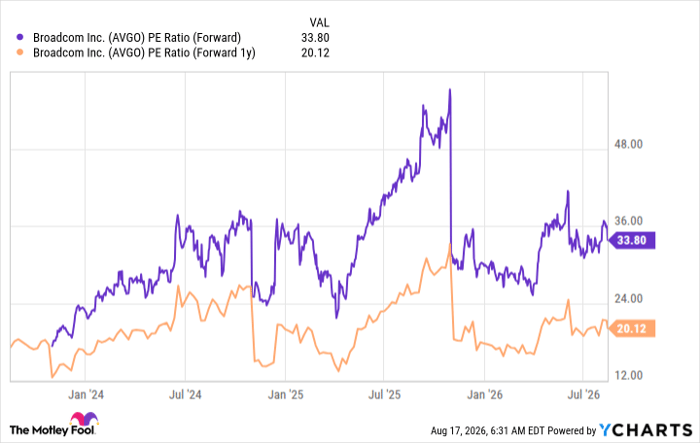
AVGO PE Ratio (Forward) data by YCharts.
That's a pretty good deal for Broadcom's stock, especially if the company can exceed expectations, as it has throughout most of the AI race. As a result, I think Broadcom is a smart stock to buy on the dip. It won't stay beaten down for long once 2027's orders start rolling in, creating huge revenue and profit growth.
Should you buy stock in Broadcom right now?
Before you buy stock in Broadcom, consider this:
The Motley Fool Stock Advisor analyst team just identified what they believe are the 10 best stocks for investors to buy now… and Broadcom wasn’t one of them. The 10 stocks that made the cut could produce monster returns in the coming years.
Consider when Netflix made this list on December 17, 2004... if you invested $1,000 at the time of our recommendation, you’d have $409,970!* Or when Nvidia made this list on April 15, 2005... if you invested $1,000 at the time of our recommendation, you’d have $1,381,040!*
Now, it’s worth noting Stock Advisor’s total average return is 969% — a market-crushing outperformance compared to 215% for the S&P 500. Don't miss the latest top 10 list, available with Stock Advisor, and join an investing community built by individual investors for individual investors.
See the 10 stocks »
*Stock Advisor returns as of August 18, 2026.
Keithen Drury has positions in Alphabet and Broadcom. The Motley Fool has positions in and recommends Alphabet and Broadcom. The Motley Fool has a disclosure policy.
Recommended Articles


