




BofA Says Market Overestimates Risks of Nvidia's AI Ecosystem Investment, Sets $350 Target
TradingKey - Nvidia (NVDA) recently announced a strategic partnership with SB Energy to provide credit guarantees of up to $105 billion for the PORTS-Pike technology park in Ohio, developing it into a hyperscale data center dedicated to Nvidia's AI computing infrastructure, with OpenAI as the sole tenant.
This disclosure comes at a time when the market is concerned about Nvidia's circular financing. Previously, Nvidia's stock price dropped 5% on the day media first reported a $250 billion guarantee plan.
However, Bank of America believes the market may be overestimating the risks associated with Nvidia's aggressive investments in the AI ecosystem, resulting in a noticeable discount in its valuation.
BofA analyst Vivek Arya noted, following a conceptual sum-of-the-parts valuation based on Nvidia's free cash flow, that even factoring in the related financing risks, Nvidia's stock price may still trade at a 34% to 50% discount to its underlying value.
BofA noted that Nvidia has continuously invested capital across the upstream and downstream AI supply chain in recent years to secure critical resources such as chip supply, land, power, and computing infrastructure, while reducing its reliance on hyperscale cloud providers like Microsoft and Google. These cloud providers are accelerating their in-house AI chip development, which could pose long-term competition to Nvidia.
According to BofA's estimates, Nvidia's capital support commitments to ecosystem partners currently total approximately $300 billion, including about $70 billion in equity investments and around $230 billion in credit arrangements such as equipment residual value guarantees, lease support, or power payment backstops. Notably, this amount does not equate to Nvidia's recognized on-balance-sheet debt, nor does it represent a lump-sum cash outlay; whether this support translates into actual losses depends on project commissioning, customer performance, and equipment disposition.
Regarding the support of up to $105 billion for OpenAI, BofA considers such investments strategically reasonable against the backdrop of elevated GPU lease prices, tight computing power supply, and Nvidia's abundant free cash flow, as they help convert chip demand into larger-scale actual deployments.
However, the bank also cautioned that if AI demand slows significantly, Nvidia's revenue growth, earnings quality, and balance sheet could come under pressure. To alleviate market concerns over ecosystem investments and "circular financing," BofA suggested the company deploy more free cash flow toward share buybacks to enhance shareholder returns and drive a valuation re-rating. BofA maintains a "Buy" rating and a $350 price target on Nvidia, implying roughly 60% upside from the current level of around $220.
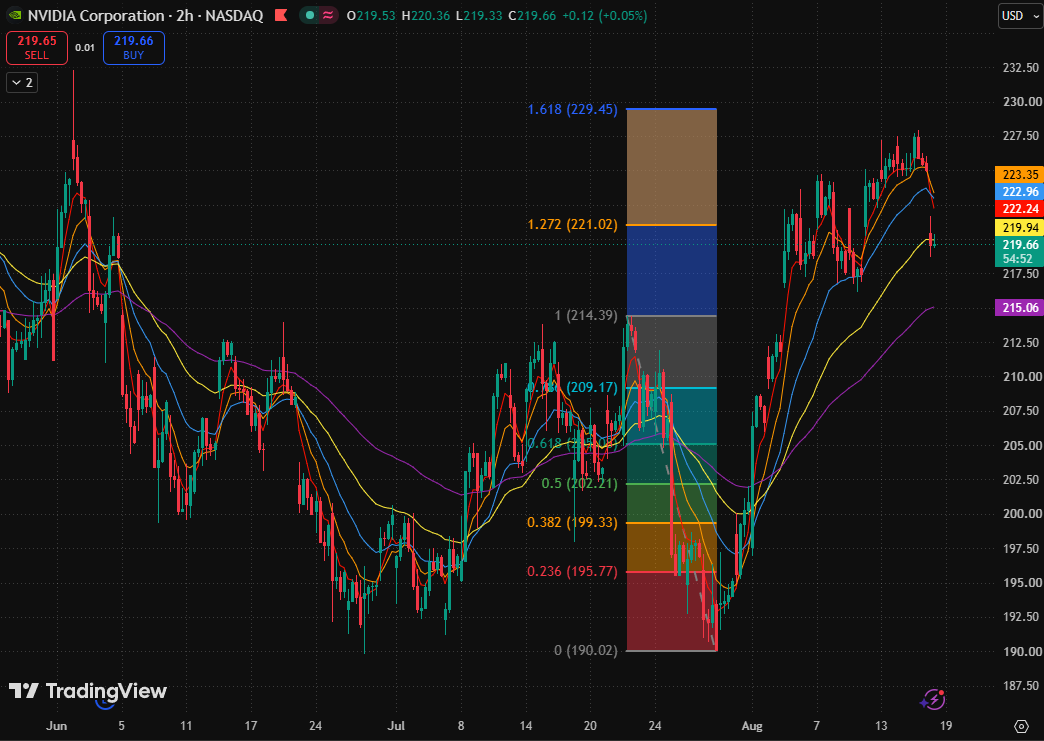
Nvidia 2-hour candlestick chart, Source: TradingView
After stabilizing and rebounding near $190.02, Nvidia's stock price touched a high above $227 before recently pulling back from elevated levels. It has now fallen back below the 1.272 Fibonacci extension level ($221.02), shifting from a strong upward surge to a short-term pullback confirmation phase. The current price remains above the 80-day moving average (around $215.06), indicating that the medium-term rebound structure has not been fully broken.
To the downside, initial support centers on the previous high ($214.39), a key bull-bear pivot in the current rebound structure and the primary absorption zone for short-term pullbacks. If $214.39 gives way, the next level to watch is the 0.618 Fibonacci retracement level ($209.17), with further downside targeting the 0.5 Fibonacci retracement level ($202.21).
To the upside, a rebound would first require reclaiming the 1.272 Fibonacci extension level ($221.02) before attempting to retest the 1.618 Fibonacci extension level ($229.45).
Recommended Articles


