




Win10 Government Edition Phased Out Early as Microsoft's China Business Faces New Headwinds
TradingKey - On August 18 Eastern Time, according to a Bloomberg report, China's Ministry of State Security has requested certain government-affiliated agencies to uninstall ahead of schedule Microsoft's (MSFT) Windows 10 operating system version customized specifically for government departments.
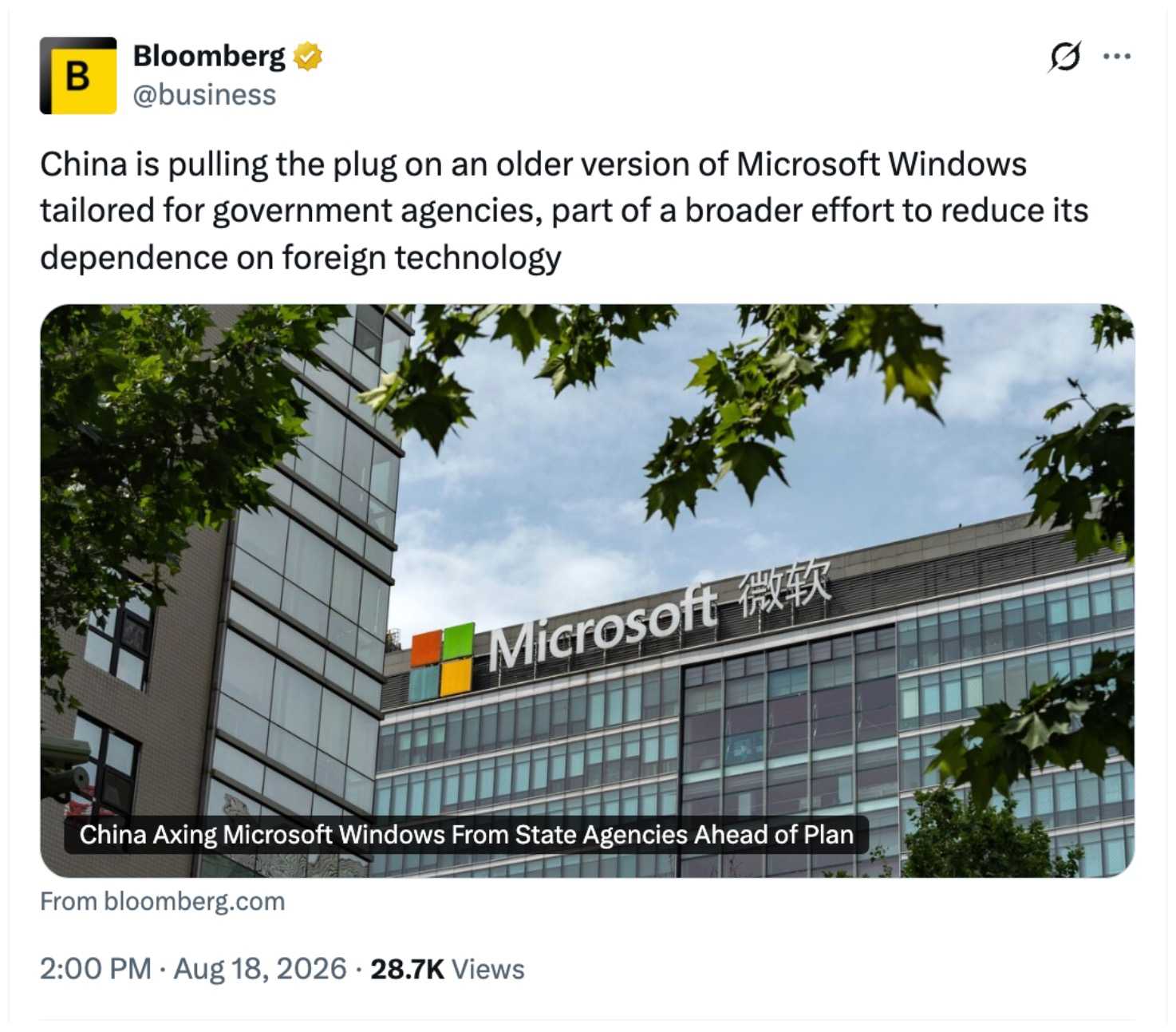
[Source: X]
This system, named "Windows 10 CMIT Government Edition," was developed by CMIT, a joint venture between Microsoft and China Electronics Technology Group Corporation. Originally scheduled to terminate support in February 2027, the new directive has moved this timeline forward by several months.
Since 2017, China has been promoting the prioritized procurement of domestic software by government agencies and state-owned enterprises. Local companies such as Kylinsoft and UnionTech have launched domestic operating systems to replace Windows. In the July procurement of portable computers for central government organs this year, operating systems in all four winning bid packages were completely replaced with domestic systems, and Windows 10 CMIT Government Edition was no longer listed as an optional configuration.
Over the past five years, Microsoft has closed at least 15 branches and joint ventures in China. The company seriously discussed completely exiting the Chinese market in 2023, as some executives felt that the geopolitical risks of its China business were relatively high and the economic returns limited.
However, Microsoft ultimately shelved this option for two reasons.
First is the demand for Azure cloud services from Chinese companies expanding overseas, such as ByteDance. These companies rely on Western cloud technology to manage their overseas operations, and ByteDance has become one of Microsoft's largest AI customers in recent years, with annual procurement scale expected to surpass $1 billion.
Second is China's vast pool of engineering talent. Microsoft Research Asia, established nearly 30 years ago, has cultivated top AI talent now spread across global tech giants; losing this frontier position means a contraction of R&D vision for Microsoft.
From a financial perspective, the direct impact of this event on Microsoft's stock price is limited. Previously, Microsoft stated in 2024 that the Chinese market accounted for only about 1.5% of its global revenue. Now, with revenue from the government edition of Windows falling to zero, the impact on overall performance is relatively controllable. Microsoft's stock price is driven more by Azure cloud growth, AI commercialization progress, and the global macroeconomic environment.
However, the symbolic significance cannot be ignored. Windows once opened the door to the Chinese market for Microsoft, but that door is now narrowing. Microsoft's role in China is shifting from "serving the local market" to "serving Chinese enterprises expanding overseas." For investors, whether Microsoft can defend its profit growth drivers in this new arena is the question worth tracking over the long term.
Recommended Articles


