




Billionaire Ray Dalio Says Today's Artificial Intelligence (AI) Market Echoes 1929 and 2000. History Says Investors Should Watch Valuations Closely.
Key Points
Ray Dalio founded the world's largest hedge fund and is respected for his commentary on financial markets.
Dalio recently said that he thinks optimism around AI echoes that of a stock market bubble.
The S&P 500 is trading near all-time highs, but history suggests the index is flirting with unsustainable valuation levels.
- 10 stocks we like better than S&P 500 Index ›
Ray Dalio has long stood as an influential sounding board for investors. As the founder of the world's largest hedge fund, Bridgewater Associates, Dalio's reputation is supported by his ability to dissect economic cycles with unusual clarity. His outlook often serves as a guide for both institutional and individual investors.
In a recent appearance on The Diary of a CEO podcast, Ray Dalio said that the current euphoria surrounding artificial intelligence (AI) has produced "classic signs" that a bubble is forming. While Dalio acknowledges that AI technology is transformative, he argues that some stock prices mirror the speculative excesses that preceded two of history's most severe market collapses in 1929 and 2000.
Missed Nvidia in 2009? This Rare Signal Is Flashing Again. In 2009, a "Double Down" signal flashed for a little-known chipmaker called Nvidia. For the first time in years, that same "Total Conviction" signal is flashing for a company 1/100th the size of Nvidia. Continue »

Ray Dalio. Image source: Getty Images.
Analyzing valuation extremes
Dalio's warning of a bubble can be supported when viewed through the lens of the cyclically adjusted price-to-earnings (CAPE) ratio. This metric smooths earnings over a 10-year time period and adjusts for inflation. Currently, the CAPE ratio sits near 41. This reading exceeds the 32.6 level reached just before the 1929 crash and is within shouting distance of the all-time high of 44.2 recorded at the height of the 2000 dot-com era.
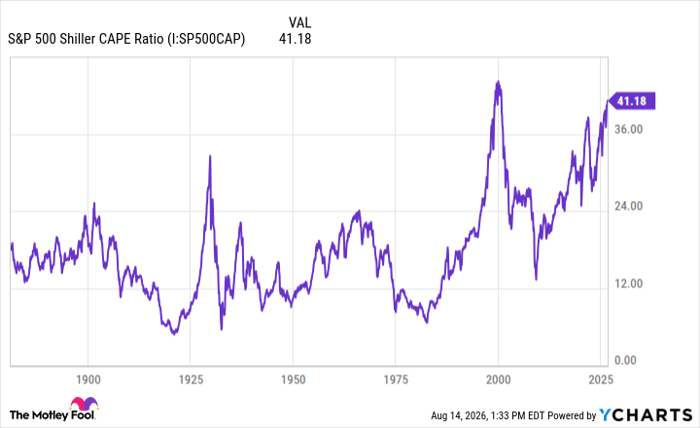
S&P 500 Shiller CAPE Ratio data by YCharts.
As shown above, elevated CAPE readings have historically signaled muted future returns. In 1929, the belief that a permanent era of prosperity fueled rapid industrialization eventually collapsed when confidence cracked. This triggered bank failures and ultimately resulted in the Great Depression. Back in 2000, internet companies with little or no sales or profits commanded astronomical valuations based solely on exciting growth narratives. Once capital dried up and reality set in, the Nasdaq (NASDAQINDEX: ^IXIC) lost roughly three-quarters of its value.
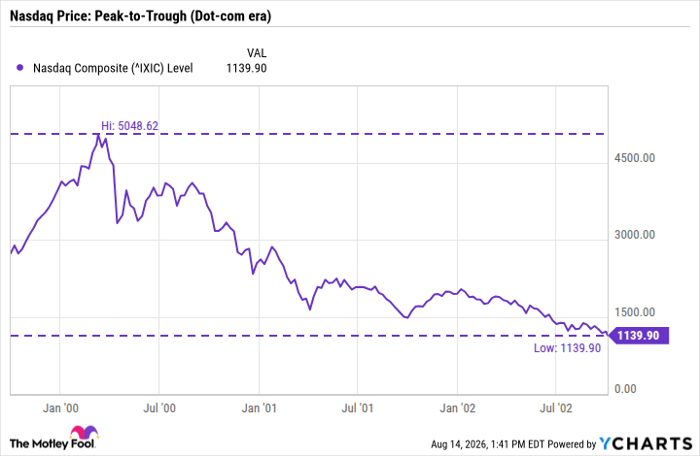
^IXIC data by YCharts.
Why Dalio's parallel matters
Today's CAPE level of 41 places the S&P 500 (SNPINDEX: ^GSPC) in rarefied territory. The parallel is not simply numerical. Just as railroads were set to revolutionize travel and commerce and the internet promised endless digital disruption, AI is now being marketed as an unstoppable force that justifies any valuation.
Dalio points out that paper gains are ballooning far beyond the actual absolute dollars flowing through the financial system. These dynamics inherently create a fragility in which a sudden need for liquidity can force widespread selling. The risk here is not that new technology will fail to deliver productivity gains, but that many AI stocks priced for perfection will correct sharply if growth expectations are not met or when liquidity tightens.
What can investors learn from Ray Dalio?
The grey-shaded columns represent recessions in the chart below. While history shows that elevated valuations eventually compress, the S&P 500 has always trended higher over the long term.
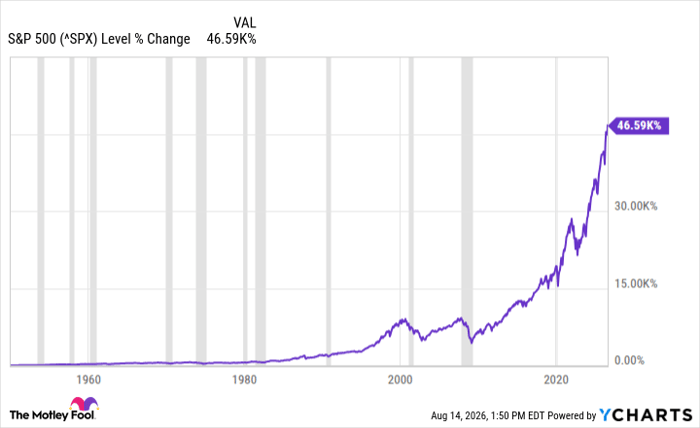
^SPX data by YCharts.
Dalio is not saying that a stock market crash is guaranteed to arrive tomorrow. He is simply reminding investors that upward biases have never been immunized against multi-year drawdowns. The most prudent response is not one of panic selling, but rather disciplined preparation. Maintain diversification across industries, especially durable sectors such as consumer staples, and hold sufficient cash to meet financial responsibilities without forced stock sales.
Investors who treat the AI revolution as one more cycle rather than a generational exception will be better positioned, whether the market continues to climb or eventually revisits the painful corrections of 1929 and 2000.
Should you buy stock in S&P 500 Index right now?
Before you buy stock in S&P 500 Index, consider this:
The Motley Fool Stock Advisor analyst team just identified what they believe are the 10 best stocks for investors to buy now… and S&P 500 Index wasn’t one of them. The 10 stocks that made the cut could produce monster returns in the coming years.
Consider when Netflix made this list on December 17, 2004... if you invested $1,000 at the time of our recommendation, you’d have $421,511!* Or when Nvidia made this list on April 15, 2005... if you invested $1,000 at the time of our recommendation, you’d have $1,381,960!*
Now, it’s worth noting Stock Advisor’s total average return is 981% — a market-crushing outperformance compared to 216% for the S&P 500. Don't miss the latest top 10 list, available with Stock Advisor, and join an investing community built by individual investors for individual investors.
See the 10 stocks »
*Stock Advisor returns as of August 17, 2026.
Adam Spatacco has no position in any of the stocks mentioned. The Motley Fool has no position in any of the stocks mentioned. The Motley Fool has a disclosure policy.
Recommended Articles


