




Should You Buy Meta Platforms Stock Below $600 Before Mark Zuckerberg Unveils Its AI Cloud Business? Here's My Honest Take
Key Points
Meta is considering selling some of its data center capacity to third parties.
The company is struggling to find ways to monetize its capital spending outside of advertising efficiency.
The stock looks cheap, but earnings are likely to decline in the near future.
- 10 stocks we like better than Meta Platforms ›
The interest in all things artificial intelligence (AI) in the stock market went back into overdrive in August. Unfortunately, Meta Platforms (NASDAQ: META) failed to join the party.
The company, led by founder Mark Zuckerberg, is investing heavily in AI but is not being rewarded by the market, and adoption has failed to materialize across most of its software services.
Missed Nvidia in 2009? This Rare Signal Is Flashing Again. In 2009, a "Double Down" signal flashed for a little-known chipmaker called Nvidia. For the first time in years, that same "Total Conviction" signal is flashing for a company 1/100th the size of Nvidia. Continue »
Now, Zuckerberg and the team are considering selling some of Meta's compute power in a new AI cloud business. Does that make the stock, now trading below $600, a buy? Here's my honest take.

Image source: Getty Images.
New cloud business?
Last quarter, Meta spent $30 billion on capital expenditures, nearly doubling its capex year over year. For the full year, Meta expects to spend $130 billion to $145 billion on capital expenditures, mainly related to artificial intelligence. Some of this will be used to advance its advertising platform, but the majority will go toward frontier research and inference capacity for AI models.
Right now, Meta's AI models do not see much external use, so it is already building up excess capacity in data centers that is not being utilized. Zuckerberg said that other AI companies have reached out to Meta Platforms to buy access to its compute capacity at a premium over the purchase price, although the exact financial details of the arrangement are unclear. However, if we compare it to recent deals signed by Space Exploration Technologies that are set to generate tens of billions in annual revenue, Meta could quickly grow this AI cloud business if it wants to turn on the spigot.
The risk arises because Meta is already struggling to identify internal use cases for its AI infrastructure. It could sell these services to third parties today in a similar move to SpaceX, CoreWeave, or Nebius Group, but eventually, the AI software providers are going to stick with the best-in-class hyperscalers like Amazon Web Services that can provide a comprehensive cloud service above just reselling compute, such as databases and other software. Meta is years away from doing this, if it even wants to.
Solid core operations
What all this means is that if Meta is already thinking of selling excess compute capacity to third parties, it is a bearish signal for the company. This means it cannot find ways to directly monetize the AI services it has spent tens of billions developing. According to third-party estimates, Meta's AI chatbots have just a sliver of market share, losing out to competitors like Alphabet's Gemini, OpenAI's ChatGPT, and Anthropic's Claude.
I believe Wall Street is right to be bearish on all the investments Meta is making in AI. However, it still has a phenomenal advertising business across Facebook, Instagram, and WhatsApp that is seeing accelerating growth due to improvements in targeting technologies. Last quarter, Meta's revenue grew 28% year over year to $61 billion, mainly driven by advertising growth. It couldn't outpace expense growth on AI and Reality Labs (Meta's wearables division is losing billions every quarter), with operating margin falling from 43% a year ago to 31% in Q2 2026, but it can help stabilize the ship as more money is spent every quarter on AI capital expenditures.
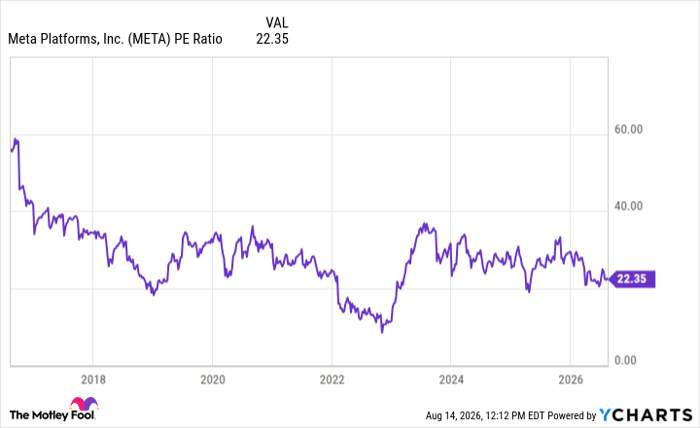
Data by YCharts.
My honest take on Meta stock
For the first time in a long while, Meta's operating earnings fell last quarter. Over the last 12 months, earnings before interest and taxes (EBIT) were $87 billion and are likely to continue falling over the next few years if capital expenditures continue to grow without an AI business model in place. Why? Because there will be massive amounts of depreciation flowing through to Meta's income statement. Advertising revenue is growing quickly, but it is already unable to keep up with these rising expenses.
The stock trades at a discount to many big technology peers, with a price-to-earnings ratio (P/E) of 22. However, Meta's earnings are likely to shrink in the years ahead unless it reverses these aggressive AI investments or finds a way to monetize said investments, generating tens of billions in revenue overnight. I have my doubts that this will happen, which is why I don't think Meta stock is a buy, even as it trades below $600.
Should you buy stock in Meta Platforms right now?
Before you buy stock in Meta Platforms, consider this:
The Motley Fool Stock Advisor analyst team just identified what they believe are the 10 best stocks for investors to buy now… and Meta Platforms wasn’t one of them. The 10 stocks that made the cut could produce monster returns in the coming years.
Consider when Netflix made this list on December 17, 2004... if you invested $1,000 at the time of our recommendation, you’d have $421,511!* Or when Nvidia made this list on April 15, 2005... if you invested $1,000 at the time of our recommendation, you’d have $1,381,960!*
Now, it’s worth noting Stock Advisor’s total average return is 981% — a market-crushing outperformance compared to 216% for the S&P 500. Don't miss the latest top 10 list, available with Stock Advisor, and join an investing community built by individual investors for individual investors.
See the 10 stocks »
*Stock Advisor returns as of August 16, 2026.
Brett Schafer has no position in any of the stocks mentioned. The Motley Fool has positions in and recommends Alphabet, Amazon, and Meta Platforms. The Motley Fool has a disclosure policy.
Recommended Articles


